

























































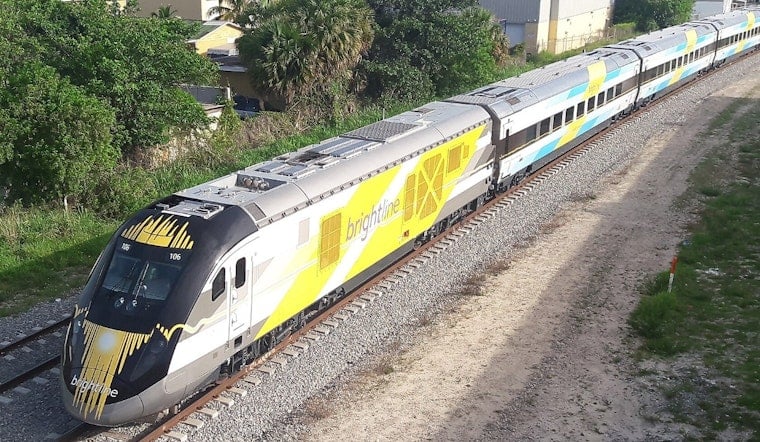
A 63-year-old woman is dead after a northbound Brightline train struck her while she was walking on the railroad tracks west of the Walmart in the 2000 block of U.S. 1 in Sebastian. The crash happened at approximately 11:15 p.m. on September 2, and it did not occur at a designated railroad crossing.
The Sebastian Police Department has not released the woman's name and is working to notify her next of kin, according to Sebastian Daily. Interim Police Chief Tim Wood said officers do not believe the death was an attempted suicide, and the outlet reports the woman was not homeless. The investigation remains open.
A Recurring Pattern Along U.S. 1
This is the second Brightline fatality in Indian River County so far in 2026 and the sixth documented death in the county since regular passenger service through the corridor launched in September 2023, per the same account. The county's other 2026 death came on June 21, when an unnamed man was struck just south of 1000 16th Street in Vero Beach — a case Vero Beach police classified as an apparent suicide, distinct from how officers are characterizing the Sebastian crash.
Indian River County recorded three Brightline fatalities in 2024 and one in 2025, the report notes. Those earlier deaths include 29-year-old Wesley Alan Ducheneaux Walsh, struck while walking on the tracks just north of Highland Drive Southeast in January 2024; 35-year-old Emily Kayser, hit at the Fourth Street crossing south of Vero Beach the following month; and 25-year-old Bryan De Paz Vazquez, who went under a lowered crossing arm and tried to run across the tracks at the 12th Street crossing in Vero Beach in December 2024 while wearing headphones. The county recorded one other fatality in 2025. No fatal vehicle-versus-Brightline crashes have occurred in the county, the outlet reports — every death has involved a pedestrian on foot.
According to the Federal Railroad Administration's Grade Crossing Toolkit, its database contains railroad safety information including accidents and incidents, inventory and highway-rail crossing data.
A Speed Gap Locals Have Long Warned About
Brightline passenger trains travel at speeds up to 110 mph through Indian River County, while Florida East Coast Railway freight trains on the same tracks move at just 40 to 60 mph, according to Vero News. That gap has fueled concerns that pedestrians and drivers misjudge how quickly an oncoming train will actually arrive, a dynamic that has shadowed the corridor since regular service began.
The safety debate predates the trains themselves. Indian River County spent more than $3.5 million in taxpayer funds fighting Brightline in court before reaching a June 2021 settlement, Vero News has reported. Local governments in the county also pay Florida East Coast Railway to maintain and license public crossings along the corridor, split among three municipalities.
Train horn requirements remain in place at county crossings.
Fencing Has Proven to Save Lives Elsewhere
Brightline has faced safety concerns since its launch in 2018, and the company's overall record has drawn national scrutiny. A July 2025 investigation by WLRN and the Miami Herald, cited in an August 2026 report from Meldon Law, found the railroad had killed 182 people since testing began in 2017 — averaging one fatality every 13 days and giving it the highest per-mile death rate of any U.S. passenger railroad. Pedestrians and cyclists accounted for 158 of those 182 deaths through mid-2025.
The contrast with Brightline's newly built infrastructure elsewhere is stark. A December 2025 analysis by Transit Talent found that the company's 36-mile spur between Cocoa and Orlando — fully enclosed by six-foot chain-link fencing with zero grade crossings, where trains reach speeds up to 125 mph — recorded zero fatal crashes in its first 27 months of operation. Federal Railroad Administration data indicates roughly 96% of all rail crossings nationwide are at grade, underscoring how physical barriers change outcomes on unfenced coastal segments like the one running through Sebastian.
The federal government has moved to close some of that gap. A federal grant covers most costs for fencing, warning signage and suicide-crisis signs along 33 miles of the Brightline corridor, the Tampa Bay Times has reported. The expansion buildout was also discussed by Southland Holdings.
A 2020 SunRail Corporate document says officials were conducting outreach and adding fencing to improve pedestrian safety and reduce grade-crossing risks.
Brightline operates passenger trains between Miami and Orlando, and Hoodline has previously reported on the route.




