

























































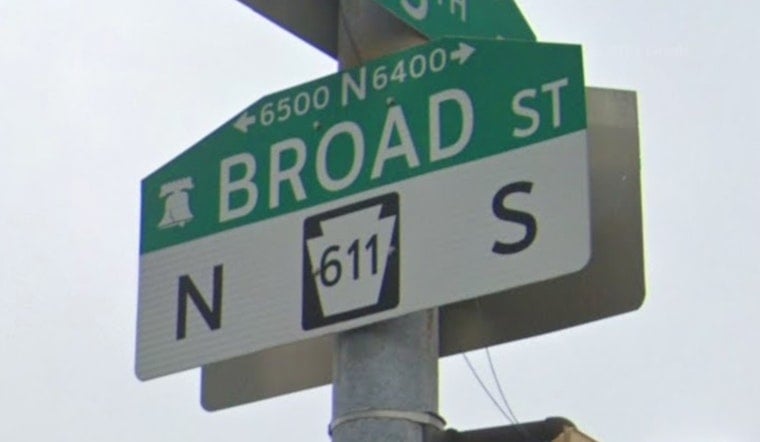
Philadelphia's speed cameras on Broad Street logged nearly 800,000 enforceable events in their first seven months, but the rollout hit a costly snag: more than 23,000 tickets issued near 55th Street are being reversed and refunded because a required warning sign was missing from a stretch of southbound North Broad Street.
According to the Fox 29 Philadelphia report on the Philadelphia Parking Authority's annual speed camera report, the agency operated 31 cameras across 15 Broad Street sites and recorded 799,655 total enforceable events between September 2025 and March 2026 — a mix of 464,361 warning notices and 335,294 live violation tickets, according to the Philadelphia Parking Authority. Broad Street's warning period began September 15, 2025, before full fine enforcement started November 14, 2025, per the same report.
A Signage Gap Near 55th Street Triggers Mass Refunds
Southbound drivers near 6500 N. Broad St., close to 55th Street, were missing a required “PHOTO ENFORCED” sign, and the parking authority kept ticketing there until it shut the camera off on April 22, 2026, according to Patch. The outlet reports that the parking authority had actually noticed the missing sign back in January 2026, but weather and construction delayed reinstallation for months, allowing the erroneous citations to keep piling up. The agency is now reversing more than 23,000 violations tied to that camera and issuing refunds to affected drivers, the Fox 29 report notes.
The reversal underscores how strict Pennsylvania's rules are around automated enforcement. Under the tiered civil fine structure — $100 for driving 11 to 19 mph over the 25 mph limit, $125 for 20 to 29 mph over, and $150 for 30 mph or more over, with no license points attached — a properly posted warning sign is a legal prerequisite for issuing a ticket, according to the City of Philadelphia. State law requires a 60-day warning period before any new camera corridor begins collecting fines.
Violations Fell Sharply After a October Peak
Beyond the signage error, the seven-month numbers show a steep drop-off in speeding on Broad Street. Violations peaked at more than 213,000 in October before falling to about 70,000 in March — a 67 percent decline from October to March, per the Fox 29 account. Most of those cited violations involved drivers going 11 to 19 mph over the posted limit, the report notes.
Philadelphia Parking Authority spokesperson Gabe Roberts said the program is meant to change driver behavior over time, not just generate citations. “The speed camera program is intended to encourage behavioral change and reduce speeding so lives are saved and streets are safer,” Roberts said, according to Fox 29's reporting.
Why Broad Street Became the Priority Corridor
The push to camera-enforce Broad Street followed grim crash data. The roadway recorded 206 fatal and serious injury crashes between 2020 and 2024, and city traffic analysts designated it Philadelphia's highest-priority speed enforcement corridor after it surpassed Roosevelt Boulevard in total traffic deaths in 2024, Hoodline previously reported. Broad Street sits on Philadelphia's High Injury Network, where roughly 80 percent of severe crashes occur on just 12 percent of city streets.
Governor Josh Shapiro signed House Bill 1284 into law as Act 38 in December 2023, permanently reauthorizing speed cameras on Roosevelt Boulevard and clearing the way for Philadelphia to expand automated enforcement to five additional pilot corridors, including Route 611 — Broad Street — and Route 13, according to Land Line Media. The same law permanently authorized work-zone speed cameras statewide and required larger advance warning signs.
Roosevelt Boulevard's Track Record Set the Bar
City officials pointed to Roosevelt Boulevard as their model. After cameras went up there in 2020, speeding violations dropped 95 percent, fatal and serious injury crashes fell 21 percent, and pedestrian-involved crashes dropped 50 percent, according to the parking authority's program page. Roosevelt Boulevard had previously been considered one of the most dangerous roadways in Pennsylvania.
Demographic data from the parking authority's 2026 state report shows the enforcement is landing mostly on local drivers rather than outside commuters: Philadelphia residents made up 59 percent of drivers cited on Broad Street and 56 percent on Roosevelt Boulevard during fiscal year 2026, with Pennsylvania-registered vehicles accounting for the vast majority of citations overall. City traffic planners have framed changing local driver behavior as a central goal of the broader Vision Zero effort.
Camera Network Keeps Growing Citywide
Philadelphia's automated enforcement footprint has since grown well beyond Broad Street. By September 2026, the city's total camera count reached 80 locations, including a 60-day warning period that began August 31 along the final stretch of the Route 13 corridor running from West Philadelphia to Strawberry Mansion, with ticketing set to begin October 30, per Patch's reporting. Those Route 13 cameras span Baltimore Avenue, University Avenue, 38th Street, 34th Street, Girard Avenue, 33rd Street, and Ridge Avenue.
The parking authority also launched a separate automated speed enforcement pilot across five Philadelphia school zones in February 2026, issuing warnings before shifting to full fine collection in April. Participating schools include Widener Memorial Elementary, John B. Stetson Middle, High School of the Future, William L. Sayre High, and KIPP North.
Pushback Grows Alongside the Expansion
Not everyone is on board with the buildout. In July, Philadelphia civil rights attorney Michael Coard organized protests against the parking authority outside City Hall, offering pro bono legal help to drivers looking to contest speed and red-light camera citations, according to Philadelphia Magazine. Critics quoted in that report have argued the expanding camera network functions less as a safety measure and more as a municipal revenue generator — a tension that's likely to keep following the program as it grows to 80 cameras and counting.





