

























































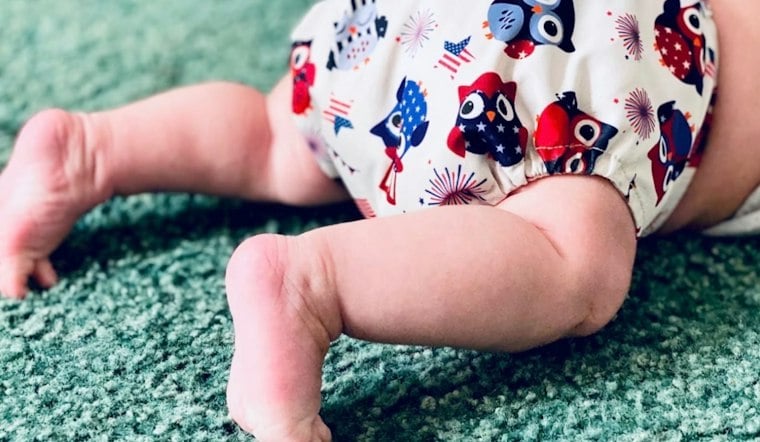
California just became the first state to force diaper manufacturers to disclose exactly what's touching babies' skin both online and on the package itself. Gov. Gavin Newsom signed Assembly Bill 1901, requiring companies that sell, distribute or manufacture children's diapers in California to fully reveal their ingredients, with online disclosure starting January 1, 2029, and packaging labels following on July 1, 2029.
The new requirement means every intentionally added ingredient will need to be listed by name, its Chemical Abstract Service number and its specific function, whether that's a preservative, a fragrance or an absorbent polymer, according to the Environmental Working Group. Packaging and online product pages may include an outbound link to a manufacturer webpage carrying the complete ingredient list, per the seed reporting from the Los Angeles Times. Companies that don't comply face administrative penalties of up to $5,000 for a first violation and up to $10,000 for each one after that, enforced through the Department of Toxic Substances Control.
The bill's author, Assemblymember Marc Berman of Menlo Park, framed the measure in personal terms as a first-time father, saying increasing transparency about diaper ingredients is not a partisan issue but a pro-parent issue, according to the Los Angeles Times report. Babies use about 3,000 disposable diapers a year, and diaper ingredients touch their skin every hour of every day for the first few years of life, the same reporting notes. Infant skin is also thinner than adults' skin, making babies more vulnerable to whatever chemicals end up in disposable diapers.
What's Actually Showing Up In Diaper Testing
Some disposable diapers use synthetic musks to create fragrances, and some contain plastics with phthalates and volatile organic compounds, per the Los Angeles Times. A Consumer Reports examination of 37 diaper products found that seven disclosed little to no ingredient information at all, EWG reported. Disposable diapers commonly include cellulose or pulp for the core, super-absorbent polymers, binders, adhesives, fragrances and dyes, according to Consumer Reports.
Recent tests have found that diapers may contain volatile organic compounds and phthalates linked to hormone disruption and reproductive and developmental harm, EWG's release states. Some wetness indicators may contain quaternary ammonium compounds, sometimes called quats, which the group links to reproductive effects, skin irritation and asthma. Separately, a study published in a peer-reviewed chemistry journal found toxic VOCs at trace levels in every disposable diaper and wipe it tested, with researchers concluding that risks in some high-use scenarios were serious enough to warrant additional attention and possibly corrective measures, according to the journal Environmental Science & Technology.
A Coalition Push And A Governor's Caveat
Children Now signed onto a letter with more than 300 other organizations urging Newsom to sign the bill, the Los Angeles Times reported. Newsom said he supported the broader mission of increasing ingredient transparency for families, but he also voiced concern that the law as written lacks protections for confidential business information, and he encouraged the Department of Toxic Substances Control to initiate rule-making authority to clarify those confidential-information issues.
California's law builds on a similar measure New York passed in 2024, which took effect on December 11, 2025, but it goes further. New York's law requires ingredient disclosure only on the package, according to EWG, while California requires disclosure both online and on packaging. New York's statute, Senate Bill S2279C, applies to disposable diapers and requires ingredients to be listed in order of predominance, but it does not mandate disclosure of contaminants, only intentionally added substances. Consumer Reports notes New York's law allows fines of up to $1,000 per noncompliant package, a smaller ceiling than California's $10,000 maximum for repeat violations.
Why The Fragrance Label Matters
The word “fragrance” on a diaper label can hide up to 4,000 different ingredients, according to EWG's reporting on New York's earlier law, a gap California's disclosure rules are meant to close. Babies' skin is 20% to 30% thinner than adults' skin, Consumer Reports notes, making the question of what's hiding behind that single word more than academic for parents changing diapers multiple times a day. Advocates cited by the Los Angeles Times argue that plastics, fragrances and other chemicals in disposable diapers can trigger health and environmental risks for infants, while studies cited by EWG link some chemicals used in diapers to developmental delays, reproductive harm, endocrine disruption and cancer, and to severe rashes and asthma.
For now, parents in California will have to wait until 2029 to see the fuller ingredient lists on shelves and online. Until then, the debate over confidential business information protections that Newsom flagged is likely to shape how much manufacturers ultimately have to reveal.



