

























































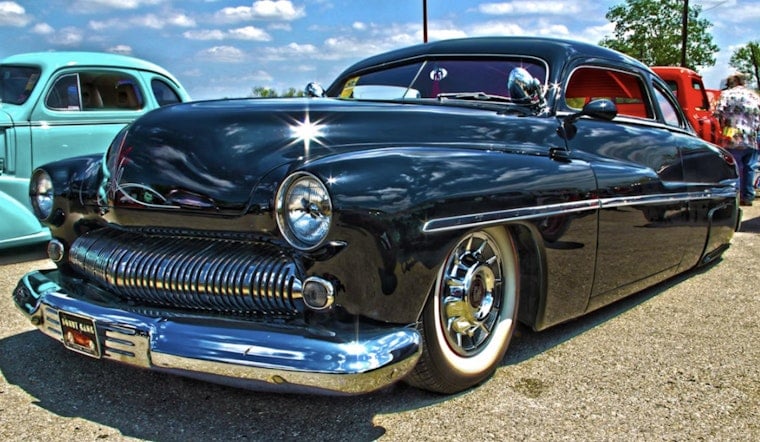
California drivers could soon have the option to put a lowrider on their license plate. The state Legislature has passed a bill creating a specialty plate celebrating lowrider culture and heritage, and it now awaits Governor Gavin Newsom's signature.
Assembly Bill 2541, authored by Assemblymember Mark González, who represents Boyle Heights in Los Angeles, cleared both chambers of the Legislature without a single dissenting vote — the Assembly passed it 78-0, the Senate 40-0, and it received final concurrence 79-0 before being sent to the governor's desk on August 30, according to LegiScan. As reported by Abridged by PBS KVIE, the bill was co-authored by Assemblymembers Maggy Krell, who represents Sacramento, and Stephanie Nguyen, who represents Elk Grove.
If Newsom signs it, the bill would direct the California Arts Council to sponsor the plate, coordinating its design and implementation and consulting with a nonprofit organization to create the artwork. The plate must reflect lowrider culture and heritage, and drivers would select it during their usual registration renewal paperwork for a fee of roughly $50, according to Cruz and González as cited by Abridged. California drivers could request the plate from the DMV once those requirements are met.
A Sacramento Lobbyist's 1959 Impala
Behind the bill is Steve Cruz, a native of South Sacramento who owns his own lobbying firm, Cruz Strategies. Cruz owns a 1959 Chevrolet Impala drop-top lowrider with traditional 13-inch wheels that he keeps near the California State Capitol, and he described the car as a connection to people who share the culture, per the same account. Cruz said lowriding is a peaceful hobby and a stress reliever, and he hopes the plate will express the sense of community inherent in the subculture.
Cruz worked with Carlos Molina, lead organizer of the volunteer group Cruising for Community, and with the Latino youth empowerment organization Brown Issues to bring the license plate idea to the Capitol. Cruz previously worked for California officials including former Assembly Speaker and San Francisco Mayor Willie Brown, and he studied at Sacramento State, where he took a class taught by Joe Serna Jr., Sacramento's first Latino mayor.
Decades of Stigma, Now a Path to Recognition
Lowrider subculture was born in the post-World War II era, and lowrider creators and drivers have historically faced stigma and harassment, with drivers profiled by police, the article notes. California law blocked cities and towns from banning lowrider cruising starting in 2023 and also lifted restrictions on how low a vehicle could ride that year. Cruz said the license plate effort could help remove that stigma and increase appreciation for lowrider cars and culture, and he hopes it will reduce negative associations directed at lowriders.
That statutory shift built on years of local organizing. Cities including Sacramento, San Jose, and National City repealed their own long-standing anti-cruising ordinances following Chicano community advocacy, according to Hoodline's coverage of San Jose's fourth annual Lowrider Day, held in front of City Hall to mark the repeal of its 36-year-old cruising ban. San Jose repealed its ordinance in June 2022, and National City followed in April 2023, ending a Highland Avenue cruising prohibition it had maintained since 1992, according to KPBS.
The 7,500-Signature Hurdle
Before the plate can hit the road, the proposed design requires 7,500 signatures of support, Cruz said. Specialty license plate proposals in California require supporting signatures to be submitted to the DMV, and under state law a sponsoring agency must secure a minimum of 7,500 advance paid applications within 12 months before the DMV will produce and distribute a plate, according to LegiScan. Sponsoring agencies can request up to a 12-month extension if the threshold is not initially met. If AB 2541 is signed, the Arts Council will conduct community outreach and publicity about the plate effort to help clear that bar.
Net revenues from the plate would flow into the state's Specialized License Plate Fund and be distributed as grants by the California Arts Council to support lowrider arts and cultural preservation efforts, youth engagement, and public educational exhibitions, per BillTrack50. The legislation instructs the Arts Council to prioritize nonprofit organizations serving Chicano and Latino communities. It would not be the state's first arts-dedicated plate — California's 1994 program featuring Wayne Thiebaud's palm tree artwork has historically generated about $3 million annually and once provided up to 60 percent of the Arts Council's grant budget, according to the Los Angeles Times.
State law also requires the DMV to consult with the California Highway Patrol to confirm that any proposed lowrider plate design does not obscure vehicle registration readability or exceed physical graphic boundaries, since specialized plate graphics in California are limited to a 2-by-3-inch area on the left side of standard plates, per the Assembly Committee on Transportation. For now, the bill sits on Governor Newsom's desk, with its fate — and the fate of Cruz's Impala getting a matching plate — still undecided.



