

























































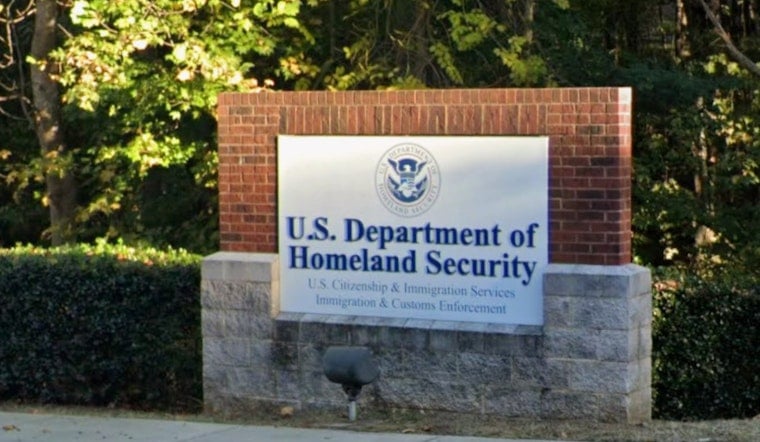
Tito Sabillón opened a letter from the Department of Homeland Security in July and found a bill for more than $1 million in civil fines. The Honduran immigrant, who has lived in the Charlotte metro area for 13 years and runs an apartment remodeling business, is married to a U.S. citizen and is petitioning for legal residence through that marriage — yet DHS says he owes six figures for every day he allegedly stayed in the country after a removal order.
Sabillón told WUNC News he never received notice of the 2023 removal order DHS cites as the basis for the fine, and he missed the 15-day window to appeal it — a deadline that, under the current rule, comes with no extension. He said he is now in limbo, with few options and a persistent fear of arrest at his own home. He does not want to leave the United States, he said, or abandon the family and business he has built here.
A Nationwide Fine Program Scaled Up in North Carolina
Sabillón's bill is one small piece of a much larger federal effort. DHS reported that as of mid-July, it had issued more than 103,000 civil fines nationwide, totaling over $84 billion, according to a DHS spokesperson cited by WUNC. The agency has already collected $1.2 million of that total, the spokesperson said. North Carolina's own tally of fines issued statewide is not clear, though WUNC identified at least one other case, an immigrant man in Fayetteville who also received a civil fine.
The fines rely on a provision that has existed since 1996 but was rarely used until recently. Section 274D of the Immigration and Nationality Act, codified at 8 U.S.C. § 1324d, was enacted as part of that year's Illegal Immigration Reform and Immigrant Responsibility Act, originally capping daily penalties at $500, a figure that has since risen to $998 through inflation adjustments, according to the U.S. House Office of the Law Revision Counsel. The statute went largely unenforced until 2018, when the first Trump administration issued notices to nine sanctuary-seeking noncitizens before rescinding them in 2021, per the Immigration Policy Tracking Project.
New Rules Sped Up Enforcement, Shortened Appeals
The scale of the current effort is unprecedented, and a June 2025 interim rule from DHS and the Department of Justice explains why. The rule eliminated the requirement to personally serve fines or send them by certified mail, allowed service by regular mail instead, and cut the response window down. Under the first Trump administration, immigrants had 30 days to appeal plus an additional 30 days to respond; the new policy gives them just 15 days to appeal a civil fine, with no option for an extension.
Immigration-fine letters accuse recipients of willfully failing or refusing to depart the United States after a removal order. But Hasan Shafiqullah, a supervising attorney at the Legal Aid Society of New York, said proving that immigrants willfully failed to depart is genuinely difficult, particularly because removal orders are often filed in absentia, without the person present in court, according to the Legal Aid Society. Legal fines can total as much as $1.8 million per person, and the Trump administration charges undocumented immigrants $998 for each day they remain in the country after a judge's deportation order.
A Family Divided Over Immigration Politics
Sabillón's father-in-law, Ricky Robinson, a Cary native, voted for Donald Trump in the 2024 presidential election. Robinson said he had believed Trump's promise to target criminal aliens who committed crimes, but he now regrets that vote and opposes the administration's immigration policy targeting immigrants who work and support families. He called the million-dollar fine against his son-in-law a scare tactic.
The Legal Aid Society and the NYU Immigrant Rights Clinic have joined a class action lawsuit challenging the fines, arguing they are unlawful. The suit, filed in the U.S. District Court for the District of Massachusetts under the case name Maria L. v. Mullin (Case No. 1:25-cv-13471), was brought last November by advocacy groups including Public Justice and the Legal Aid Society on behalf of noncitizens fined up to $1.8 million while actively seeking legal status. A decision in the case is still pending, and a federal judge could temporarily pause the fines.
Liens, Garnishment and the Push to Self-Deport
Immigrants who do not pay risk arrest or the seizure of assets and tax refunds, per the article's reporting. An August 2026 study by the NYU School of Law Immigrant Rights Clinic, titled “Debt and the Deportation Agenda,” found that unpaid immigration fines can trigger property liens, wage garnishment, referrals to private collection agencies, Treasury Offset Program tax refund seizures, and Department of Justice lawsuits.
DHS has paired the fines with an explicit alternative: its expanded Project Homecoming initiative, updated in January 2026, offers undocumented immigrants who voluntarily depart using the CBP Home mobile app complete forgiveness of their civil failure-to-depart fines, free travel, and a $2,600 exit bonus, according to the Department of Homeland Security. DHS calculations published that same month found a government-enforced deportation costs taxpayers $18,245 per person, versus $5,100 for a self-deportation processed through the app — a cost gap the agency has used to justify pushing self-deportation over enforcement.
The financial pressure lands hardest in states like North Carolina, where undocumented immigrants form a significant share of the workforce. An estimated 325,000 to 460,000 undocumented immigrants live in the state, accounting for roughly 12% of its total labor force and 25% of its construction workforce, according to the NC Budget & Tax Center. Sabillón, who remodels apartments for landlords in the Charlotte metro area, said parts of Honduras where he once lived can be dangerous — a reason he migrated to the United States 13 years ago and later learned to speak English in his twenties.
Separately, the fine program has become entangled in broader fights over federal data-sharing. In February 2026, a federal judge in Massachusetts issued a preliminary injunction blocking an IRS-ICE data-sharing agreement after civil rights groups argued DHS intended to use confidential tax records to locate noncitizens and assess civil immigration fines, according to Thomson Reuters. And in a separate but related track, the Board of Immigration Appeals ruled in August 2026 in Matter of R-P-L- that DHS has statutory authority under 8 U.S.C. § 1229c(d) to assess civil penalties of $1,000 to $5,000 against noncitizens who miss a voluntary departure deadline, per the Department of Justice.
For Sabillón, none of the legal or policy debate changes the immediate reality: a seven-figure bill, a missed appeal deadline, and a pending federal case that may or may not intervene before collection efforts escalate. He remains married, employed, and, by his own account, stuck.





