

























































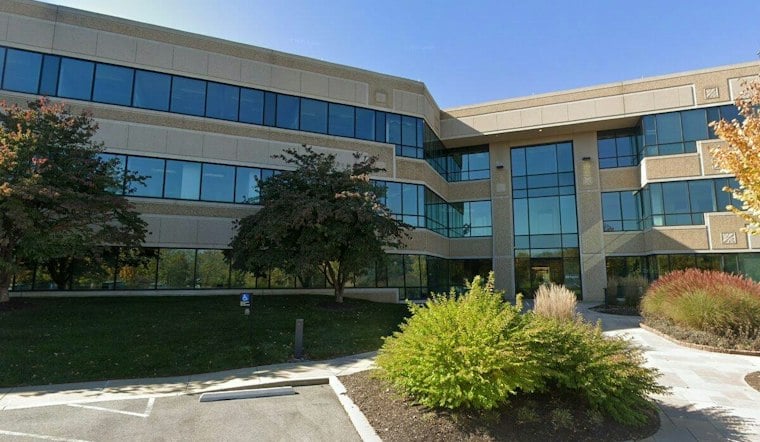
A networking company tucked inside a Chesterbrook office park just landed the biggest venture capital check any Greater Philadelphia startup has cashed so far this year. Cornelis Networks announced a $205 million Series C funding round to build out high-speed networking technology designed to keep expensive AI data centers running at full speed instead of sitting idle waiting on data to move.
The round was led by IAG Capital Partners, according to BUCKSCO.Today, which first reported on the raise. Cornelis has not disclosed its valuation following the round, and the Chesterbrook company's total, according to the outlet, now represents the largest reported venture capital raise for a Greater Philadelphia startup so far in 2026. The company is headquartered at 1500 Liberty Ridge Drive in the Chesterbrook corporate park, per Cornelis Networks' own contact information, placing the deal squarely in Chester County's stretch of the Route 202 tech corridor near Wayne.
Why AI Data Centers Need Better Plumbing
Modern AI systems run on data centers packed with thousands of processors that all need to share information constantly, and Cornelis builds the high-speed networking technology meant to move that data between them without creating a traffic jam. Networking bottlenecks can leave expensive processor clusters waiting around instead of computing.
Alongside the funding announcement, the company introduced what it calls Active Compute Fabric, an open architecture that embeds programmable processing directly into network switches and adapters so computations can run inside the network itself rather than relying solely on central processors, Forbes reported. The move builds on hardware Cornelis already sells: the company's 400-Gbps CN5000 scale-out networking gear claims 35% lower latency and double the message rate of Nvidia's competing 400-Gbps InfiniBand NDR solution, according to CRN.
From Intel Cast-Off to Federal Supercomputers
Cornelis Networks did not start as an independent company. Its core technology, known as Omni-Path, was Intel technology, but Intel halted second-generation development in 2019 and spun the asset out as Cornelis Networks in 2020, per CRN's reporting on the technology's history.
That lineage has already found its way into some of the country's most powerful research machines. Cornelis' fabric powers Oak Ridge National Laboratory's Frontier system, described as the world's fastest supercomputer, and the Texas Advanced Computing Center's Stampede3, which formally accepted a CN5000 networking upgrade across 600 compute nodes in June, according to Multiples.vc. The firm lists a $20 million Series A in September 2020.
A Growing Roster and a CEO With Intel Roots
The company has grown from 40 employees to more than 250, per BUCKSCO.Today's reporting, and now counts Dell, Lenovo, Supermicro, and Hewlett Packard Enterprise among its customers. Cornelis also announced a partnership with Qualcomm Technologies that the two companies say aims to shape the next wave of AI data center designs, the outlet reported.
Leading that expansion is CEO Lisa Spelman, who joined Cornelis in 2024 after serving as an Intel executive. The fresh capital will support the company's continued development.
What Comes Next for the Networking Fight
Cornelis is already looking past its current hardware. The company's roadmap includes a CN6000 series designed to support open multi-protocol industry standards, including RoCEv2 and Ultra Ethernet Consortium protocols, alongside Omni-Path on PCIe 6.0, according to reporting from iTechGuides. That open-standards push is aimed at hyperscalers and cloud providers that increasingly want to avoid locking themselves into a single vendor's proprietary hardware ecosystem.
The stakes are sizable as hyperscalers and enterprises keep expanding their AI infrastructure. Cornelis' raise also lands amid state efforts to keep growing tech companies from leaving Pennsylvania, after the state launched the $125 million Innovate in PA 2.0 initiative in August to fund and retain high-growth firms, a program Hoodline previously covered.





