

























































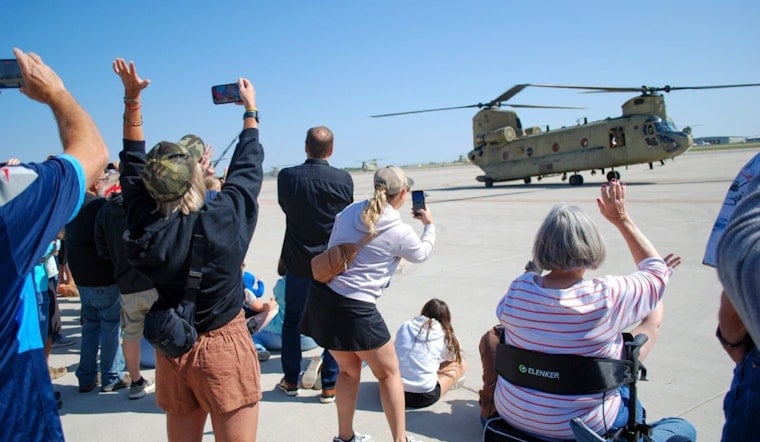
Hundreds of spectators gathered at New Century AirCenter last Sunday to watch a formation of CH-47 Chinook helicopters make one final pass over Johnson County and the southern Kansas City metro area. The flight marked the end of the road for the Spartans, the last military aviation unit stationed at the airfield, whose deactivation closed out 37 years of service for the Army Reserve Aviation Command.
The unit performing that farewell mission was Bravo Company, 7th Battalion, 158th Aviation Regiment, known as the Spartans, according to a Johnson County, KS Government Facebook post documenting the event. The company flew heavy-lift Boeing CH-47 Chinook helicopters, and its deactivation is part of a much larger Pentagon-driven shift. Under the Department of Defense's Army Transformation Initiative, the U.S. Army Reserve Aviation Command was directed to deactivate all rotary-wing units and divest all helicopter assets nationwide by September 15, 2026, as detailed in an order cited by the Defense Visual Information Distribution Service.
That nationwide drawdown is not a small bureaucratic footnote. The shutdown of Army Reserve rotary-wing units affects roughly 4,600 reservists and support personnel across the country, according to Military.com, as cited by the Shawnee Mission Post, with pilots moving toward commercial airlines or other military aviation branches and some reservists potentially facing months of retraining. For the Spartans at New Century AirCenter, that meant packing up a mission that had defined the base for decades.
A Unit Marked by Sacrifice
The Spartans' history carries a weight beyond routine reshuffling. On August 6, 2011, three members of Bravo Company, 7-158th Aviation Regiment based at New Century AirCenter — CW2 Bryan Nichols, Sgt. Alex Bennett, and Spc. Spencer Duncan — were killed in Afghanistan when their CH-47 Chinook, call sign Extortion 17, was shot down. The same report notes that day marked the deadliest single day for U.S. forces in the entire war.
That loss remains part of the unit's identity, even as the farewell flight was framed as a salute to the Spartans' broader legacy rather than a single event. The formation flight over Johnson County brought an end to more than 80 years of continuous active military flight operations at the airfield, where military aviation had been present since World War II, the same account states.
From Prairie Navy to County Airport
New Century AirCenter's military roots stretch back to October 1, 1942, when the site was commissioned as Naval Air Station Olathe, nicknamed the “Prairie Navy,” to train World War II naval aviators and serve as a hub for the Naval Air Transport Service, according to Johnson County, Kansas Government. Two names tied to American pop culture and space history passed through those early classes: future NASA astronaut and U.S. Senator John Glenn made his first solo military flight in 1942 as part of the base's first cadet class, while television host Bob Barker trained at the station.
The Navy decommissioned the base in 1970 amid defense budget reductions. The Johnson County Airport Commission acquired the property in 1973 and gave it its current name, New Century AirCenter, in 1995, according to the county government's account. What began as a wartime training ground evolved into a working county airport that has kept growing ever since.
Economic Engine Outlasts the Military Mission
Even with military flight operations now over, New Century AirCenter isn't going quiet. The airfield spans more than 2,700 acres and features a 7,339-foot main runway — the second longest in the Kansas City metro region, per Johnson County, Kansas Government figures. A study from the County Economic Research Institute found the aircenter generates $1.1 billion in annual economic impact for the region and supports nearly 5,000 local jobs through its surrounding business park.
So while the Spartans' Chinooks have made their last pass over Olathe, the airfield they called home for decades is set to keep humming along as a civilian and commercial hub. The farewell flight closed an era defined by war, sacrifice, and training missions dating back to the World War II years — but for New Century AirCenter itself, the runways are far from empty.





