

























































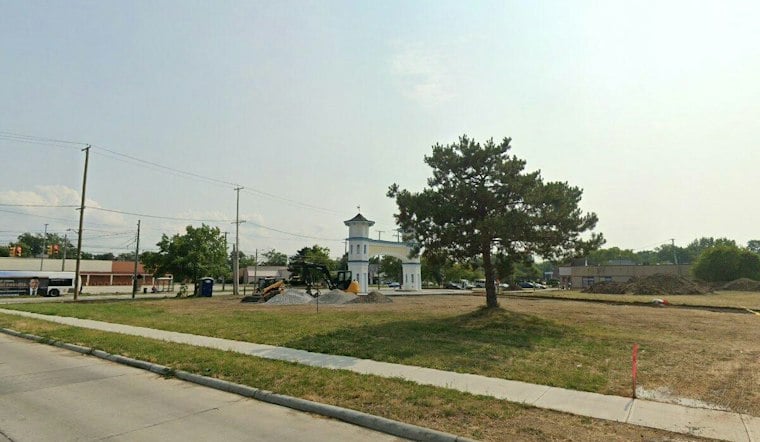
Cleveland officials flipped the switch Friday night on the newly restored Euclid Beach Park Arch, relighting the 1921 landmark in its new home on Lakeshore Boulevard after months of preparation; the physical move itself took about 10 minutes. The relit archway now serves as the centerpiece of Euclid Beach Arch Park, a brand-new municipal green space carved out of a parcel that used to hold a fast-food restaurant.
The relocation effort began in earnest on July 17, 2025, when construction crews used a crane to lift the entire arch and shift it roughly 150 feet west, away from its original position straddling East 159th Street, according to WKYC. The move was designed to get the fragile, century-old gateway away from the narrow portion of East 159th Street it straddled, a park entrance roadway that was not built to city-street code and was never officially dedicated by the city, where it had absorbed repeated vehicle strikes over the decades. City officials officially relit the restored structure on Friday night, September 25, 2026, establishing it as the centerpiece of the new park, which now bookends Cleveland Metroparks' lakefront holdings alongside Veterans' Park, the station reports.
From McDonald's Lot To Municipal Parkland
The 1.55-acre parcel where the arch now stands didn't cost the city a dime to acquire. It was donated by McDonald's Real Estate, which had previously operated a restaurant on the site before it was torn down, per the same WKYC report. The former fast-food property sat empty along Lakeshore Boulevard before the city folded it into the arch relocation plan, turning an unused lot into a dedicated park.
Getting the arch off East 159th Street wasn't a cosmetic decision. Originally situated over a narrow portion of East 159th Street, a park entrance roadway that was not built to city-street code and was never officially dedicated by the city, the delicate structure faced decades of vehicle strikes, most severely on January 11, 2007, when an SUV collided with its east tower and tore out a third of its lower wall, according to euclidbeach.org. That crash forced emergency scaffolding bracing and an extensive restoration; the arch had been designated an official Cleveland landmark back in 1973, and the 2007 repair effort later won a regional preservation award, per the same account. This time around, the city engineered an $800,000 relocation to make sure history didn't repeat itself on the pavement.
An H-Shaped Tribute Built By The Humphrey Family
The arch's origins trace back to 1921, after the Humphrey family took over management of Euclid Beach Park in 1901. Its design is no accident: the structure was built in the shape of an uppercase letter H, a nod to the family's surname, before receiving a Perma-Stone finish in 1942, WKYC notes. The Humphreys ran the popular lakefront amusement park under a family-friendly free-entry policy until it closed in 1969.
Euclid Beach Park itself opened in 1895 and operated along Lake Erie's shoreline for 74 years before shutting down permanently on September 28, 1969, after at least five seasons of financial losses, according to the Encyclopedia of Cleveland History. Most of the park's rides were sold off or demolished after closure, scattering what remained of the beloved attraction across the region and beyond.
A Complicated Legacy Beyond The Rides
Public memory of Euclid Beach Park tends to center on Humphrey family treats and beloved rides, but the historical record includes a tougher chapter too. Black Clevelanders faced discrimination at the park, including restrictions on dancing and skating, which sparked civil rights demonstrations in 1946 and led Cleveland City Council to pass an anti-discrimination ordinance governing local amusement parks in 1947, per the Encyclopedia of Cleveland History. Those racial tensions remain part of the park's complicated legacy.
Where The Rest Of Euclid Beach Lives On
The arch isn't the only piece of Euclid Beach that survived the wrecking ball. The park's 1910 Philadelphia Toboggan Company Grand Carousel was saved after closure and reopened in November 2014 as a permanent operating exhibit at the Western Reserve Historical Society's Cleveland History Center, according to the Western Reserve Historical Society. That carousel actually spent decades operating in Maine before it made its way back to Cleveland for restoration.
Another surviving ride traveled even farther afield. The park's 1921 Great American Racing Derby was purchased by Cedar Point in 1967 and relocated to Sandusky, where it still operates today as the Cedar Downs Racing Derby, one of only three such racing derbies left in the world, according to the Sandusky Register. The attraction features 64 hand-carved horses moving on a revolving track that simulates a horse race, a detail that still draws visitors nearly six decades after it left Cleveland.
Part Of A Bigger Lakefront Push
The arch's relighting doesn't stand alone. It anchors a broader wave of East Side lakefront investment, including the Euclid Beach Connector Trail project, which is moving forward, according to Cleveland City Council. The trail is funded through a combination of local, state, and federal park partnerships.
With the arch now lit and standing on its own dedicated park land, one of Cleveland's last physical markers of the old shoreline amusement park has a permanent, safer home — even as pieces of its history remain scattered from a museum floor downtown to a fairground two hours west in Sandusky.




