

























































A Coast Guard helicopter crew fired warning shots at a go-fast boat south of Costa Rica before Coast Guard law enforcement personnel boarded it, while more than 25,000 pounds of cocaine was seized from four separate vessels over six days. Thirteen suspected smugglers were detained in the operation, which unfolded in international waters off Central America between September 11 and September 16, 2026.
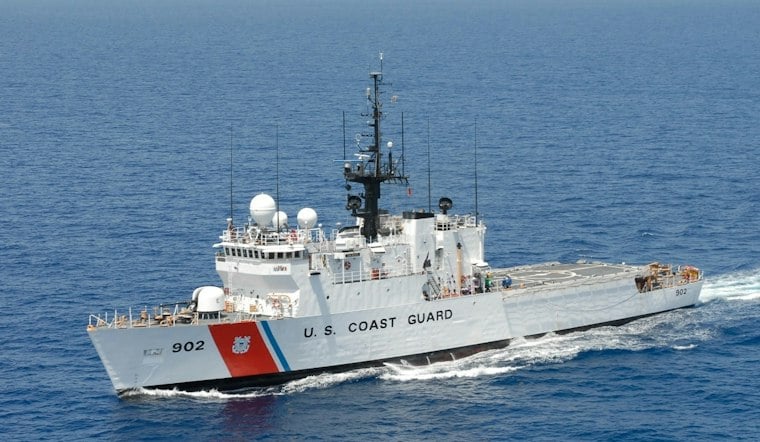
The first interdiction came on September 11, when USCGC Tampa intercepted a go-fast boat south of Costa Rica. An embarked helicopter crew fired warning shots, and Coast Guard law enforcement personnel seized over 6,800 pounds of cocaine; Coast Guard personnel later sank the vessel as a hazard to navigation, according to Newsmax, which detailed the tactical sequence. Four days later, the Coast Guard intercepted two more vessels carrying a combined 15,000 pounds of cocaine, and just one day after that, a fourth boat was stopped carrying more than 3,400 pounds, according to WFLA, which cited Coast Guard social media posts detailing the interdictions. All told, the three interdictions involving four vessels pushed the September total past 25,200 pounds.
USCGC Tampa, the cutter that led the first interdiction, is a 270-foot Famous-class Medium Endurance Cutter commissioned in 1984 and homeported in Portsmouth, Virginia, per U.S. Coast Guard Atlantic Area records. Tampa has carried out a range of missions.
Doses Prevented and the Bigger Campaign
Federal authorities benchmark 1.2 grams of cocaine as a potentially lethal dose, a standard that puts the September seizure at roughly 9.5 million doses kept out of American communities, according to the Coast Guard's own accounting cited by WFLA. That framing is meant to translate raw tonnage into a more tangible measure of harm prevented.
The four-vessel sweep is also the latest chapter in Operation Pacific Viper, the elevated counter-drug campaign the Coast Guard launched in August 2025. The operation has now surpassed 260,000 total pounds of cocaine seized in the Eastern Pacific, according to a statement from the U.S. Department of Homeland Security. The campaign leans on surging cutters, tactical aircraft, and interagency intelligence to disrupt smuggling corridors running through South and Central America.
Much of that intelligence originates far from the interdiction itself. Joint Interagency Task Force South, based in Key West, Florida, detects and tracks maritime drug movements across a 42-million-square-mile transit zone before handing operational control to the Coast Guard once an interdiction becomes imminent, per the same DHS statement. Coast Guard law enforcement detachments then operate under statutory maritime authority to board, search, and seize foreign or stateless vessels in international waters.
A Record Year Behind the Latest Bust
This September surge follows a fiscal year 2025 in which the Coast Guard seized more than 511,000 pounds of narcotics in the Eastern Pacific and Caribbean — over triple the historical annual average seizure weight of 167,000 pounds, according to Military.com. That earlier surge alone was estimated to have kept roughly 193 million lethal doses out of domestic markets, per the same report.
Federal drug valuation metrics reported by Military.com put the wholesale value of interdicted cocaine at approximately $16,588 per kilogram, with 2025's cocaine interdictions estimated to have saved $2.3 billion in direct healthcare costs. That same year, Coast Guard Cutter Hamilton set the record for the largest single-ship drug offload in agency history, bringing ashore 76,000 pounds of illicit drugs — including 61,740 pounds of cocaine — worth an estimated $473 million at Port Everglades, Florida.
Deep-water corridors in the Eastern Pacific remain a central focus of federal counter-drug strategy. Go-fast boats are among the vessels used on maritime smuggling routes.
Supply Keeps Pace With Seizures
A United Nations Office on Drugs and Crime report has found that global pure cocaine production reached a record high of approximately 4,100 metric tons in 2024; the Eastern Pacific is also a major transit route, as Hoodline previously reported. Andean production has risen even as Coast Guard cutters rack up historic totals offshore.





