

























































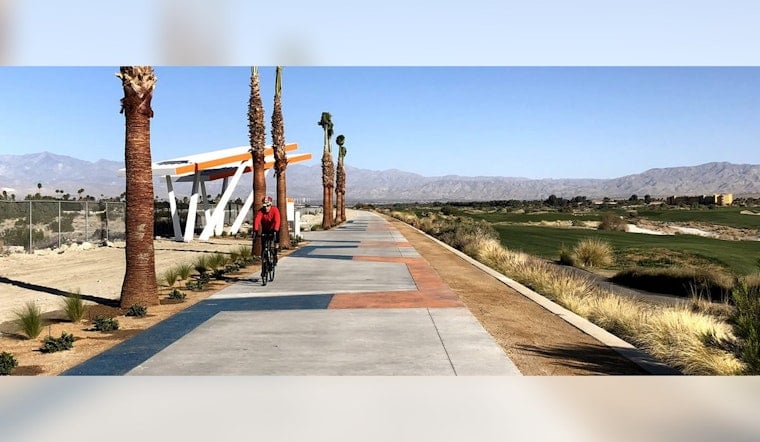
The Coachella Valley Association of Governments will receive $1,248,586 in grant funding to install shade structures and native shade trees at rest stops along the CV Link, the 40-mile pathway that links Coachella Valley cities for pedestrians, cyclists and low-speed electric vehicles. The project will add more than 20 trees and shade structures at rest stops in Palm Springs, Palm Desert and Coachella, according to a report from KESQ.
The funding comes from the Coachella Valley Mountains Conservancy, a state land trust agency established by the legislature in 1991 that has protected more than 106,000 acres of open space and wildlife habitat across the region, according to the Coachella Valley Mountains Conservancy. The grant was awarded through Proposition 4, the Safe Drinking Water, Wildfire Prevention, Drought Preparedness and Clean Air Bond of 2024, per the same KESQ report. Elizabeth King said the CV Link Shade Structure and Shade Trees Project is a strong example of the kind of investment Proposition 4 was designed to support, KESQ reports.
Specific improvements will target five rest stops: Promontory Point, Vista Chino, Jenkins Trail, Palm Desert High School and Sierra Vista Park, according to Patch. CVAG is matching the conservancy grant with $531,185 in local agency funding, while the Urban Conservation Corps of the Inland Empire is assisting with the tree-planting labor, per a Coachella Valley Mountains Conservancy Facebook post shared by CVMC.
Why the Trail Needed Shade in the First Place
When the CV Link opened in November 2025, it launched with 30 rest stops equipped with benches, bike racks and hydration stations, but limited protection against direct sun exposure, according to Patch. The shade project directly responds to feedback following the trail's opening, per KESQ's reporting. Deborah McGarrey said warm temperatures are a familiar aspect of daily life in the Coachella Valley, and that outdoor recreation is an essential public amenity for residents and visitors alike, KESQ reports.
The conservancy prioritizes expanding shaded areas throughout the Coachella Valley, and the urgency behind that goal is backed by regional climate data. Climate models cited by CVMC's Facebook update project the Coachella Valley will see more than 100 days per year with maximum temperatures exceeding 100 degrees Fahrenheit by 2035. The CV Link allows pedestrians, bicyclists, e-bikes and low-speed electric vehicles like golf carts to share the pathway under a 20 mph speed limit, according to the CV Link project FAQ, meaning the rest stops serve a wide mix of trail users exposed to that heat.
Timeline and the Bigger Funding Picture
Officials expect the shade project to be completed by 2028, according to KESQ. CVMC's Facebook update specifies that construction of the shade structures and tree planting is scheduled to wrap up within 21 months of the grant agreement, setting full operational delivery by mid-2028. The grant draws from a much larger pool of state money: California voters approved Proposition 4 in November 2024 as a $10 billion climate bond, allocating $446.6 million specifically toward extreme heat mitigation programs statewide, according to the California Natural Resources Agency.
The shade project also arrives on the heels of a long history of capital investment in the trail. Major construction on the CV Link accelerated in October 2020 after CVAG approved a $52.7 million contract with Ames Construction Inc. to build 20 miles of path, bridges and undercrossings, KESQ reported at the time. Trail users should also note that a separate municipal project could temporarily affect access along the corridor: Palm Springs officials in August considered plans to widen the Ramon Road Bridge, which would require a temporary closure and detour of the underlying CV Link undercrossing, as Hoodline reported in its piece on the bridge widening plan.





