

























































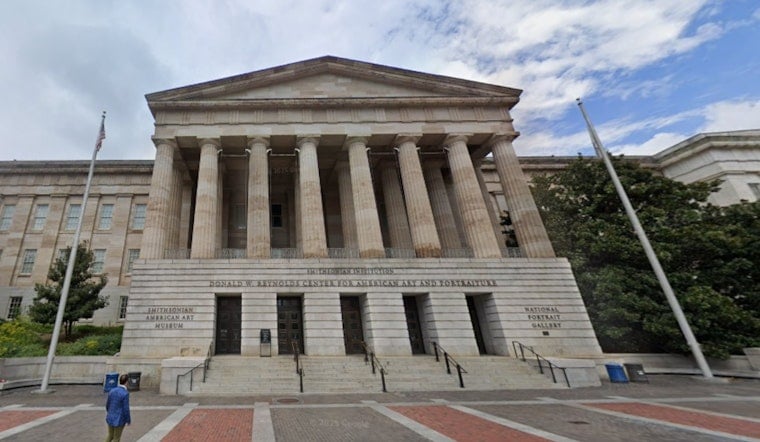
Tucked on the third floor of the Smithsonian American Art Museum in Penn Quarter sits a wing many visitors walk right past: the Luce Foundation Center, an open-storage gallery packed with more than 3,300 objects that most museums would keep locked away in a back room. It shares its building with the National Portrait Gallery, and the structure itself carries a past stretching back to the Civil War era, when it served as the headquarters of the U.S. Patent Office.
The center was recently spotlighted by WTOP's Matt About Town series, which described the Luce Foundation Center as an underrated wing that often flies under the radar even though it functions as an open storage environment for unique Smithsonian pieces. According to WTOP, the building housing the center features Greek Revival-style architecture and has connections to President Abraham Lincoln. The segment is part of a recurring feature that explores hidden gems, local landmarks and unique stories across the D.C. area, airing on 103.5 FM and posted to YouTube, with new episodes released each Tuesday and Thursday.
An Open-Storage Format That Quadruples What's on View
The Luce Foundation Center opened to the public on July 1, 2006, becoming Washington, D.C.'s first visible art storage and study facility, funded by a $10 million grant the Henry Luce Foundation awarded in 2001, according to the Smithsonian American Art Museum. Rather than rotate a handful of pieces through traditional gallery walls, the center displays its holdings in an open-storage format that makes more of the museum's permanent collection visible to the public at any given time.
Right next door sits the Lunder Conservation Center, which opened the same month in July 2006 and features floor-to-ceiling glass walls. Visitors can watch conservators work in real time as they restore paintings, works on paper and sculptures, a detail the museum highlights as a complement to the open-storage concept next door.
A Patent Hall Repurposed for Modern Art
The multi-tiered cast-iron balconies that now hold glass display cases were not built with art in mind. According to Smithsonian Magazine, Robert Mills was the building's architect; the Patent Office Building was begun in 1836 and completed in 1868.
The building's history runs deeper still. During the Civil War, from 1861 to 1865, the structure served as a military hospital, temporary barracks and morgue, according to the U.S. National Park Service. On March 6, 1865, the building hosted President Abraham Lincoln's second inaugural ball in its Great Hall, the first time a federal government building had ever been used for a presidential inaugural celebration.
Saved From the Wrecking Ball
The building's survival was not guaranteed. The landmark structure was scheduled for demolition in the 1950s but was saved from the wrecking ball in 1955, according to the National Park Service. Congress then gave the building to the Smithsonian Institution in 1958, and both the Smithsonian American Art Museum and the National Portrait Gallery opened inside it in 1968.
The building reopened on July 1, 2006, following a six-year, $283 million renovation, and was officially named the Donald W. Reynolds Center for American Art and Portraiture, per reporting at the time from The Washington Post.
Why an Open-Storage Wing Matters
Open-storage spaces like the Luce Center give visitors access to collections that would otherwise stay in storage, underscoring why they matter for public access. The Smithsonian American Art Museum and the National Portrait Gallery make the Luce Center a wing that hides in plain sight.





