

























































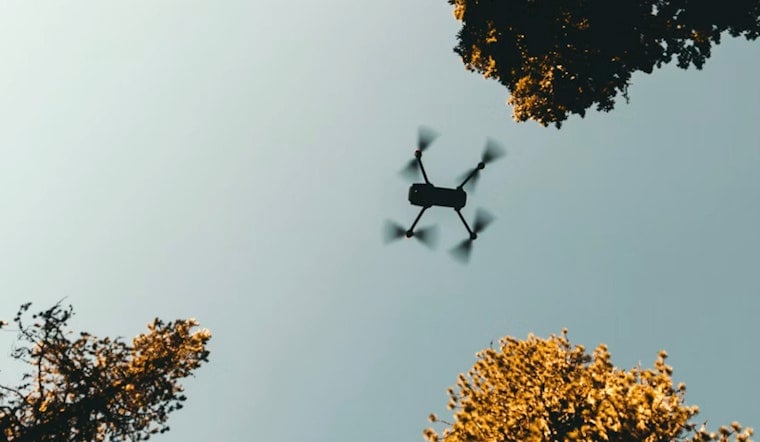
Duke University is set to lead a $24 million U.S. Army research effort aimed at developing new ways to detect, disrupt and even seize control of enemy drones without firing a single shot. The multi-year project will bring together Duke engineers, six other academic institutions, defense contractor Lockheed Martin and government stakeholders in what officials describe as a new kind of research hub — one that will not exist as a physical building at all.
The U.S. Army's DEVCOM Army Research Office is funding the $24 million team to build what it calls foundational science for countering unmanned aerial attacks, according to a news release cited by CBS 17. The grant, officially titled ICE-CEM — Inducing Cyber and Physical Effects in Unmanned Aerial Systems via Cyber-Electromagnetic Convergence — spans six years, running from August 31, 2026, through August 30, 2032, per Scholars@Duke. Duke officials say the research is meant to be the culmination of multiple decades-long research pursued by the university's engineering faculty.
Miroslav Pajic, Duke's director of master's studies and a professor in the Department of Electrical and Computer Engineering, will direct the new effort. Pajic is joined by a roster of Duke faculty co-investigators spanning electromagnetics, wireless networking, cybersecurity and hardware AI, including David R. Smith, an internationally recognized pioneer in electromagnetic metamaterials, along with Yiran Chen, Hai “Helen” Li, Tingjun Chen and Neil Gong, according to Scholars@Duke.
A Center Without a Building
Rather than standing up a physical lab space, the new research effort is designed to function as a distributed center, according to Duke media relations, described in the seed reporting as a network built to bring together the Army, defense and government stakeholders, researchers, startups and established industry leaders. The team's stated aim is to accelerate collaboration and move technologies toward real-world national security impact, per the same reporting. Duke provost Alec Gallimore said the university is thrilled to expand its partnership with the military to advance drone technologies.
The research plan calls for developing fundamental tools and automated procedures capable of detecting, thwarting and taking control of enemy unmanned aerial vehicles, requiring only minimal system interaction and limited prior knowledge of the target drones, per the CBS 17 report. That's a notably different approach than kinetic counter-drone weapons — the project is aimed squarely at software and radio-frequency manipulation.
Building on Prior Radar-Spoofing Work
Pajic and Tingjun Chen aren't starting from zero. The pair previously developed “MadRadar” in 2024, a physical-layer attack framework capable of learning radar configurations in real time and spoofing sensors into detecting fake targets or ignoring real obstacles, according to ScienceDaily. That earlier research demonstrated that millimeter-wave radar sensors on autonomous systems could be tricked on the fly without prior knowledge of a system's settings, laying technical groundwork for the new ICE-CEM effort.
Chen's work fits into a broader institutional push at Duke: he was named director of the university's newly established Institute for AI Engineering in July, according to Scholars@Duke, underscoring the university's growing investment in AI hardware and autonomous systems integration — capabilities increasingly critical for identifying targets aboard uncrewed aircraft.
Why the Timing Matters
The research team plans to serve as a focal point for North Carolina's rapidly growing defense ecosystem, per the CBS 17 report, and the timing lines up with a war overseas that has forced militaries to rethink how drones are countered. Russia and Ukraine have both used uncrewed aerial vehicles extensively — Ukraine has used UAVs to hold off Russian forces and to strike deep inside Russian territory, with the article noting Ukraine's UAV use crippled Russian oil infrastructure in March. Ukraine and Russia have also increasingly turned to fiber optic lines for drone control instead of radio or satellite signals, a shift that has made taking control of enemy UAVs more difficult, according to the report. Adding to the challenge, AI-enabled drones can bypass heavy radio jamming and autonomously navigate the final miles of a strike deep inside enemy territory — the exact kind of adversary capability the ICE-CEM team is being asked to counter.
The Army has continued testing its own counter-drone hardware alongside this kind of foundational research. In April, the Bumblebee V1 system — designed to make contact with and physically incapacitate enemy drones — intercepted a practice target at Fort Bragg, North Carolina. The Army also continues fielding software-defined electronic warfare systems such as the CREW Duke vehicle-mounted countermeasure, built to neutralize radio-controlled threats in fast-changing battlefield conditions, according to Military Embedded Systems.
Durham's Defense Research Roots Run Deep
The location isn't incidental. DEVCOM's Army Research Office maintains its nationwide headquarters in Research Triangle Park, where it has managed the Army's extramural basic research program since relocating from Duke's campus in 1975, according to the DEVCOM Army Research Laboratory. The region is also home to AERPAW, a $24 million National Science Foundation-funded drone and wireless testbed led by nearby North Carolina State University, giving the Triangle a dense concentration of advanced drone-testing infrastructure.
The military and defense sector is North Carolina's second-largest economic driver, generating an estimated $79.7 billion in annual economic impact and accounting for roughly 12.8% of the state's GDP in 2026, according to the North Carolina Military Business Center. State leaders have leaned into that reality: North Carolina established the NC ALIGN council through its Department of Commerce specifically to coordinate university research assets with federal military priorities and grow the state's share of federal defense research spending.
Lockheed Martin, the sole industry partner named alongside Duke's academic team, brings its own fielded military experience to the project. The defense contractor tested its Next Generation Command and Control platform in May during military field demonstrations aimed at integrating real-time airspace data with electronic warfare capabilities, according to Lockheed Martin's own announcement. That kind of industry involvement is meant to help align early-stage academic science with command architectures the Army could eventually field.
For now, the open question is how quickly research like this — still fundamentally academic in nature — can be translated into deployable tools capable of countering the kind of jamming-resistant, AI-enabled drones already reshaping combat in conflicts abroad. Duke officials have framed the six-year window as a chance to converge decades of engineering research into something the Army, and the broader North Carolina defense ecosystem, can eventually put to use.





