

























































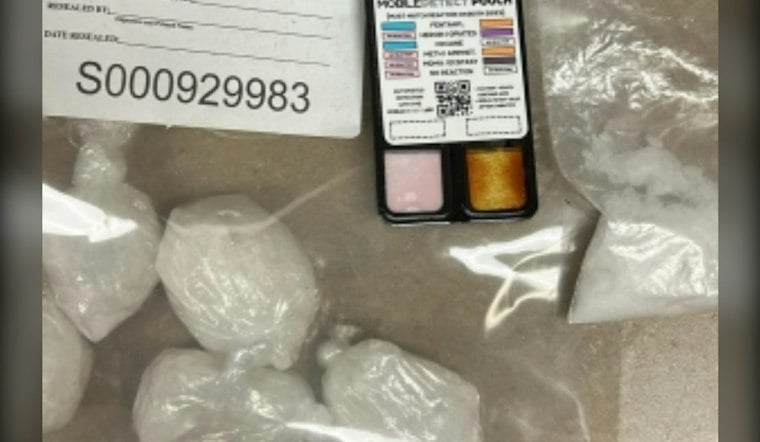
A federal judge in Tacoma sentenced 40-year-old Everett resident Levi Frank Graham to 10 and a half years in prison Friday for conspiring to distribute methamphetamine and fentanyl as part of a cartel-connected trafficking organization that investigators tracked for years using wiretaps and undercover buys. Prosecutors described Graham as a local redistributor who kept ordering drugs from suppliers even after he was arrested with drugs and cash in his possession.
Federal prosecutors said Graham repeatedly tried to obtain fentanyl powder and was recorded on wiretaps ordering pounds of methamphetamine and thousands of fentanyl pills, according to KOMO. Investigators intercepted calls and texts in June 2024 showing Graham ordering drugs directly from Rosario Abel “Joaquin” Camargo Banuelos and Francisco “Fernando” Camargo Banuelos, brothers from Sinaloa, Mexico, who authorities say arranged for kilograms of methamphetamine and fentanyl to be moved into the Pacific Northwest using semi-trucks traveling north on Interstate 5.
Local police arrested Graham in September 2024 with drugs and cash from drug sales, but that did not stop him. Prosecutors said Graham continued communicating with the trafficking organization after that arrest and even obtained another firearm and body armor. He was arrested again in September 2025 with drugs and a gun at an Everett hotel.
A Tacoma-Based Network With Reach Beyond Washington
The Tacoma-based operation distributed large quantities of methamphetamine, fentanyl, heroin and cocaine across Western Washington and beyond, with ties extending into Nevada, Oregon and California, per the KOMO report. According to the U.S. Department of Justice, commercial truck driver Isabel Villarreal Zapien transported bulk narcotics in semi-trucks from Mexico through California into Washington before her initial state arrest in January 2024, a method prosecutors say helped the ring move large shipments while avoiding detection along I-5.
Court filings show the network organized deals across Western Washington, reaching as far north as Arlington and Whidbey Island in Snohomish and Island counties and as far south as Tacoma and Lacey, according to MyNorthwest. Graham was one of four Everett residents indicted in the broader federal conspiracy. His co-defendant John Hardman had his Everett home searched on August 4, 2025, where agents recovered a compressed brick of fentanyl powder stamped with a swastika alongside $50,000 in cash, according to The Everett Herald.
Coordinated Raids Netted Guns, Cash and Hundreds of Pounds of Drugs
The August 4, 2025, coordinated arrests and searches turned up seven pistols, three rifles, nine kilograms of methamphetamine, nearly four kilograms of cocaine, more than five kilograms of fentanyl, and more than a kilogram of heroin, per KOMO's account of the operation. Authorities also seized more than $342,000 in suspected drug proceeds that day. Those numbers came on top of what investigators had already pulled from the broader case before the August 2025 operation: about 465 pounds of methamphetamine, 269 pounds of fentanyl, 6.4 pounds of heroin, 23 pounds of cocaine, roughly 11 firearms, and more than $309,000 in assets, KOMO reported.
The Drug Enforcement Administration's Seattle Field Division found that the 269 pounds of fentanyl powder and pills seized from the ring contained approximately 6.9 million lethal doses, according to FOX 13 Seattle — enough, the station reported, to cause fatal overdoses for the entire population of the Seattle-Tacoma metro area. That single seizure dwarfs even the DEA's statewide haul from a year earlier: the agency's Seattle Field Division removed 4.8 million lethal fentanyl doses across Washington in 2023, according to the Drug Enforcement Administration.
A Two-Year Investigation Rooted in Undercover Buys
The DEA's investigation began in September 2022 with undercover agents purchasing narcotics from Tacoma-area dealers, an effort that led to an October 2023 seizure, the Department of Justice said. That foundation eventually supported the wiretaps that captured Graham's own orders. A 37-count federal indictment returned in August 2025 ultimately charged 19 people in connection with the ring.
Federal prosecutors say 19 local distributors and couriers have now been indicted in Washington, and the Justice Department's Office of International Affairs is working to hold conspirators accountable in the United States and abroad, per MyNorthwest's reporting on the case.
Prosecutors Cited Graham's 26 Prior Convictions
At sentencing, First Assistant U.S. Attorney Charles Neil Floyd highlighted Graham's 26 prior convictions over 22 years, which included prior offenses involving drugs and guns, according to the U.S. Department of Justice. Graham has criminal convictions dating back to age 18, including prior offenses involving drugs and guns, and prosecutors said he trafficked drugs for at least 15 months during this investigation despite his history of arrests and prison time.
Prosecutors asked Chief U.S. District Judge David G. Estudillo to impose a 15-year sentence. Estudillo instead sentenced Graham to 10 and a half years, citing the significant amount of drugs Graham was likely distributing and the impact of that volume on individuals, families and communities, KOMO reported.
Part of a Larger Statewide Overdose Crisis
Under federal conspiracy law, individuals convicted of conspiring to distribute controlled substances face the same mandatory statutory minimums as primary distributors — five to ten years or more — without prosecutors needing to prove an overt act by every co-conspirator, according to the Spodek Law Group. That legal framework helps explain why a local redistributor like Graham faced federal prison exposure on par with major suppliers.
Graham's case lands amid a broader fentanyl crisis across Washington. Drug-poisoning deaths statewide declined in 2024, with the decline continuing into preliminary 2025 data. Synthetic opioids such as fentanyl were involved in fatal opioid overdoses in Washington.





