

























































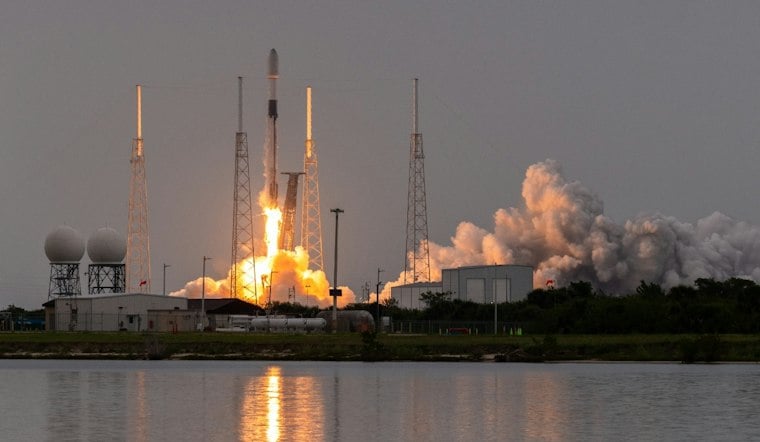
A SpaceX Falcon 9 rocket lifted off from Cape Canaveral Sunday afternoon carrying the final three satellites needed to complete a 13-spacecraft broadband constellation for Luxembourg-based operator SES, marking the first time three of these satellites launched together on a single rocket.
A Constellation Years in the Making
The launch, targeted for 2:49 p.m. from Space Launch Complex 40 at Cape Canaveral Space Force Station within an 87-minute window, according to WESH, delivered the last batch of Boeing-built O3b mPOWER satellites to Medium Earth Orbit. The mission completes SES's initial 13-satellite constellation, positioning three Boeing-built spacecraft on a single Falcon 9 for the first time, as reported by BASENOR. Earlier O3b mPOWER missions on Falcon 9 typically orbited pairs of satellites rather than trios, the outlet noted. Boeing delivered the final three satellites, designated F11, F12, and F13, to Cape Canaveral earlier in September, according to SatNews.
The constellation, per the same account, provides global broadband connectivity for maritime, government, enterprise, and aviation customers. The Boeing 702X-based satellites operate at an altitude of roughly 8,000 kilometers, or about 5,000 miles, using electronically steerable phased array antennas capable of shaping up to 5,000 dynamic spot beams per satellite across latitudes between ±50 degrees. SatNews reports the architecture covers 96% of the global population and can scale bandwidth from megabits to multiple gigabits per second per service.
Engineering Fixes Behind the Final Batch
Boeing re-engineered power system components and applied software routing modifications for this final batch of satellites, addressing power module anomalies that surfaced on early O3b mPOWER satellites launched in 2022 and 2023. Those power degradation issues on the initial flight units prompted SES and Boeing to expand their procurement contract and implement hardware mitigations for system longevity, according to the SatNews report.
Separately, Medium Earth Orbit constellations like this one deliver signal latency of around 150 milliseconds, a marked improvement over the roughly 600 milliseconds typical of traditional geostationary satellites operating at 36,000 kilometers, according to Orbital Radar. That lower latency can support time-sensitive uses such as cloud computing.
A Well-Traveled Booster Makes Its 29th Flight
The Falcon 9 first stage booster supporting Sunday's launch, identified by WESH as flying its 29th mission, is expected to land on the droneship A Shortfall of Gravitas, stationed in the Atlantic Ocean. That booster, designated B1080 by SpaceX, has previously supported Axiom Space's Ax-2 and Ax-3 crewed missions, ESA's Euclid space telescope, NASA's CRS-30 cargo resupply flight, SES's ASTRA 1P satellite, the NG-21 mission, and 22 Starlink launches, according to SpaceX. SpaceX has certified Falcon 9 boosters for up to 40 missions as rapid reusability becomes standard operating procedure. WESH also reported a backup launch opportunity was available September 14 at the same scheduled time in case Sunday's attempt did not go forward.
Weather officials assigned a 60% probability of favorable conditions for the launch window, citing potential violations of cumulus cloud, surface electric field, and anvil cloud rules, per BASENOR's reporting. Late-summer afternoon launch windows on Florida's Space Coast frequently run into these atmospheric electricity and thunderstorm cloud constraints.
What Central Florida Residents Should Expect
The Federal Aviation Administration's Air Traffic Control System Command Center issued advisories anticipating airspace routing changes and potential flight rerouting around Orlando and Tampa between 18:40 UTC and 21:10 UTC Sunday, according to Deep Arrival. Commercial space launches routinely require temporary airspace closures that compress air traffic corridors across Central Florida, the outlet notes.
Space Coast spectators were advised that no sonic booms would occur during the launch attempt because the Falcon 9 first stage was headed for the offshore droneship landing rather than a return to land, per Deep Arrival's report. Droneship recoveries take place hundreds of miles out in the Atlantic, avoiding the atmospheric shockwaves associated with land-based booster returns to Landing Zone 1. Separately, Space Launch Complex 40 reached a milestone of 400 total orbital launch attempts with Sunday's flight, according to The Space Devs, cementing the pad's role as SpaceX's primary workhorse for East Coast commercial and Starlink missions.



