

























































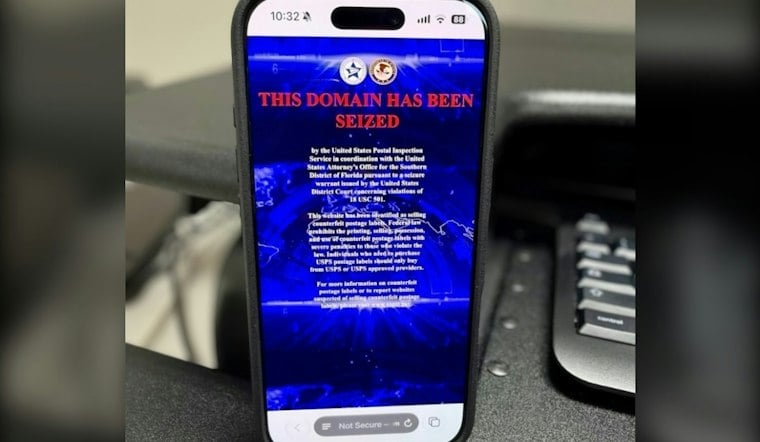
The U.S. Postal Inspection Service seized a website earlier this week that allegedly created millions of fake shipping labels, a scheme federal officials say cost the Postal Service an estimated $126 million. Federal prosecutors in Miami have now indicted the man they say ran it: 33-year-old Pakistani national Faheem Akram, accused of operating LabelsBank.com, a site that allegedly sold more than 5.1 million counterfeit postage labels before agents shut it down.
According to USPIS, court records show Akram allegedly charged a flat rate of $2 per shipping label regardless of a package's weight or destination, a pricing model that made the fraudulent labels far cheaper than legitimate postage. The USPIS-Fort Worth
field office, which covers North Texas, East Texas, portions of the Texas Panhandle, Arkansas, and Oklahoma, amplified the announcement from national headquarters, which first confirmed the domain seizure earlier this week.
The operation allegedly served more than 5,000 customers who used the fraudulent labels to dodge legitimate shipping fees. Akram now faces 10 federal counts, including one count of conspiracy, five counts of making and selling counterfeit postage labels, and four counts of wire fraud, per the same USPIS account of the case.
A Multi-Billion-Dollar Problem for USPS
The LabelsBank.com case lands amid a much larger reckoning for the Postal Service. A U.S. Postal Service Office of Inspector General audit released this month found that USPS lost an estimated $3.1 billion in unrecoverable revenue to counterfeit shipping labels between March 2024 and February 2026, according to Shopifreaks. Counterfeit shipping labels alone accounted for an estimated $1.6 billion in losses in fiscal year 2025 alone, the outlet reports.
Detecting the fakes before they reach a doorstep has proven especially difficult. Postal Service tracking data cited by the same outlet showed that packages bearing counterfeit shipping labels were successfully processed and delivered 97 percent of the time between October 2023 and February 2026. Fraudulent volume peaked at 29.4 million fake labels in December 2025, up from 9.7 million in late 2023, before new controls brought the numbers down in early 2026, the report notes.
Crackdown Also Snags Legitimate Shippers
The enforcement effort has not been without collateral damage. Automated fraud-prevention controls deployed by USPS mistakenly intercepted roughly 2 million legitimate packages with valid, paid postage between December 2024 and February 2026, Shopifreaks reports, adding that the extra processing required for those false-positive interceptions cost USPS an estimated $7.2 million.
Those seizures are legally possible thanks to a 2023 rule change. Under Domestic Mail Manual Section 604.8.4, adopted in May 2023, USPS considers any item found in the mail stream bearing counterfeit postage to be abandoned property, authorizing the agency to open, seize, and dispose of the package without delivery or return, according to the Federal Register. The rule was implemented to eliminate the administrative cost of returning fraudulent packages to their senders.
What the Law Says, and What Past Cases Show
Counterfeit postage is a federal felony under 18 U.S.C. § 501, which makes forging, printing, selling, possessing with intent to sell, or knowingly using counterfeit postage stamps or postal meter markings punishable by fines and up to five years in prison, per FindLaw. The statute penalizes both the suppliers who create counterfeit postage and the individuals or vendors who knowingly use it.
Recent sentencing shows federal courts are willing to hand down steep penalties. In July, a federal judge sentenced California resident Lijuan “Angela” Chen to two years and six months in federal prison and ordered her to pay $158 million in restitution for using counterfeit postage to ship more than 34 million parcels from China, according to FreightWaves. Chen managed Southern California warehouses that received Chinese goods and affixed duplicated Netstamps to evade USPS fees, the outlet reported.
Yet actual prosecutions remain rare relative to the scale of the fraud. Between March 2020 and March 2025, Postal Inspectors presented 44 counterfeit-label cases to the Department of Justice, but federal prosecutors accepted only nine for prosecution, recovering just $572,250 out of $57 million in investigated losses, according to Value Added Resource. All nine cases accepted during that five-year window ultimately resulted in criminal convictions, the site notes.
The Postal Inspection Service's Revenue Investigations Program has also stepped up efforts at the border, conducting joint package interdictions with U.S. Customs and Border Protection at major international logistics hubs in Los Angeles and New York, according to USPIS. Previous joint operations at those entry points have included seizing $2.5 million in counterfeit stamps originating from China.
A Local Connection to Prior Postage Fraud Cases
This is not the first time counterfeit postage schemes have drawn federal scrutiny with ties beyond a single region. Hoodline previously reported on a related case involving logistics companies and an owner in Queens and Los Angeles who faced a temporary restraining order over an alleged counterfeit postage scheme.
For now, USPIS is urging consumers to buy postage only through USPS or approved postal providers, warning that printing, selling, possessing, or using counterfeit postage is illegal. The agency has directed the public to its consumer guidance page for more information on spotting counterfeit stamps and labels.




