

























































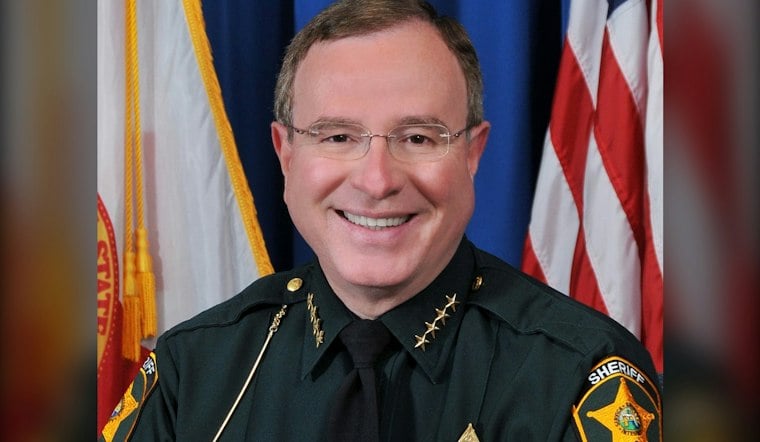
Florida sheriffs, fire chiefs and firefighters gathered at a news conference in Lake Mary this week to deliver a blunt message about the property tax measure headed to voters in November: reject it. Polk County Sheriff Grady Judd said voters should turn down the expanded homestead exemptions in Amendment 3 and instead push state lawmakers to craft a better tax relief plan, one that does not come at the expense of local police and fire funding.
The event, first reported by the Orlando Sentinel, brought together sheriffs, fire chiefs, police chiefs and law enforcement leaders from around the state to voice a shared concern: Amendment 3 would create a new $150,000 homestead exemption in 2027 and expand it to $250,000 in 2028, delivering potentially thousands of dollars in tax savings to homeowners while draining the revenue that funds local government. Judd said voters should vote no on the measure and demand tax relief that also protects public safety and local services, according to the paper's reporting. Property taxes fund most local services in Florida, including police and fire protection, which is typically the largest line item in a local government budget, the Sentinel noted.
Marion County Sheriff Billy Woods, who serves as president of the Florida Sheriffs Association, described Amendment 3 as half of a good plan. Woods said the measure relies too heavily on the Legislature to work out critical details later and would strip away the largest source of public safety funding without putting any replacement mechanism in place, per the Sentinel's account.
Sheriffs Association Runs Ads Featuring Uniformed Officers
The Florida Sheriffs Association has released an advertisement opposing Amendment 3 that features uniformed sheriffs, including Orange County Sheriff John Mina. The ad argues the amendment would force local governments to raise other taxes or fees to replace lost revenue, the Sentinel reported. Sheriffs also noted that state lawmakers built in funding protections for public schools before sending the amendment to the ballot but did not create similar protections for law enforcement funding.
That statewide law enforcement opposition lines up with a broader coalition tracked separately by Florida Politics, which reported that the Florida Sheriffs Association joined the Florida State Fraternal Order of Police, Florida Professional Firefighters and the Florida Fire Chiefs Association in opposing the measure in August. The Fraternal Order of Police represents roughly 24,000 officers statewide and has warned that essential emergency services should not be left facing fiscal uncertainty, according to that outlet's reporting.
A $10 Million Campaign Backs the Amendment
Amendment 3 is backed by prominent Republican figures including Byron Donalds, Gov. Ron DeSantis, Rick Scott and Blaise Ingoglia. The pro-amendment campaign is bankrolled largely by Florida Realtors, which contributed $10 million to the effort. Chuck Bonfiglio Jr. said Florida residents need meaningful housing affordability relief and that families need to be able to afford to keep the homes they purchase.
That financial imbalance is stark: Florida Realtors' political committee, Vote Yes on 3, launched with its $10 million contribution dwarfing the roughly $225,000 raised across four opposing political committees combined, according to Action News Jax. Amendment 3 would take effect with the $150,000 exemption in 2027 and the $250,000 exemption in 2028, and it needs approval from 60% of voters in the November 3 election to pass.
The Fiscal Numbers Behind the Fight
State economists and Florida TaxWatch project the measure would cut statewide local property tax revenues by $4.93 billion in fiscal year 2027-28, growing to $11.83 billion annually by fiscal year 2031-32, for a five-year total of $45.84 billion. County commissions would absorb 65% of that loss, municipalities 26% and independent special districts 9%, per Florida TaxWatch's analysis. The Florida Association of Counties has separately estimated that the state's 29 fiscally constrained rural counties could lose between 20% and 33% of their annual revenue, while Miami-Dade County faces the largest raw dollar hit at $445 million in first-year losses, according to Florida Politics.
The amendment also reduces the maximum annual assessment increase cap on non-homestead properties — including commercial buildings, rental housing and second homes — from 10% down to 5% for non-school property taxes, according to the Florida House of Representatives. That 10% cap has been in place since Florida voters approved it in 2008. Residents who establish a Florida homestead after December 31, 2026, would also face a five-year wait before qualifying for the expanded exemptions, receiving only the baseline homestead exemption in the interim.
Ballot Language Faced Its Own Legal Fight
The amendment's path to the ballot was not smooth. Leon County Circuit Judge David Frank ruled in early August that the original ballot title, “Save Our Homes From Excessive Property Taxes,” and its summary were “clearly and conclusively defective” and resembled a political slogan, ordering Attorney General James Uthmeier to submit revised wording within 10 days, Florida Politics reported. Judge Frank found that claims the measure would “ensure funding for core services” were misleading given the scale of the reduction to the local tax base — a legal battle Hoodline covered in an earlier report on the ballot fight.
Cities across the state are not waiting for the vote to start planning. Clearwater Fire & Rescue has modeled 5% departmental budget cuts, and cities including Kissimmee, Winter Springs and Apopka have frozen non-essential municipal hiring, according to WUSF. Clearwater's contingency planning has pointed to potential staffing reductions in fire logistics and fire inspection units specifically.
Spending Restrictions Add Another Layer
Beyond the tax cuts themselves, Amendment 3 contains a constitutional restriction limiting county and municipal non-school property tax spending to public safety, education, infrastructure, natural resources, bond debt service, employee retirement benefits and basic government operations, according to Ballotpedia. Critics and local officials contend that language further restricts home-rule control over how communities can spend their own tax dollars. Under current law, primary homeowners already receive a standard exemption of up to $50,000 — a baseline $25,000 exemption applying to all taxing authorities including schools, plus an additional $25,000 exemption on home values above $50,000 applying only to non-school taxes, according to Mainstreet Daily News. Florida voters last expanded that standard exemption in 2008.




