

























































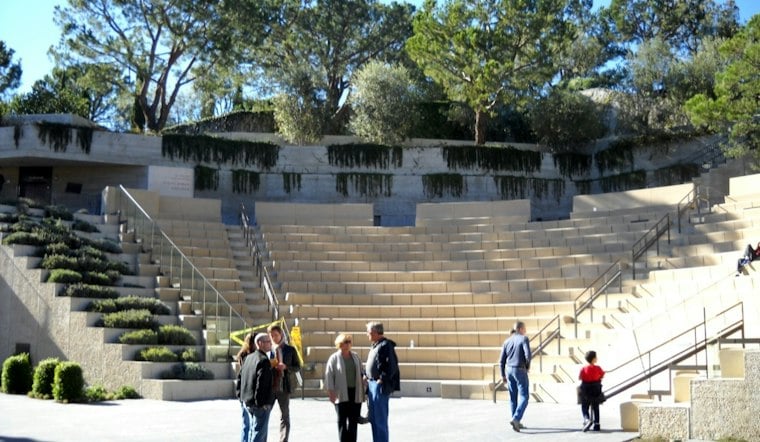
Antigone: In the Language of Kings brings Sophocles’ tragedy to the Getty Villa’s outdoor theater through Oct. 3, with performances scheduled Thursdays through Saturdays at 8 p.m. The Getty and Latino Theater Company production is staged in English, Spanish and Nahuatl, with projected supertitles supporting the multilingual performance. Broadway World lists the production’s schedule, languages and creative team.
The adaptation moves the story from ancient Greece to Tenochtitlan, the Mexica capital. In playwright Evelina Fernández’s version, Antíkona challenges the newly crowned ruler Tlahtoani Klion after he classifies her dead brother as an enemy of the state and refuses him a traditional burial. The production retains the play’s central conflict between civic authority and religious or familial obligation while placing it in a different historical and cultural world, according to the Los Angeles Times.
What audiences will see
José Luis Valenzuela directs a 20-performer cast that includes Cástulo Guerra as Klion and Sal Lopez as Tetzahuitl. Tiffany Bonita Litz plays La Muerte, while choreography supplies the production’s stylized battle action. Stage Raw also describes a towering, stilt-walking Death figure as part of the staging. An ASL-interpreted performance is scheduled for Sept. 24. Stage Raw and Broadway World provide the production and accessibility details.
Selected passages were translated into Nahuatl by Cal State Northridge professor Fermín Herrera, who also worked with actors on pronunciation and delivery, the Times reports. That language choice is not a claim that Nahuatl is a single, uniform speech form: Mexico’s National Institute of Indigenous Languages says the country’s Indigenous linguistic diversity is cataloged across language families, groupings and variants. Mexico’s statistics agency identified 7,364,645 people age 3 and older who spoke an Indigenous language in the 2020 census, according to INALI and INEGI.
A new setting inside an old theater tradition
The production is the 20th-anniversary season offering for the Getty Villa’s Outdoor Classical Theater program. The venue is designed around ancient Greek and Roman theater models, creating a deliberate contrast between the architecture of the performance space and Fernández’s Mexica setting, according to the Getty.
The current staging is part of a program that has repeatedly reworked or revisited classical material rather than presenting only conventional museum programming. The Getty lists Memnon in 2024 and the Troubadour Theater Company’s Oedipus the King, Mama! in 2025. Getty archival records also identify Sophocles’ Elektra as the Villa’s 2010 annual outdoor theater production. Those examples establish a programming history, but they do not make the different productions artistically equivalent. Getty program records and the Getty archive document the earlier presentations.
The title also points to In the Language of Kings: An Anthology of Mesoamerican Literature, Pre-Columbian to the Present, edited by Miguel León-Portilla and Earl Shorris and published by W. W. Norton in 2002. Fernández consulted scholarship associated with the volume while developing the adaptation, the Times reports. The book’s title is therefore a literary reference within the production, not evidence that the play reproduces a historical account of Tenochtitlan. W. W. Norton publication information describes the anthology.
Antigone adaptations are not interchangeable
The Getty production can be placed alongside other modern reworkings of Antigone, but the comparisons have clear limits. Theater of War Productions’ Antigone in Ferguson was developed with community members after Michael Brown’s death and premiered at Normandy High School in 2016; it used dramatic readings and live choral music rather than a Mexica historical setting. In Mexico, INBA has separately reported a performance of Ohtli/Camino emphasizing the poetic force of Nahuatl. These are examples of different uses of classical or Indigenous-language theater, not evidence of a single movement or rising trend. Theater of War Productions and INBA document those separate productions.
For this season, the distinguishing feature is the combination: Sophocles’ burial dispute, a Tenochtitlan setting, three performance languages and an outdoor venue modeled on ancient Mediterranean theaters. The production’s costumes were developed with reference to Mexica codices and pre-conquest Mexican cultures, while the creative team includes composer Christopher Garcia, choreographer Urbanie Lucero, set designer François-Pierre Couture and costume designer Maria Catarina Copelli, according to the Times and Broadway World.
The Getty and Latino Theater Company are co-producing the engagement. The Getty is also marking the season with an agave-based cocktail called El Cosmico, according to the museum. Further details about performances and the anniversary program are available from the Getty.



