

























































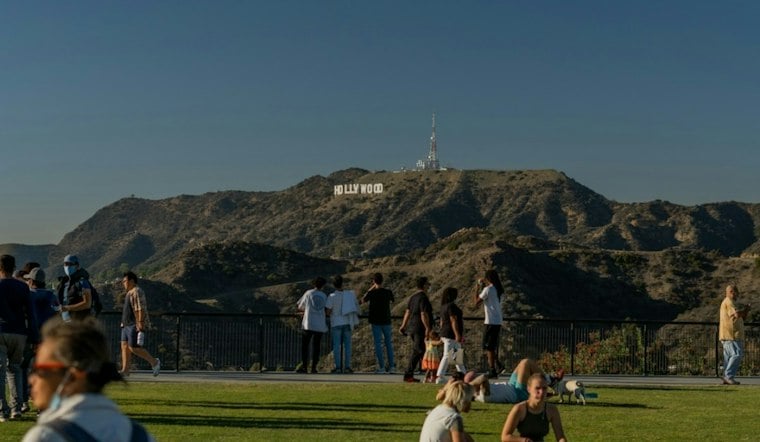
A 1912 Steinway grand piano is rolling into Griffith Park this weekend, set up below the Hollywood Sign, near land preserved from development. Pianist Hunter Noack will perform there Saturday and Sunday from 3 to 4:30 p.m., marking the first Los Angeles stop in the 11-year run of his outdoor classical series, and both shows are already sold out.
The performances, held at 3200 Canyon Dr. inside Griffith Park, are part of Noack's touring project “IN A LANDSCAPE: Classical Music in the Wild,” organized with the Trust for Public Land, according to LAist. The site sits near the historic Bronson Caves, the early 20th-century rock quarry famously used as the Batcave in the 1960s “Batman” television series, according to Time Out. The caves themselves remain closed to the public, per event details posted by the tour's ticketing partner.
Attendees who can't get in are being pointed to a waitlist for the sold-out dates, LAist reports. The series' full itinerary also includes a Los Angeles kickoff show at Elysian Park on Sept. 25, 2026, according to IN A LANDSCAPE — giving local fans another shot at catching Noack before he leaves the region.
A Piano That Has Weathered Wind, Fire and Idaho Gravel
Noack has hauled his Steinway — the same model used at Carnegie Hall — through rough terrain for a decade, moving it by Ford F-350 to shows from Yosemite Valley to Joshua Tree National Park, per the LAist report. He's played 370 concerts so far, and the piano, he says, has survived 112-degree heat and negative 2-degree winter cold without falling apart. It did go out of tune once, LAist notes, after being towed along washboard gravel on Schweitzer Mountain in Idaho.
The series traces back to 2016, when Noack played his first show at the Columbia River Gorge and, mid-performance, found himself surrounded by 40 Harley-Davidsons circling the piano. His response, per the same account: he launched into Frederic Rzewski's “Winnsboro Cotton Mill Blues.” The project takes its name from composer John Cage's piece “In a Landscape” — fitting, given Cage's belief that any sound could be music, LAist reports.
The Ridgeline Above the Piano Has Its Own Rescue Story
Concertgoers with headphones on will be sitting almost directly below Cahuenga Peak, the 138-acre parcel adjacent to the Hollywood Sign that the Trust for Public Land helped preserve for public use, per LAist's reporting. That 2010 campaign hit its $12.5 million fundraising goal only after Hugh Hefner made a final $900,000 donation, blocking plans for four luxury mansions on the ridge, according to the Trust for Public Land.
The land's backstory runs deeper still. Howard Hughes bought the parcel in the 1930s intending to build a hilltop estate for actress Ginger Rogers, but after their relationship ended it sat undeveloped for decades until Chicago investors purchased it in 2002, the Los Angeles Times reported at the time. Those investors had originally sought as much as $40 million for the property. The eventual save drew $3.1 million from California and support from entertainment figures Steven Spielberg and Tom Hanks, according to Trust for Public Land records — all under a strict one-year option deadline. To rally public attention, organizers draped banners spelling SAVE THE PEAK across the Hollywood Sign letters.
Nature Boy and a Songwriter Who Lived Under the Sign
Noack's Griffith Park program includes “Nature Boy,” the song Nat King Cole made famous. LAist reports the tune was written by eden ahbez, who lived outdoors under the first L of the Hollywood Sign while composing it. The song went on to become a pop standard.
Noack's series has grown well beyond its Pacific Northwest origins. Since 2016, Noack has performed 370 concerts, according to LAist. The nonprofit distributes more than $100,000 in free and subsidized tickets annually to keep outdoor classical music accessible, per the Trust for Public Land.
What Audiences Will Hear and Where They'll Sit
Rather than straining to hear an acoustic piano outdoors, ticket holders are issued wireless headphones that deliver concert-hall-quality sound as they wander the canyon grounds, LAist notes. Griffith Park itself, the backdrop for the performances, was created in 1896 when benefactor Griffith J. Griffith donated his estate to the City of Los Angeles, according to IN A LANDSCAPE's own event materials. The park now serves as the backdrop for performances.
For two afternoons this weekend, the park's soundtrack belongs to a century-old Steinway and the ridge above it that nearly became somebody's driveway.





