

























































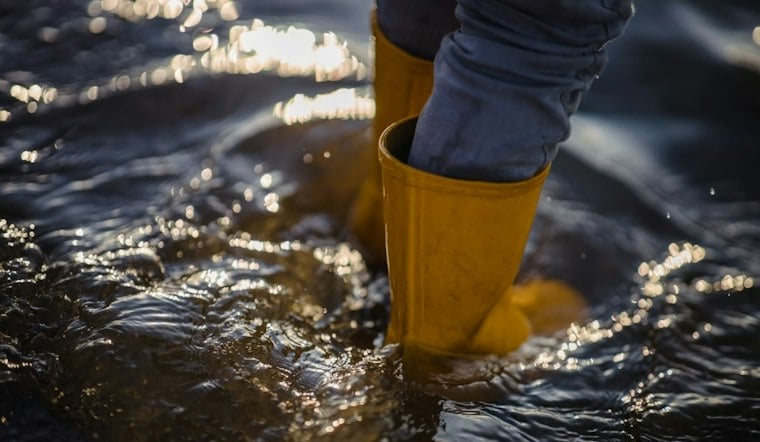
Nearly two weeks after Hurricane Lowell flooded their Haena property, Ricky Ewing and Lindsey Friedberg were still pumping sewage-contaminated water out of their yard as of September 18. Testing conducted days earlier had found highly elevated levels of fecal-related bacteria not just in their yard, but in a nearby drainage ditch, a culvert and the ocean itself.
The couple's yard filled with more than 3 feet of water when the hurricane hit Kauai's North Shore on September 8, according to the Honolulu Star-Advertiser. Ewing and Friedberg spent a full week pumping their yard, cleaning their property and disinfecting their belongings, while Friedberg and her children stayed at a friend's house during the worst of it. Hurricane Lowell also knocked out power in Haena, which was not restored until September 17.
Friedberg told the paper the standing water amounted to a public health hazard. Her children wanted to return home, she said, and she noted that yards in the area can take one to two months to fully recover, with water typically taking a week or two just to drop. Ewing, for his part, said the sewage problem at his home has progressively worsened over the years, and that this round of floodwater turned foul faster than it did during the 2018 floods.
Testing Reveals Extreme Bacteria Levels
Surfrider Kauai tested the yard, the drainage ditch, a culvert and the ocean on September 16, using equipment loaned from Reef Guardians, according to the same report. The results found highly elevated enterococci — fecal-related bacteria — at all four locations, with the yard registering more than 24,196 MPN, a concentration more than twice that of the ocean sample, three-and-a-half times the culvert reading, and more than five times the level found at a nearby stream outlet.
That yard reading worked out to 186 times what's considered a medium-bacteria level and 691 times what's considered low. Surfrider classifies readings above 130 MPN as high bacteria. Ayahna Shea cautioned, however, that elevated enterococci counts do not necessarily indicate ongoing sewage contamination, and said more testing would need to be done to pin down the source of the bacteria and how far the problem extends. The Hawaii Department of Health said in an email that it had observed flooding and accumulated water in a residential yard, along with minimal odor and no significant mosquito activity, but that the source of the accumulated water had not been definitively determined.
Neighbors Demand Action at Community Meeting
Friedberg and Ewing organized a community meeting on September 17 that drew more than a dozen neighbors to address the sewage flooding problem. Attendees called for the Department of Health's Clean Water Branch to open a formal case, for homeowners to fix inefficient culverts, and for a better county and Robinson family drainage and land-management system. Residents reported black mucky sediment, foul stenches, headaches and lingering concerns about the standing water.
Homes on Alamihi Street, Mikala Place and along nearby Kuhio Highway typically flood during large weather events, and the affected area contains roughly 30 to 40 homes. Undeveloped mauka land behind the neighborhood pushes debris, animal feces and sometimes even dead animals into properties when floods hit, the Star-Advertiser reported. Friedberg and Ewing estimated that the area has seen four to five severe floods over the past 12 years.
Who Owns the Drainage, and Who's Responsible
Area drainage systems are owned by a patchwork of Kauai County, the Robinson family and some private property owners, complicating any fix. The Robinson family's holdings span more than 4,300 acres of undeveloped land mauka of Haena, stretching from Powerhouse Road to Haena Point — with Keith Robinson owning a roughly 225-acre parcel and Bruce Robinson owning a 4,100-acre parcel within that footprint. As of September 18, the drainage ditch on the Robinson property remained relatively full of dark water and nearly stagnant, dammed up by debris and vegetation.
A Robinson family representative told the paper the family was checking with another branch, but did not respond to follow-up messages, emails or phone calls. Cola Lindman, who grew up next door to Ewing, has watched the neighborhood's flood dynamics shift over time as development reduced culvert sizes and filled in parts of the drainage ditch. Kauai County referred questions about the situation to the Hawaii Department of Health.
The Cesspool Problem Behind the Flooding
Almost every property in Haena runs on a cesspool system, according to the University of Hawaii's cesspool prioritization tool, and heavy rain can cause those cesspools to back up and push raw sewage to the surface, as previously reported by the Star-Advertiser. Switching to another wastewater system typically costs homeowners between $20,000 and $50,000, a price tag most families in the area can't absorb.
Statewide figures on the scope of the problem vary by source. Civil Beat mentions 83,000 cesspools statewide, while the Department of Health has said it identified 43,000 of the state's 88,000 cesspools as posing a risk to water resources, with 53 million gallons of raw sewage released daily. Hawaii law — under Act 125 of 2017 and Act 87 of 2022 — requires cesspools statewide to be upgraded, converted to a director-approved wastewater system, or connected to sewer before January 1, 2050, with certain exemptions, according to bill text on file with the Hawaii State Legislature.
Some help may be available. The County of Kauaʻi Housing Agency opened its Residential Cesspool Conversion Grant Program 2 for applications from September 8 through October 6, offering selected, qualified homeowners up to $20,000 in reimbursement toward Department of Health-approved systems, according to Kauai Now. Nearby Hanalei, which has roughly 115 cesspools and groundwater sitting as shallow as 3 feet below the surface in places, has floated a $19.26 million pressure sewer system as a long-term fix, per Honolulu Civil Beat. Researchers with Hawaii Sea Grant have noted that up to 170 cesspools in the Hanalei watershed may be contributing sewage to streams and the ocean, and that the state considers Hanalei an area where cesspools have the potential to affect sensitive waters — a designation that echoes the concerns now surfacing a few miles away in Haena.





