

























































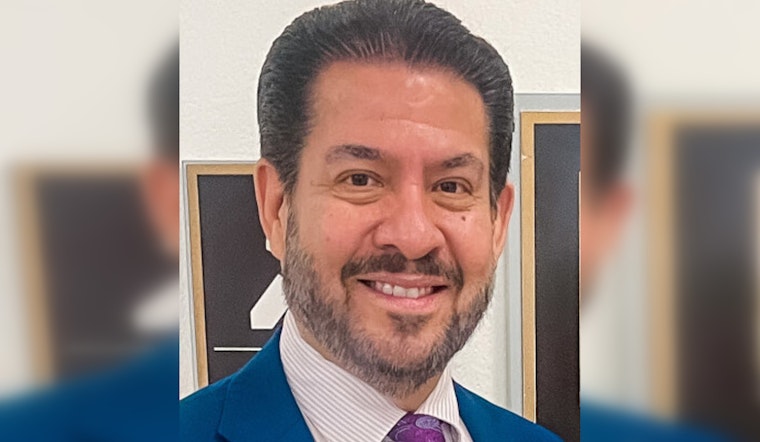
Harris County's long-delayed, $1.45 billion bridge over the Houston Ship Channel finally has an opening timeline, and the first vehicles could be crossing it by spring 2027. Precinct 2 Commissioner Adrian Garcia shared the phased schedule during his annual State of the Precinct address, saying the massive span will have a significant impact on Harris County, Texas and the national economy.
The crossing, now officially named the Dr. Richard A. Tapia Bridge, will carry the Sam Houston Tollway over the Houston Ship Channel between Highway 225 and Interstate 10, according to Chron. Garcia said the south portion of the bridge, which will carry traffic in both directions, is expected to open in spring 2027. The north portion is projected to be finished by the end of 2030, per Garcia.
Once complete, the bridge will feature four 12-foot travel lanes in each direction along with 10-foot inside and outside safety shoulders, a major upgrade over the current span. Garcia said the first half of the project will retain the existing number of lanes while adding a breakdown shoulder, something the current 1982-era bridge lacks entirely.
Why the Project Ballooned to $1.45 Billion
The bridge's price tag and timeline trace back to a dramatic mid-construction pivot. Harris County Commissioners Court voted unanimously in August 2020 to terminate original design firm FIGG Bridge Engineers after an independent engineering review uncovered 21 significant design flaws in the cable-stayed bridge plans, according to a report at the time from Click2Houston. That review came amid heightened scrutiny of FIGG following the 2018 collapse of a FIGG-designed pedestrian bridge in Florida, which prompted the Federal Highway Administration to suspend the firm from federally funded projects and propose a 10-year debarment, per Global Highways.
Harris County Commissioners approved a $24.9 million contract in October 2020 hiring COWI North America, which had initially served as an independent reviewer, to take over as engineer of record and redesign the main cable-stayed span, Construction Dive reported. The fallout from the flawed original design proved costly: in December 2021, commissioners authorized a $291 million contract amendment to tear down and rebuild previously constructed bridge pylons after structural weakness concerns, according to Harris County records. That single amendment stands as the primary driver behind the project's climb from an original $962 million contract to its current $1.45 billion total, with commissioners approving an additional $390.3 million for the project that year.
New Design Clears the Way for Bigger Ships
Beyond commuter traffic, the redesign carries major implications for the Houston Ship Channel itself. Garcia said the new bridge design removes ship risk from pillars in the water, since the Dr. Richard A. Tapia Bridge's support columns sit outside the waterway entirely, unlike the current structure's main piers, which have been an obstacle to channel widening and deepening plans. The columns are also spaced wider to accommodate the larger vessels now calling on Port Houston, which is expanding to serve bigger ships.
That redesign dovetails with Port Houston's separate $1 billion Project 11 expansion, which completed its primary navigation dredging in October 2025, widening the Galveston Bay reach of the Houston Ship Channel from 530 feet to 700 feet, according to Business Wire. Removing the old bridge's in-water piers was considered essential to that widening effort, since it lets larger container ships pass through the channel more safely. The redesigned bridge's concrete main support towers will reach a final height of 514 feet above the ship channel, Hoodline previously reported on lane reopenings tied to the project.
Replacing an Aging, Overcrowded Crossing
The bridge it replaces, originally named the Jesse H. Jones Memorial Bridge, opened on May 6, 1982, with a 175-foot vertical clearance and just four lanes and no breakdown shoulders, and was acquired by the Harris County Toll Road Authority in May 1994, according to AARoads. That aging span currently carries about 55,000 vehicles each day, but per Harris County Toll Road Authority officials, traffic on the new bridge could eventually grow to as many as 160,000 vehicles daily. Main construction on the replacement began in March 2018, with Ship Channel Constructors — a joint venture between Traylor Bros., Inc. and Zachry Construction Corp — serving as the primary contractor throughout.
Honoring a Rice University Legend
The bridge's new name honors Dr. Richard Tapia, a longtime Rice University mathematician, educator and STEM advocate who spent more than five decades at the university. Harris County Commissioners Court voted unanimously in March 2026 to rename the bridge after him, with Garcia calling Tapia a titan of engineering, math and science. Tapia was recognized for his work in computational and applied mathematics and for expanding opportunities for underrepresented STEM students, and he was the first Hispanic person elected to the National Academy of Engineering.
In 2011, President Barack Obama awarded Tapia the National Medal of Science, the nation's highest scientific honor, according to Click2Houston. Tapia once said he tried to be the best mathematician he could be without forgetting his identity, reflecting the pride his parents held in being both Mexican and American. Tapia died in May at age 88, shortly after commissioners approved the tribute — a story Hoodline covered in Rice math trailblazer's death at 88.





_(cropped).jpg)