

























































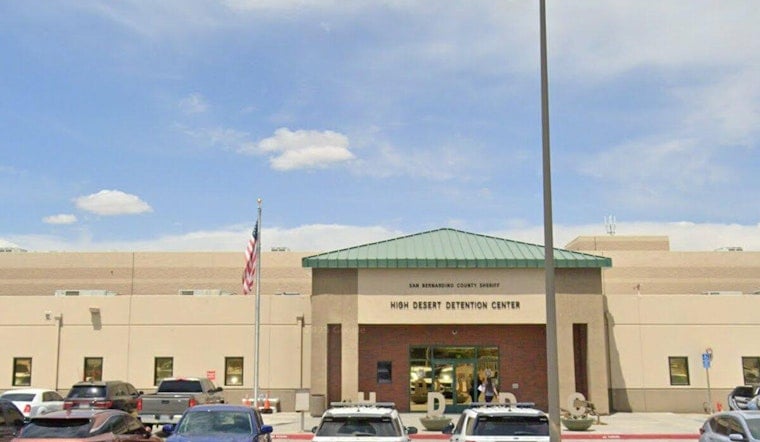
A 24-year-old Hesperia man is facing a felony escape charge after he allegedly cut off his court-ordered GPS ankle monitor and left it on the ground outside his girlfriend's residence, evading capture for more than three weeks before deputies caught up with him during a traffic stop. Gabriel Joshua Alferez was booked at High Desert Detention Center on Sept. 1 on a no-bail arrest warrant charging him with escape from electronic confinement.
According to the San Bernardino County Sheriff
, Alferez had been enrolled in the Sheriff's Department's Electronic Confinement Program on July 24, part of a 75-day sentence stemming from a June 18 conviction for trespassing a residence with intent to execute a threat of great bodily injury, along with battery. As a condition of the program, he was given instructions on curfew rules and how to charge and maintain his GPS device.
That arrangement fell apart on Aug. 7, when the Satellite Tracking of People monitoring call center notified Work Release deputies of a master tamper alert on Alferez's device. Investigators determined he had cut off the ankle monitor and left it on the ground in front of his girlfriend's residence, according to the sheriff's account. The gap between that alert and his eventual arrest stretched more than three weeks.
Traffic Stop Ends the Search
Deputies with the Work Release, Community Service, and Reentry Division served Alferez's warrant on Sept. 1 after locating his girlfriend's vehicle near Main Street and Key Pointe Avenue in Hesperia. A traffic stop at that location, near 12750 Main Street, led to Alferez being taken into custody without incident, the sheriff's office said. The sheriff's account did not identify a deputy or case number.
Under California Penal Code Section 4532(b)(1), escaping or attempting to escape from electronic confinement while booked on or convicted of a crime is classified as a felony escape from custody, according to Shouse Law Group. The charge carries a potential sentence of up to three years in state prison or up to one year in county jail, served consecutively to the underlying sentence. Separately, Penal Code Section 1203.016 addresses home detention using electronic monitoring, per Eisner Gorin LLP — meaning that under state law, home confinement is legally treated as official custody, and disabling the monitor amounts to an escape.
How the Electronic Confinement Program Works
San Bernardino County's Electronic Confinement Program is administered through Glen Helen Rehabilitation Center and requires participants to wear a GPS ankle transmitter at all times, according to the San Bernardino County Sheriff's Department. Participants are charged a fee of $15 per day, though inability to pay does not disqualify inmates from the program. Inmates sentenced to work release may participate in the program, which the department says allows them to re-establish family ties and return to previous employers while also providing manual labor to improve or maintain public facilities. The Board of Supervisors authorizes the sheriff to run the broader work release program, and the department says its Work Release division works to ensure participants comply with state laws and community safety requirements.
Glen Helen Rehabilitation Center in Devore, which oversees both the Work Release and Electronic Confinement programs, sits on 9 acres and originally opened as a work camp in 1960; it now has a maximum capacity of 1,446 male and female inmates, per the department's own figures. High Desert Detention Center in Adelanto, where Alferez is now held, opened in January 2006 as the county's first Type II facility in the High Desert region and holds a capacity of over 2,100 pre-trial and sentenced inmates, according to VVNG. The facility is staffed by more than 200 security, medical, and general support personnel, the sheriff's department notes.
Part of a Pattern in the High Desert
Alferez's case is not an isolated one. In July 2025, San Bernardino County deputies arrested a convicted arsonist in Helendale after he removed a GPS monitor, VVNG reported. And in September 2025, a Work Release participant who cut off his ankle monitor in La Puente opened fire on responding deputies before being taken into custody following a SWAT standoff, according to the Sierra Sun Times — a stark illustration of how volatile warrant enforcement in these cases can become.
The program has also faced other compliance troubles. In May 2025, four Work Release inmates were arrested in Hesperia in connection with drugs and firearms, per the same outlet's reporting. Taken together, the cases point to ongoing strain on a program the county has leaned on as a cost-saving alternative to jail incarceration for lower-risk offenders.
Cutting off court-ordered monitors has also drawn attention well beyond San Bernardino County this year. A similar ankle-monitor incident was reported in Chambersburg this year, part of what appears to be a broader challenge nationally in pretrial and post-conviction electronic supervision. San Bernardino County Sheriff's Department administers the local program. The account does not provide a contact number for information related to the Work Release case.





