

























































A cardiac-arrest rescue in Highlands Ranch is drawing attention to a basic but consequential question: what happens when a bystander starts CPR before professional help arrives? Brent Buford, 68, was receiving chemotherapy for stage 4 lung cancer when he noticed a black jacket and a man lying face down near overgrown bushes across from an elementary school, Axios reported.
Buford called 911 and began chest compressions on 36-year-old Alex Flordelis. Firefighters and paramedics found a pulse after Buford had started CPR, according to Axios. Flordelis was later diagnosed with an hereditary heart condition that had not previously been identified; his doctor told Axios that the rapid response helped prevent permanent brain damage.
The Douglas County Sheriff's Office and South Metro Fire Rescue recognized Buford at a ceremony earlier this week in Douglas County, where Flordelis also attended and thanked him, Axios reported. Buford works as a civilian statutory programs specialist for the Sheriff's Office. The available reporting does not establish whether an automated external defibrillator was used; the documented intervention was the 911 call and bystander CPR.
Why the first minutes matter
Out-of-hospital cardiac arrest is difficult to survive even when emergency systems respond. The Cardiac Arrest Registry to Enhance Survival, or CARES, reports a median survival-to-hospital-discharge rate of 10.4% and says that figure has remained virtually unchanged for 30 years. CARES's network covered approximately 186 million people, or 56% of the U.S. population, as of January 2025: CARES data provide broad national context, not a specific outcome estimate for Flordelis.
A much older local study illustrates how sharply outcomes can narrow. In Denver County, researchers reviewing arrests from 2003 and 2004 found that 25% of resuscitated patients received bystander CPR; 8% survived to hospital discharge and 6% had a good neurologic outcome, according to the study available through PubMed Central. Because the study predates current emergency-care practices and covers only Denver, it should be treated as historical context rather than a current Douglas County benchmark.
Training and AED access are the practical link
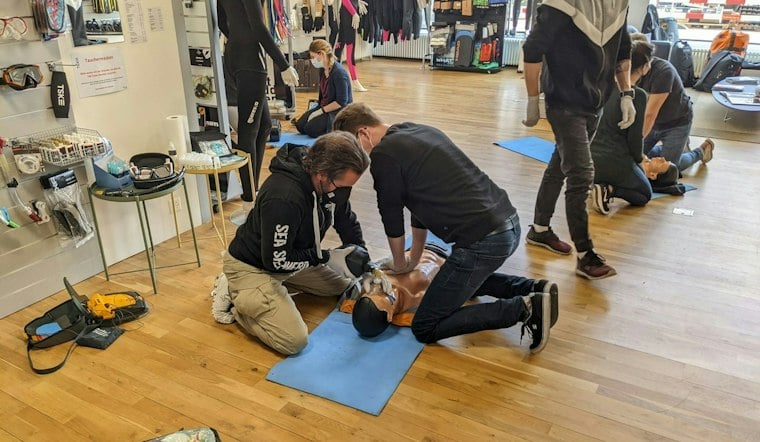
The rescue also points to the value of preparation outside the ambulance system. The American Red Cross says its in-person and blended Colorado CPR/AED courses include a two-year OSHA- and workplace-compliant certification. A Douglas County guide describes a blended Adult and Pediatric First Aid/CPR/AED course covering breathing and cardiac emergencies and meeting workplace requirements: Red Cross course information and the county guide.
An AED can add another tool when a device is available and the cardiac rhythm is one that can be shocked. A National Academies report hosted by the National Library of Medicine says timely bystander AED use is particularly beneficial in those cases, while emphasizing that no AED use has been reported in Buford's rescue: National Academies report.
Douglas County School District says it accepts qualifying AED donations and asks for one month's notice so staff can be trained before a unit arrives. That policy underscores a broader limitation of AED programs: placing equipment is only part of preparedness; people also need to know where it is and how to respond. The district's information is available here.
One documented comparison, with limits
Civilian rescues followed by public recognition are not unique to Highlands Ranch. On Feb. 2, 2023, three patrons of a club in Claremont, California, received lifesaving awards after administering CPR and using an AED on another member who suffered cardiac arrest, according to the Los Angeles County Fire Department. The cases differ in location, equipment and circumstances, and one comparison cannot show that such rescues are becoming more frequent.
What the Highlands Ranch case does show is narrower and more concrete: an otherwise ordinary passerby recognized a medical emergency, summoned professional help and started CPR before responders arrived. Buford's cancer diagnosis and Flordelis's eventual hereditary-heart-condition diagnosis make the account unusual, but the response itself is a repeatable part of cardiac-emergency preparedness—call 911, begin CPR when someone is unresponsive and not breathing normally, and use an AED if one is available and directed by emergency dispatchers.





