

























































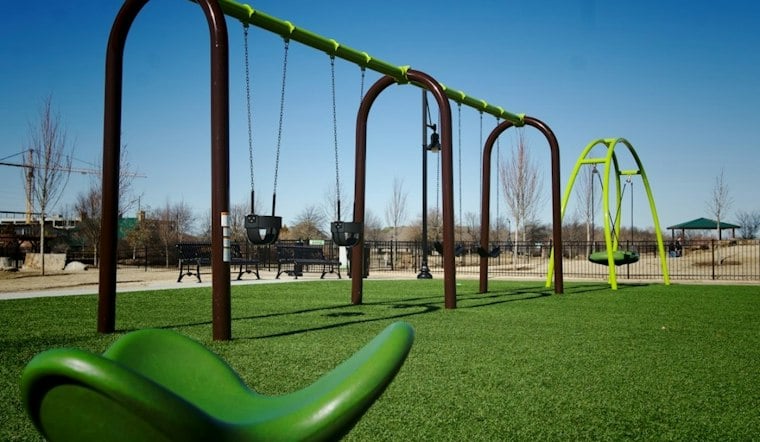
Kids who cannot speak, or who are still finding their words, now have a new way to join the fun at Ann Van Middlesworth Park in Hillsborough. Township officials and members of the local Rotary Club unveiled an augmentative and alternative communication board at the park's inclusive playground, giving nonverbal and speech-emerging children a tool to express themselves without saying a single word out loud.
The board uses pictures, symbols and words, and it is built for children with complex communication needs, according to NJ.com. Rather than forming sentences aloud, a child can point to what they want to say, whether that's asking for a turn on the swings, naming an emotion, or telling a friend they want to play. The Rotary Club of Hillsborough funded the project, and as reported by Patch, the money came from proceeds raised at the club's annual Rotary Fair.
A Tool Years in the Making
Ann Van Middlesworth Park has held a special distinction in Somerset County since 2010, when it opened as the county's first inclusive playground. Township Administrator Anthony Ferrera said the new board builds on that legacy. “This new communication board ensures that non-verbal and speech-emerging children have a voice on the playground,” he said, according to the same Patch report, adding that it helps make the park a place where all children can thrive.
Mayor Catherine Payne credited the fundraising that made the addition possible, saying it was the annual Rotary Fair that raised the funds for the communication board, and calling the park a leader in inclusive recreation. The park's other improvements over the years have similarly relied on volunteer work and fundraisers rather than tax dollars, the report notes, with the Rotary Club also funding interactive sensory boards in the park just last year.
What the Board Actually Does
The board is not just for children without spoken language. AAC boards can also be used by children who do not yet speak English, and per the same Patch report, they can help kids with limited or emerging speech interact with their peers more easily. Barbra Seltzer, a New Jersey speech-language pathologist and chair of the AAC committee for the New Jersey Speech Language and Hearing Association, said inclusive communities require inclusive environments, according to NJ.com's reporting on the unveiling.
Beyond helping individual children communicate, boards like this one are also credited with building tolerance among kids of differing abilities, per that same report, and AAC board installations have grown increasingly popular over the last five years. That trend is backed up nationally: the nonprofit resource AT3 Center has tracked symbol-based communication boards being installed in multiple states, noting that outdoor boards support equity and make it easier for people of all abilities to interact.
Part of a Broader Playground Push
Hillsborough's new board is one entry in a wider pattern of communities adding these tools to public play spaces. AT3 Center has reported that news outlets documented playground AAC signage in Michigan, Minnesota, Maryland, New Jersey and Massachusetts as far back as 2021, and a Michigan nonprofit called Communication is Key installed a large all-weather AAC board at a playground in 2019. In Philadelphia, the TechOWL program built a free downloadable communication board and worked with the city's parks and recreation department to distribute 500 copies around town in a single summer.
The reasoning behind putting these boards outdoors, rather than relying solely on personal AAC devices, has to do with practicality as much as access. AT3 Center notes that children who use AAC devices sometimes avoid bringing them outside altogether, since the devices can be broken or lost, leaving a child without any way to communicate at all. A fixed board on a playground removes that risk entirely, giving kids a communication tool that cannot be dropped in the sandbox or left behind on the swings.



