

























































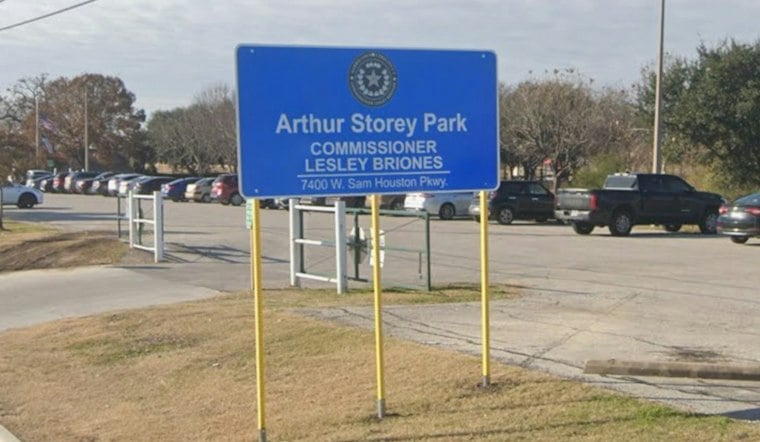
A two-mile bikeway meant to link Arthur Storey Park to Dairy Ashford Road in southwest Houston is finally creeping toward construction, but the city says it may have to seize private backyard land along a drainage ditch to finish the job. Houston officials tell reporters the $3.2 million trail project is one step closer to the construction phase, and eminent domain is now on the table for holdout property owners who won't sell.
The trail has been years in the making, and according to Click2Houston, the city applied for $2.4 million in funding back in 2023 as part of a yearslong push to get the project built. The proposed 10-foot-wide, concrete-finished path would connect an existing trail at Arthur Storey Park to Dairy Ashford Road, running along a drainage ditch that one nearby resident, Wilfredo Martinez, says stretches about three miles. Martinez owns a home with a backyard directly along the proposed route, and construction on the project isn't slated to begin until fall 2028, per the outlet's report.
City planning documents describe a much more specific alignment than a simple ditch-side path. Plans reviewed by the City of Houston call for the trail to stretch approximately 11,750 linear feet, or 2.23 miles, along existing Harris County Flood Control District drainage channels, forming an off-street shared-use path connecting Arthur Storey Park near Beltway 8 to Dairy Ashford Road close to Chambers Elementary School and Hackberry Park. The route was designed specifically to keep cyclists and pedestrians off the street by relying on flood-control easements rather than new road right-of-way.
A Project Years in the Making, Finally Reaching Design
Houston City Council took a concrete step toward the project in March 2025, adopting Ordinance 2025-0239 to appropriate $326,477.81 from the Parks Consolidated Construction Fund and approving an engineering services contract with AGHA Engineering, LLC, for the bikeway's design work between Dairy Ashford Road and Arthur Storey Park. That engineering contract represents a key milestone that has to happen before the city can move into right-of-way acquisition and, eventually, construction.
The project's full price tag runs well beyond that design contract. Regional planning documents from the Houston-Galveston Area Council put the total project budget at $3,230,127, broken down into $2,564,000 for construction, $256,400 for contingencies, $153,840 for construction engineering, $130,251 in indirect costs, and $125,636 for preliminary engineering. Municipal records show the non-federal local match includes $201,569 from the International Management District along with $200,000 from the city's Parks and Recreation Department capital improvement plan, reflecting a funding partnership between the city and the local management district that dates back roughly a decade.
What Eminent Domain Would Actually Require
Martinez told Click2Houston he needs the trail and expects it to look nice once finished, and he said he hopes the city will call residents directly to negotiate rather than escalate straight to legal action. He also said he hopes the project won't drive up his property taxes. If the city does need part of his land, Martinez said he's open to negotiating.
Any move toward eminent domain would have to follow a strict legal process. Under Chapter 21 of the Texas Property Code, specifically Section 21.0113, a government entity must make a written bona fide offer backed by a certified appraisal and then wait at least 30 days after a final written offer before it can even file a condemnation lawsuit, according to the Texas State Legislature's statutory code. The city cannot simply take a backyard; state law requires that formal offer process, delivery of a legal disclosure, certified appraisals, and potential hearings before a judge steps in.
If negotiations between the city and a landowner fail, Texas Property Code Chapter 21 requires a judge to appoint a three-member panel of disinterested county landowners as special commissioners, who hold a hearing and determine fair monetary compensation for the property. Property owners facing this process are also entitled to protections under the Texas Landowner's Bill of Rights, issued by the Office of the Attorney General of Texas, which guarantees owners the right to receive independent appraisal reports, obtain fair market value compensation for both the land taken and any damage to remaining property, and appeal a special commissioners' award to a trial court.
Part of a Much Larger Bayou Trail Network
The Dairy Ashford trail segment isn't an isolated project. According to the Houston Parks Board, it connects to the broader Brays Bayou Greenway, a 30-mile continuous off-street trail network linking Arthur Storey Park, Mike Driscoll Park, Archbishop Fiorenza Park, and Hermann Park near the Texas Medical Center. That greenway effort is part of a larger, roughly $220 million public-private push to link parks along the city's major bayous.
Regional money has flowed toward similar trail efforts in recent years. The Houston Chronicle reported in May 2022 that Harris County Commissioners Court approved a plan letting the Harris County Toll Road Authority commit $53 million in surplus toll revenue toward connecting and upgrading regional hiking and biking trails near Arthur Storey Park and the Westchase area, marking the first time toll surplus funds had been steered into off-road trail expansion.
The area the trail runs through carries its own local history. The surrounding Alief community in Council District F was originally surveyed in 1894 under the name Dairy, Texas, before being renamed a year later to honor its first postmistress, Alief Ozelda Magee, according to the Texas Historical Commission. That agricultural-era naming is why Dairy Ashford Road, which once served as a rural connector through farmland, still carries the Dairy name through what is now dense southwest Houston.
For now, the trail remains in the design and funding phase, with construction not expected to start until fall 2028. Whether Martinez and other property owners along the route end up negotiating a sale or facing a formal condemnation case will depend on how those bona fide offer talks unfold in the months ahead.




