

























































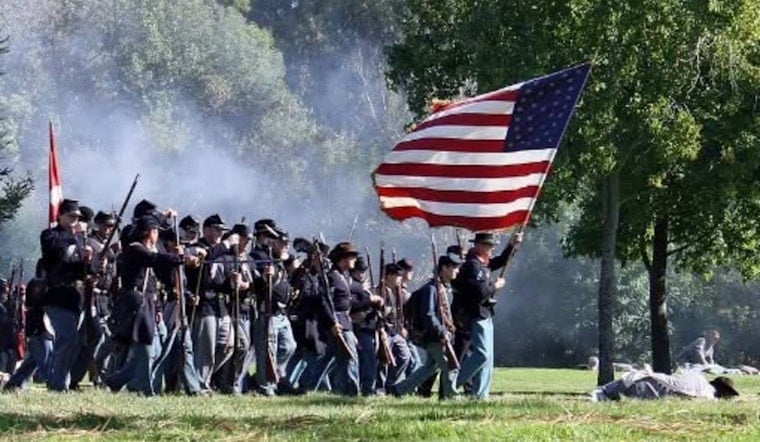
Cannon fire will echo across Huntington Beach Central Park this weekend as the Huntington Beach Historical Society stages the 33rd annual Civil War Days, billed as Southern California's largest living history event. The free two-day gathering runs Saturday from 10 a.m. to 5:30 p.m. and Sunday from 9 a.m. to 2:30 p.m., with dramatic battle reenactments, authentic military and civilian camps, weapons demonstrations, and the civilian tent town of Reedsburg set up behind the Central Library on Gothard Street, between Slater and Talbert avenues.
The event's roots run deeper than a single festival weekend. According to the City of Huntington Beach, this year's staging includes meetings with historical figures, including President Lincoln and General Grant, plus scheduled cannon fire throughout both days. Saturday's battle reenactments take place at 1:30 p.m. and 4 p.m., while Sunday's are set for 11 a.m. and 2 p.m., and the Huntington Beach Historical Society is directing the public to hbhistory.org/civilwar for full details.
Civil War Days actually began in 1993 behind the Newland House Museum in Bartlett Park, when founders Maureen Rivers and Carl Clink launched the event with a single cannon and roughly 30 reenactors, according to 69th NYSV Company C. Over three decades, it has grown into a gathering that draws hundreds of volunteer living historians and thousands of spectators from across the country each Labor Day weekend, as the Los Angeles Times has reported.
A Tradition That Predates the Modern Festival by Nearly a Century
Long before the modern reenactment existed, Huntington Beach had its own documented ties to Civil War veterans. The city's connection stretches back to July 1884, when the Santa Ana-based Gen. John Sedgwick Post of the Grand Army of the Republic held an encampment at Shell Beach — the seaside community that would later be renamed Huntington Beach, per the Orange County History Roundup.
That early gathering set the stage for something more permanent. In 1905, Union Army veterans belonging to the Grand Army of the Republic chose Huntington Beach's so-called “Tent City” as their long-term annual regional encampment site, according to the City of Huntington Beach, meeting there to reminisce and educate the public about the war. Modern Civil War Days effectively revives that 120-year-old local tradition of veteran gatherings.
The Historical Society Behind the Encampment
The Huntington Beach Historical Society, which presents the event, was itself born out of a preservation fight. Local residents formed the organization in 1974 to restore the 1898 Queen Anne Victorian Newland House — the oldest surviving home in Huntington Beach and now a National Register of Historic Places listing, according to the Los Angeles Times.
That same year, the city dedicated Huntington Beach Central Park, which spans more than 350 acres and stands as the largest city-owned park in Orange County, per the City of Huntington Beach. The park's scale is what makes room for sprawling encampments, mock battles and civilian tent towns like Reedsburg. Beyond Civil War Days, the Historical Society also produces The Revolution each spring in the same park, recognized as Southern California's largest American Revolution living history event, with its 2026 staging held in March.
California's Overlooked Role in the War
Civil War Days also pushes back on the notion that California sat out the conflict entirely. California gold financed an estimated 25% of the Union war effort, according to C-SPAN, with shipments heavily guarded against Confederate sympathizers even as the fighting raged thousands of miles away.
The state's military infrastructure backed that financial role. In nearby Wilmington, the Drum Barracks served as the Union Army's headquarters for Southern California, Arizona and New Mexico from 1861 to 1871, and it remains the region's last original Civil War military facility, according to Wikipedia. The site now operates as a historical museum, offering a companion stop for anyone drawn deeper into the region's Civil War history after visiting the encampment.





