

























































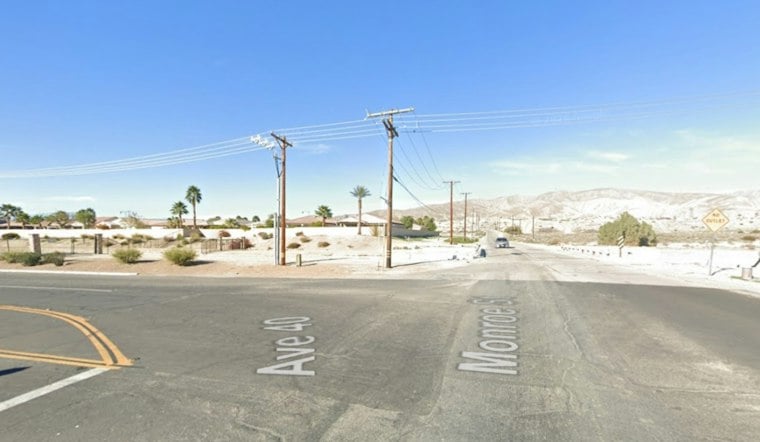
Seven years after Indio approved a gated subdivision called Affresco West near Monroe Street and Avenue 40, not a single home has been built on the site. The project calls for 146 homes, and its tentative tract map has been extended multiple times.
A CEQA filing concerning Tentative Tract Map No. 37447 was published September 24, 2026, according to CEQAnet. A 2023 proposal sought to extend the map through November 15, 2024. The site covers Assessor Parcel Numbers 691-150-008 and 692-010-012, undeveloped land located north of Avenue 40 and east of Monroe Street in Indio, per the same filing. As NBC Palm Springs reports, Affresco West still has no specific construction start timeline, and the developer has said the market will determine when construction begins.
A Two-Decade Paper Trail
The Indio City Council originally approved Tentative Tract Map No. 37447 and adopted a CEQA Mitigated Negative Declaration for Affresco West on May 15, 2019.
The Affresco project appears among Indio’s plans. Affresco West still needs approvals involving utilities, including a pedestrian bridge crossing the All-American Canal, before homes can be built, per the NBC Palm Springs report.
Officials Question Endless Extensions
The delays have drawn pointed questions from local officials. Paul Scott acknowledged that the COVID-19 pandemic created a delay for the project, but said, per NBC Palm Springs, that the project has gone on too long, and he questioned whether another developer might move it forward instead.
Tammy Bleck also questioned the extensions for Affresco West, telling NBC Palm Springs, “I'm thinking you should have a timeline before the market can guide it.” The discussion, the station reports, centered on whether housing approvals should carry clearer deadlines and whether additional criteria should be required to keep an approval active in the first place.
Approved Doesn't Mean Built
Under California's Subdivision Map Act, tentative tract maps are initially valid for two to three years, but local planning bodies have discretion to approve a series of one-year extensions up to statutory maximums before a developer must record a final map, according to CaliChi Design Group. That framework lets developers hold vested rights for years without breaking ground, and it is exactly the mechanism keeping Affresco West alive on paper while the lot itself stays empty.
The tension matters because cities often point to approved housing when discussing future supply, even though an approval does not necessarily mean construction is underway or homes will soon be available, per NBC Palm Springs. Communities dealing with housing shortages have raised the question of whether approved homes should be counted separately from homes actually built — a distinction that cuts to the heart of the Affresco West saga.
Indio's Housing Math
The stalled subdivision sits against the backdrop of a hefty state mandate. Under California's 6th Cycle Regional Housing Needs Allocation for 2021 through 2029, Indio is required to plan for 7,812 total new housing units, including 2,963 homes designated for low- and very-low-income households, according to the California Department of Housing and Community Development.
Indio has separately earned recognition for its housing policy work, becoming the first Coachella Valley city to receive California's official Prohousing Designation on September 2, 2025. Governor Gavin Newsom announced on August 20, 2026, that Indio was one of 13 jurisdictions statewide chosen to share $11.3 million from the state's Prohousing Incentive Program. Regionally, the Lift to Rise coalition has set a goal of building 10,000 affordable housing units across the Coachella Valley by 2028, with more than 9,000 units already in planning or under construction as of mid-2025 — a pace of subsidized multi-family development while Affresco West waits on its first foundation seven years after approval.





