

























































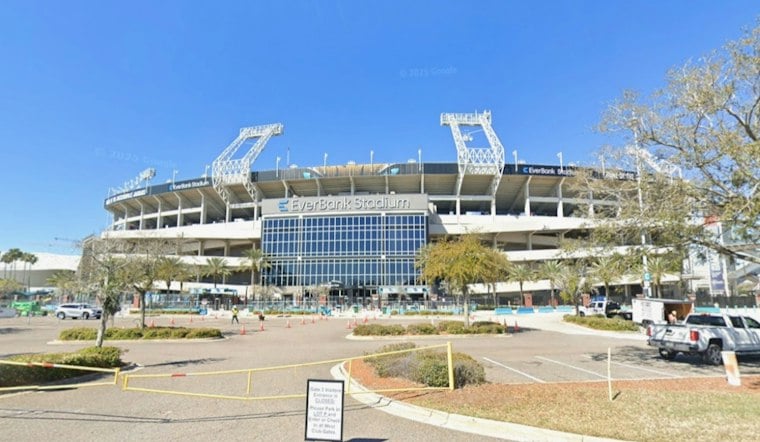
Fans heading into EverBank Stadium this season are being watched over by more than security cameras and metal detectors. The Jacksonville Jaguars have become the first NFL franchise to publicly announce an agreement with a drone defense company, arming the stadium with technology built to detect, track and locate unauthorized drones and the people flying them.
The system comes from Sentrycs, a subsidiary of Ondas, which announced it was selected to provide counter-drone protection for Jaguars games at EverBank Stadium during the 2026 season, according to Ondas. The selection process involved local law enforcement, the Jaguars organization and stadium operator Legends Global, as reported by DroneLife. Per CNBC's Jason Gewirtz, the Jaguars plan to activate the system before their game against the New England Patriots, with Sentrycs controlling the skies in and around EverBank Stadium on Jaguars game days.
How the Cyber-over-RF System Works
Sentrycs describes its Cyber-over-RF technology as combining passive detection, tracking, identification, pilot geolocation and controlled mitigation in a single portable system, the company says. It says the system can identify an unauthorized drone and locate its pilot within seconds, using radio signals rather than radio-frequency jamming or kinetic measures, according to Gewirtz's CNBC report. Broader reporting on drone defense describes systems that can mitigate threats by intercepting the communication link between an operator and a drone, taking control of it, and safely landing the aircraft — with industry executives considering that communication-disruption approach the easiest and safest takedown method, though it can also cut off legitimate radio frequencies in the area, per CNBC.
Not every counter-drone company relies on radio interception. Israel Weapon Industries develops and sells technology called Arbel that fits on most automatic rifles, including the AR-15, helping shooters follow, target and take out drones with bullets, CNBC reports. The company provides drone defense at 20 European airports and 10 U.S. sites, according to the same report.
Law Enforcement Trained for the Job
Authorized law enforcement officials who operate the portable system are expected to have undergone training at the newly established National Counter-Unmanned Aircraft Systems Training Center in Huntsville, Alabama, per Ondas. CNBC reports that drone defense operators generally must complete special certification classes through a federal program, and that law enforcement response can take as little as two minutes from detection to reaching the operator's location, according to Eric Brock, who told the outlet the sheer number of drones in the air at once was surprising.
Jaguars events and security director Bobby Lyle said the team needed to move beyond detection and add mitigation capability to its security strategy, per CNBC. The statement carried by Tectonic Defense also attributed to Lyle the view that stadiums needed to move beyond simple detection.
Why the NFL Is Racing to Catch Up
The stakes for the league have been rising. CNBC reports the NFL recorded 10,852 drone violations near stadiums between 2021 and 2025, and that the league now has the capacity to identify and track drones near all 30 of its stadiums. A 2025 playoff game between the Baltimore Ravens and Pittsburgh Steelers was paused because of an overhead drone, following a similar incident at the Baltimore stadium in 2023, according to the CNBC report. Jason Moore told CNBC that drone concerns have increased rapidly. In response, the NFL and Major League Baseball sent a letter to the Department of Homeland Security seeking more resources for drone protection during competition, warning that unauthorized drone activity presents an ongoing and growing challenge, per CNBC.
Sentrycs was contracted to help stop drone disruptions during the 2026 FIFA World Cup, which took place across 104 matches in the United States, Canada and Mexico, according to CNBC's reporting. The FBI reported roughly 700 drone interceptions during the four-week tournament, per the same report, while a separate account relayed by Tectonic Defense described the FBI seizing more than 700 illegal drones and detecting another 1,600 around the tournament's 11 stadiums — the two figures reflect different tallies from different accounts. State and local authorities received about $250 million in federal drone-defense funding ahead of the World Cup, CNBC reports.
New Law Reshapes the Rules
Much of this buildup traces back to the SAFER SKIES Act, which CNBC reports went into effect on July 1, 2026, after Congress passed it in December and Donald Trump signed it into law. The act gives state and local authorities permission to bring down drones encroaching on airports and major venues, according to CNBC. Congressional text identifies the measure, formally S.3481, as addressing drone countermeasures meant to protect public safety and critical infrastructure, according to Congress.gov. A Federal Register notice addresses counter-UAS authority for state, local, tribal and territorial law enforcement and correctional facilities, per the Federal Register.
The threat isn't confined to stadiums. CNBC reports a United Airlines pilot narrowly missed a drone near Newark Liberty International Airport, with no reported injuries, while a JetBlue pilot reported hitting a drone near John F. Kennedy International Airport while landing, also without reported injuries. About a dozen large European airports were forced to temporarily suspend flights over the past year because of drone incursions, according to CNBC, and Dutch company Robin Radar operates equipment at two dozen European airports as part of that response.
Sentrycs's move into NFL stadiums comes as its parent company expands rapidly elsewhere. Ondas reported $83.8 million in second-quarter 2026 revenue and roughly $175 million in new orders during the quarter, according to the company's investor filing, and said it expects volume deliveries to ramp further in the second half of the year, particularly across its counter-drone business. The company also landed a $6.9 million order from the Australian Department of Defence for counter-UAS deployments, per DroneLife's report.





