

























































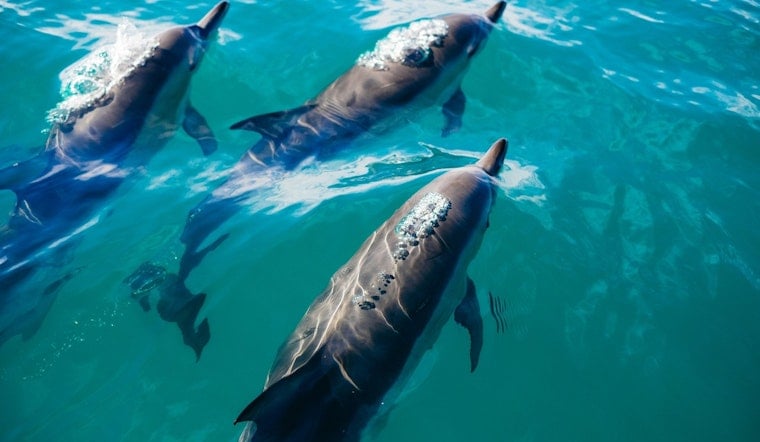
A dolphin nearly slammed into a couple's jet ski near Waties Island last week as a pod of roughly 50 of the animals surrounded them, leaping and diving so close that one launched into the air just feet away. Kimberly Malibu-Grove said her husband had to steer the jet ski out of the way at the last second to avoid a collision with the animal.
The encounter happened on August 26 near Waties Island, a barrier island that sits at the northern tip of the Grand Strand along the South Carolina-North Carolina border, according to Atlanta News First. Malibu-Grove said she and her husband have a strong love for dolphins, and she described watching dozens of them leap from the water around their watercraft as amazing. She estimated the pod at around 50 dolphins, and called the whole experience a once-in-a-lifetime encounter.
At one point, the near-miss got dicey. Malibu-Grove said a dolphin would have struck the jet ski had her husband not moved it out of the way in time, according to the same report.
Why So Many Dolphins Gather Near Waties Island
The sheer size of the pod isn't entirely surprising given the location. Waties Island is one of South Carolina's last undeveloped barrier islands, and its surrounding waters remain something of a sanctuary that draws large dolphin pods, according to NOAA Fisheries. Just weeks before the encounter, South Carolina secured a $4 million federal NOAA grant to acquire 107 acres on and around the island for permanent conservation as a new state park and heritage preserve.
Part of the island is already protected as the Anne Tilghman Boyce Coastal Reserve, managed by Coastal Carolina University for environmental monitoring and research, according to Visit Myrtle Beach. That reserve was created after the land was gifted to the university specifically to prevent private resort development from taking hold there. The South Carolina Department of Natural Resources estimates several hundred bottlenose dolphins live year-round in nearshore state waters, with adults growing up to 12 feet long and weighing between 400 and 600 pounds.
What Explains the Leaping
The airborne acrobatics Malibu-Grove described have a scientific explanation. Marine biologists say wild bottlenose dolphins leap out of the water to communicate across distance, dislodge parasites, conserve energy while swimming, and herd fish during feeding, according to LOCAL Life SC. High leaps in particular create distinct acoustic and visual signals that can travel across coastal waterways, helping explain why a pod might put on such a dramatic show near a passing jet ski.
Dolphins along the South Carolina and Georgia coast are also known for a rare cooperative hunting technique called strand feeding, in which pods charge mudbanks to force schooling fish onto the shoreline, according to Charleston Living Magazine. The behavior is observed in only a few regions worldwide and depends on synchronized rushes toward land, which can bring large pods into extremely shallow coastal and inlet waters.
The Legal Line Between Awe and Harassment
Close encounters like the one near Waties Island sit right at the edge of federal wildlife law. NOAA Fisheries guidelines require all watercraft, including jet skis and motorized boats, to stay at least 50 yards, or 150 feet, away from wild dolphins. Under the Marine Mammal Protection Act, approaching the animals too closely or causing them to change behavior can be considered unlawful harassment, with violations carrying civil and criminal penalties of up to $100,000 in fines and up to a year in prison.
South Carolina has its own rules layered on top of the federal standard. State Department of Natural Resources regulations bar motorized watercraft from exceeding idle speed within 50 feet of a person in the water or within 100 yards of the Atlantic coastline, with violations classified as misdemeanors carrying fines between $100 and $600. The agency also notes that boat collisions and crab trap entanglements rank among the leading causes of death for bottlenose dolphins in South Carolina waters, and asks boaters who strike a marine mammal to report it immediately over VHF Channel 16.
South Carolina also requires any boater born after July 1, 2007 to complete a state-approved boater safety course before operating a jet ski or any motorized vessel of 10 horsepower or more, according to Boat Ed. Those courses cover navigation rules, speed limits, and safe distance guidelines meant to prevent exactly the kind of close call Malibu-Grove described near Waties Island.





