

























































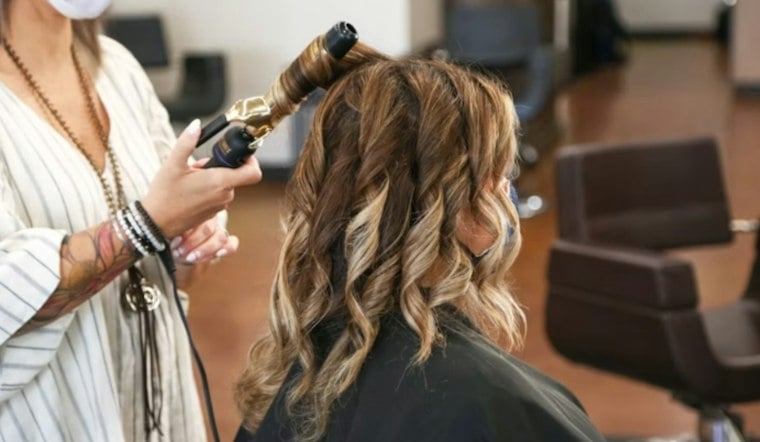
Khalilah Few can finally open the doors of her Jonesboro hair salon after more than a year of fighting Clayton County in court. The Clayton County Board of Commissioners unanimously approved a conditional use permit for Few to open Creative Crowns Collective, ending a saturation dispute that cost her tens of thousands of dollars and forced her to sue the county over her constitutional rights.
Few, who owns the natural hair salon business, sued Clayton County after commissioners rejected her permit request on July 15, 2025, according to Axios. County officials had rejected her permit based on an assessment that the area was already saturated with similar businesses. She had submitted the required conditional use permit application back in April 2025, and later signed a lease for space at 9526 S. Main St. in unincorporated Jonesboro.
The lawsuit, Khalilah Few v. Clayton County, was formally filed on August 14, 2025, in Clayton County Superior Court by attorneys with the Institute for Justice, who also requested an emergency injunction to let the salon operate while the case moved through the courts. Few relied on support from family and friends and took out loans to make ends meet during the fight, and she said that community support kept her from potentially facing financial ruin.
A Reversal Just Before Depositions
Clayton County granted Few's conditional use permit in September 2026, after commissioners opted on their own initiative to reconsider her application just before county officials were scheduled to give sworn testimony under oath. County officials faced an extensive evidentiary court record built over more than a year of litigation, per the Institute for Justice's press release.
Will Aronin, the attorney who represented Few, said the Institute for Justice will keep pushing Clayton County to change its ordinance so that officials cannot deny a permit simply because they believe an area already has enough barber shops or salons. The group wants the county's ordinance to explicitly state that protectionism is not a legitimate reason to deny a permit or license.
Clayton County's municipal code singles out hair salons and barbershops for a Conditional Use Permit that involves a multi-step review process stretching over several months, while other personal service businesses such as dry cleaners, tailors, and watch repair shops can open without one, according to WSB-TV. Few had to navigate four separate hearings over two months just to seek approval.
The Cost of Waiting
Before her permit application was rejected, Few had invested roughly $40,000 in lease payments, equipment, and renovations for the Jonesboro location, and had gathered more than 50 letters of community support, according to Black Enterprise. Per Axios, she has spent at least $30,000 in rent over the past year while using another space to keep her business running. The board ultimately rejected her application.
A planning and zoning consultant had reported that three similar businesses were operating in the immediate area and recommended denial of Few's permit, writing that the goal was to eliminate saturation of the same use and seek uses encouraging the highest and best use of the property, per Axios. When the board formally rejected the permit in 2025, official county records cited more than 20 existing salons and barbershops within a two-mile radius as the basis for the oversaturation claim, and commissioners argued the new salon conflicted with the county's 2039 comprehensive development plan.
Few had been braiding and styling hair for 20 years and launched Creative Crowns Collective in McDonough, Georgia, in 2023 before seeking to expand into the larger Jonesboro storefront, a former barbershop site, to double her capacity and hire additional stylists, according to Atlanta Black Star. Under Georgia constitutional jurisprudence, local governments are limited in barring lawful occupations and commercial land uses unless the business poses a direct threat to public health, safety, or welfare — a standard traditionally reserved for uses like pawnshops, payday lenders, or liquor stores, the outlet reports, with attorneys arguing hair salons carry no such inherent hazard.
A Precedent Already Set in Metro Atlanta
Few's case leaned on a 2023 ruling from the Georgia Supreme Court, Jackson v. Raffensperger, in which justices unanimously held that the state's Due Process Clause protects citizens' constitutional right to practice a lawful occupation and bars government regulations rooted in economic protectionism, according to WABE. That case struck down a state occupational licensing scheme for lactation consultants.
The legal groundwork was reinforced closer to home in December 2024, when Fulton County Superior Court Judge Robert C.I. McBurney ruled that the City of South Fulton abused its discretion by denying a permit to hair-braider Awa Diagne, a woman also represented by the Institute for Justice, finding that shielding existing salons from competition is not a constitutionally permissible reason to restrict business. South Fulton's city council had rejected Diagne's request to open a hair-braiding business based on a similar saturation argument, and the Institute for Justice had filed a comparable lawsuit on her behalf in 2024 before the judge ordered the city to let her open.
Few's fight is part of the Institute for Justice's national Zoning Justice Project, and her case challenges zoning standards involving oversaturation and protection of existing businesses from competition. Clayton County did not respond to Axios's request for comment on the case's resolution.
Ready to Reopen
Few said she is relieved the permit process is finally over, and that Clayton County violated her constitutional rights with its saturation argument. She now plans to finalize renovations on the Jonesboro space and hopes to open Creative Crowns Collective within the next few weeks.





