

























































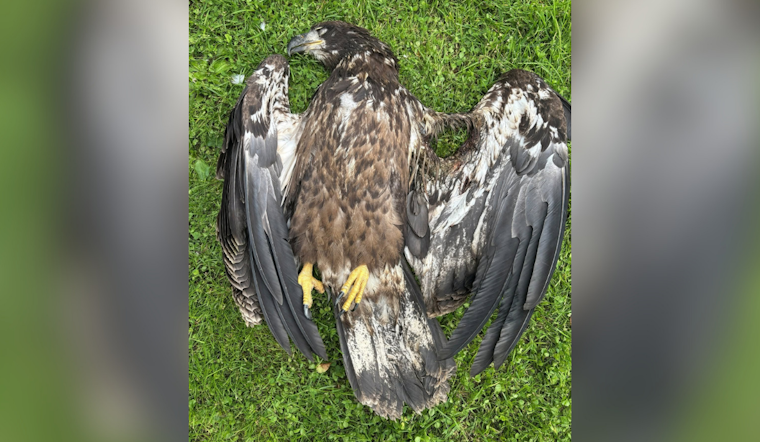
A juvenile bald eagle found along the Westmoreland Heritage Trail near Beaver Run Reservoir died from a gunshot wound before it could reach a wildlife rehabilitator, and state wildlife officials are now asking the public for help finding who is responsible. A state game warden had been called to the trail in Salem Township on August 25 after reports of an injured young eagle, and picked up the bird along the trail, only to discover an apparent air-rifle pellet lodged in its wing.
According to the CBS Pittsburgh report by Madeline Bartos, the wound had developed an advanced infection by the time the eagle was recovered, and investigators believe the bird was likely shot more than a week before it was found. The Pennsylvania Game Commission is investigating the killing as illegal, and its Operation Game Thief program has requested information from anyone who might know what happened.
Beaver Run Reservoir and the trail that runs alongside it have hosted nesting bald eagles since at least 2003, a stretch of public access that borders the reservoir's otherwise restricted grounds, according to a longtime local birdwatching record cited in earlier reporting. That history has made the area a magnet for eagle sightings for over two decades, which is part of why the loss of a young bird there has drawn attention from wildlife officials and the public alike.
A Familiar Pattern Along Westmoreland's Trails
This is not the first time a bald eagle has been shot near a Westmoreland County trail. In October 2019, state game wardens investigated a similar case after a mature breeding eagle was found shot with a small-caliber weapon along the West Penn Trail in Derry Township, according to the Pittsburgh Post-Gazette. That eagle suffered severe beak and skull injuries and had to be euthanized after being taken to the Wildlife Works rehabilitation center in Youngwood.
Anyone with information about this month's shooting is asked to report it to the Pennsylvania Game Commission at 1-833-PGC-HUNT, per the game commission. Tips can also be submitted through the Operation Game Thief hotline at 1-888-PGC-8001 or through its online portal, which accepts tips around the clock. The program received 1,232 wildlife crime tip submissions statewide during the 2024–2025 fiscal year and maintains an average response time of five minutes from tip submission to warden dispatch, according to the Pennsylvania Game Commission.
Steep Penalties Await Whoever Is Responsible
Bald eagles are protected under three separate federal statutes: the Migratory Bird Treaty Act, the Lacey Act, and the Bald and Golden Eagle Protection Act. A first-offense conviction under the Bald and Golden Eagle Protection Act carries penalties of up to a $100,000 fine for individuals, or $200,000 for organizations, plus up to a year in prison, while a second offense becomes a felony punishable by up to two years in prison and a $250,000 fine, according to WPXI.
State law adds another layer of exposure. Under Pennsylvania's Game Code, the unlawful killing of a protected bald eagle is a summary offense carrying a $2,000 fine, and state authorities can additionally assess replacement costs starting at $2,500 per bird to cover the expense of sourcing and re-nesting a young eagle, the Post-Gazette reported. Pennsylvania removed the bald eagle from its state endangered and threatened species list in 2014, reclassifying it under the state code's protected species designation rather than dropping legal safeguards altogether.
A Recovery Decades in the Making
The eagle's death lands against the backdrop of one of the state's most notable conservation turnarounds. Bald eagles were near extinction in the mid-1900s, per the U.S. Fish and Wildlife Service, driven down by habitat destruction, illegal hunting, and DDT contamination of their food supply. Pennsylvania had just three nesting pairs left in 1980, all in Crawford County, and that number climbed to more than 270 nesting bald eagles by 2013 before reaching an estimated 500-plus active nesting pairs statewide by 2026, according to conservation tracking cited by Local 21 News.
That rebound leaned heavily on an international reintroduction effort in the 1980s, when state wildlife officials imported 88 eaglets from Saskatchewan, Canada, to be raised in human-shielded hacking towers designed to let young raptors mature and fledge without imprinting on their human caretakers, as detailed by Route Fifty. The Game Commission credits those decades of conservation work with the growth in nesting pairs statewide.
But that same recovery has pushed more eagles into closer contact with people, trails, and roadways, and the risks haven't disappeared with the population growth. Statewide necropsy data collected by the Pennsylvania Game Commission between 2006 and 2016 found that roughly 30 percent of documented bald eagle mortalities involved lead toxicity, largely from eagles scavenging animal remains containing lead bullet fragments, according to the Altoona Mirror. Wildlife violations remain a significant part of state game wardens' caseload, with 5,966 total prosecutions recorded statewide during the 2024–2025 fiscal year and unlawful taking of game or wildlife the single most common charge, at 1,266 cases.
Westmoreland County's juvenile eagle joins a string of recent Pennsylvania bald eagle deaths that Hoodline has covered this year, including a young eagle killed near New Brighton in a likely train strike and a York County eagle that died of lead poisoning. As of now, the person responsible for the Westmoreland County shooting has not been identified, and investigators have not said publicly whether ballistics or trail-camera footage have turned up any leads.



