

























































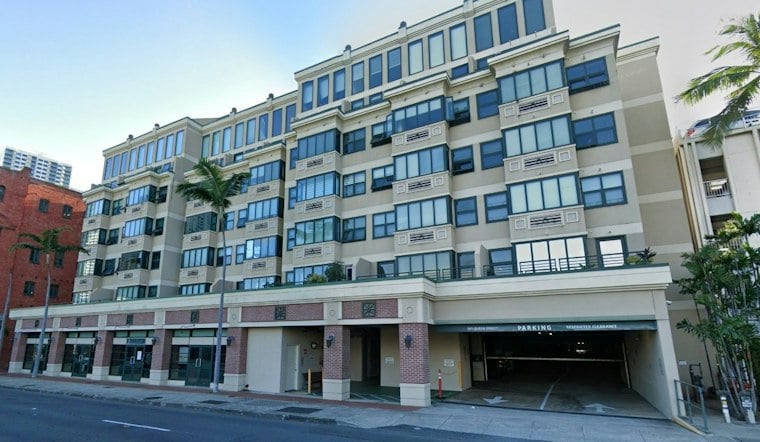
Some Honuakaha tenants received bills for alleged back rent.
Miyasato is one of several elderly tenants at the Kakaʻako senior high-rise caught in the fallout after Honuakaha's 30-year federal affordability commitment expired last December, according to Honolulu Civil Beat. The building, developed in 1995 on a 1.49-acre site at 545 and 547 Queen Street, was built as a hybrid property with 150 senior rental units owned by Honuakaha Limited Partnership alongside 93 fee-simple condominiums governed by a separate homeowners association, according to a Department of Business, Economic Development & Tourism staff report. The Hawaiʻi Community Development Authority, or HCDA, developed and owns Honuakaha and has managed development in Kakaʻako and other state lands since it was created in 1979.
Honuakaha was built with federal Low-Income Housing Tax Credits, which required the senior apartments to remain affordable for 30 years. The building is no longer restricted to seniors or bound by any rent limits beyond market conditions now that the commitment has lapsed, the outlet's report notes. The complex had been reserved for seniors over 62 with incomes below 60% of Honolulu's median income, roughly $52,000 a year as of 2020.
Back-Rent Bills
Lynda Lydon, 73, lives in a 350-square-foot third-floor studio and says she used to pay $600 a month including electric, water and sewer utilities. Her rent has since climbed 16%. Tenants also faced alleged back-rent bills.
Elevators, Sewage and a Long History of Complaints
Tenant friction at Honuakaha long predates the expired tax credits. State Senator Sharon Moriwaki and City Councilmember Tyler Dos Santos-Tam convened town hall meetings in spring 2023 over mold, electrical hazards, unaddressed garage sewage leaks, and an $800,000 maintenance fee debt HCDA owed the building's condo association, according to a report from Honolulu Civil Beat. That $800,000 debt stemmed from a period when Honuakaha ran a $25,000 monthly deficit in 2021, even though rents were not raised between 2013 and 2021 despite federal law allowing increases of up to 10%.
More recently, all three elevators at Honuakaha failed for weeks in August and September following storm activity and Hurricane Lala, leaving elderly residents stranded until HCDA restored temporary operation to one elevator on September 3, amid a statewide backlog of 3,421 pending elevator inspections affecting aging high-rises across Oahu. Elevators at the building break down regularly.
Rent Hikes and the Path to a Possible Sale
HCDA started raising Honuakaha rents in January 2022, and a board committee later recommended 5% annual increases along with market-rate rents for vacated units. Craig Nakamoto has said normal yearly rent increases would run about 3% to 4%.
HCDA has pledged that no Honuakaha tenants will have their rents raised or face eviction as a result of the expired affordability requirements. The agency says it plans only to raise rents to keep pace with building expenses, while it intends to rent open units at market rates in hopes that market-rate vacancies will improve short-term financial stability. About 30 units sat vacant in August, out of roughly 120 occupied units in the building's 150 total.
Roy Lim has said more bluntly that the owners are trying to get seniors out and make their lives miserable. Honuakaha is one of at least 600 units across seven other properties statewide facing expiring affordability requirements over the next three years.
A Different Path at Pohulani
The dilemma facing Honuakaha stands in contrast to what happened at Pohulani, a 263-unit Kakaʻako senior housing project included in a 2019 75-year ground-lease deal involving Stanford Carr Development and Standard Communities across six state-owned affordable properties. Under the terms of that 2017 award, reported by Maui Now, existing senior residents at Pohulani were protected by a cap limiting annual rent increases to no more than 2% for the duration of their tenancies. The property also offers a state rental assistance subsidy of up to $300 a month, according to Civil Beat's report.
The $223.9 million public-private partnership finalized in 2019 between Standard Communities, Stanford Carr Development and the Hawaii Housing Finance and Development Corporation involved 75-year ground leases and funded an $85 million rehabilitation across the six properties, totaling 1,221 units, as detailed by the Commercial Observer. The long-term target for the six properties was residents earning 80% to 100% of area median income. The state had lacked the $85 million needed to upgrade and modernize the six properties on its own in 2019.
Honuakaha tenants say they fear being priced out of the only home many of them have known for decades, even as the state weighs whether a private buyer, a nonprofit, or continued direct oversight offers the more stable path forward.





