

























































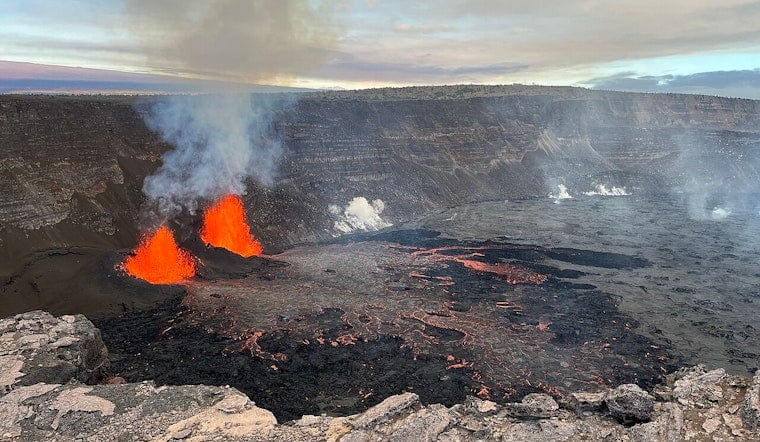
Kīlauea is stirring again. The Hawaiian Volcano Observatory says precursory low-level eruptive activity began around 12:45 p.m. HST on Monday at Halemaʻumaʻu crater, marked by a sluggish overflow from the north vent, and scientists now expect the volcano's 55th lava-fountaining episode to break out sometime between Monday and Thursday, September 10.
The precursory activity prompted the Hawaiian Volcano Observatory to raise Kīlauea's alert level from Advisory to Watch and its aviation color code from Yellow to Orange, according to Maui Now. Under protocols the U.S. Geological Survey standardized in April, that Watch and Orange designation signals that fountaining is either underway or imminent, with hazards largely confined to the boundaries of Hawaiʻi Volcanoes National Park, according to the U.S. Geological Survey. This kind of slow buildup before a burst has become the volcano's rhythm since the summit eruption began on December 23, 2024, and HVO says it will issue another Volcano Alert Notification once fountaining actually starts.
What to Expect When the Fountains Return
Precursory activity like this can stretch on for hours or even days before full fountaining kicks in, and most episodes since the eruption began have lasted a day or less once they do. Winds at Kīlauea are currently light out of the south, but forecasters warn that could shift and carry tephra and volcanic fumes northward past the rim of Kaluapele during the episode. Tephra fall is expected to be heaviest within three miles of the vents, while lighter ash and Pele's hair — the volcano's signature strands of volcanic glass — can drift much farther on the wind.
The eruptive vents and lava flows remain confined to Halemaʻumaʻu crater within the national park, a containment pattern that has held throughout this cycle even as individual episodes grow more dramatic. Episode 54, the most recent completed fountaining event, erupted an estimated 5.2 million cubic yards of lava over nine hours on August 25, with peak discharge from the north vent reaching roughly 58,000 gallons per second and a plume rising 17,000 feet above sea level, per the U.S. Geological Survey. That burst covered close to 30 percent of the crater floor and happened to fall on the National Park Service's 110th anniversary.
A Crater Reshaped by Repeated Fountaining
The cumulative effect of more than fifty episodes is visibly altering Kīlauea's summit. A September survey using helicopter LiDAR found that the tephra cone on Halemaʻumaʻu's western rim now stands 3,891 feet above sea level, having piled up 154 feet of material above pre-eruption ground levels — a measurement the agency's report notes was only possible because LiDAR could see through volcanic fumes that had previously blocked photogrammetric modeling.
This eruption cycle has already rewritten the record books. Episode 48, on June 1, became the highest-numbered lava-fountaining sequence ever recorded at Kīlauea, surpassing the 47 episodes of the 1983–1986 Puʻuʻōʻō eruption — and it took Halemaʻumaʻu less than 18 months to get there, compared to the more than three years Puʻuʻōʻō needed. Some individual bursts have rivaled historic extremes too: Episode 43 on March 10 sent fountains up to 1,770 feet from the south vent, among the tallest recorded at Kīlauea since the 1,900-foot fountains of Kīlauea Iki in 1959, an event that also triggered brief park road closures from heavy airborne tephra.
Why the Eruptions Keep Coming So Fast
Behind the rapid pace is a magma supply running about 25 percent above Kīlauea's long-term average since the eruption began in late 2024, based on Hawaiian Volcano Observatory reporting from May. That elevated supply drives the cyclic ground inflation between bursts that scientists track using tiltmeters at Uwēkahuna Bluff to forecast when the next fountaining window will open. Data compiled through September on 53 completed quiet pauses since December 2024 shows a median gap of 10 days between episodes, ranging from as short as 16 hours after Episode 1 to as long as 30 days after Episode 43, according to Hawaii Watch.
Downwind Communities Still Watching the Sky
The summit eruption didn't emerge in isolation — it capped a year of multi-zone volcanic activity across Kīlauea that included separate eruptions in the Southwest Rift Zone in June 2024 and the East Rift Zone that September, a pattern not seen on the volcano since 1974. High-effusion fountaining episodes have frequently pushed sulfur dioxide emissions above 50,000 tonnes per day, prompting Hawaiʻi County Civil Defense and the National Weather Service to issue health advisories urging Kaʻū district residents in Pāhala and Nāʻālehu to disconnect their rain catchment systems when vog rolls through.
The hazards aren't limited to air quality. Heavy tephra fallout during intense fountaining has damaged monitoring equipment inside the national park before, including in December 2025 when falling tephra buried and destroyed a USGS streaming camera positioned under a mile from the vents. Park authorities continue to keep off-limits zones around Kaluapele while leaving designated caldera overlooks open so the public can watch safely from a distance, as fountaining episode 55 approaches on Kīlauea's now-familiar countdown.





