

























































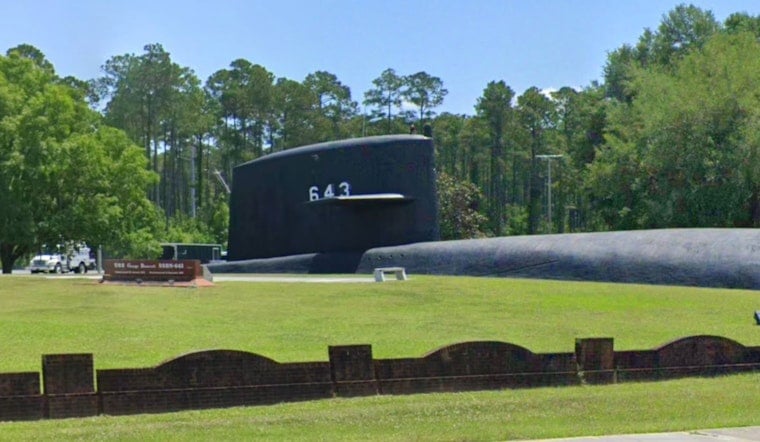
A military spouse who was blocked from Naval Submarine Base Kings Bay's Facebook page after criticizing the base's response to a power outage has settled his federal lawsuit, forcing the Georgia installation to admit it violated his constitutional rights and to permanently change how it moderates comments online.
Sergio Rodriguez, a disabled Army veteran, filed the federal civil rights lawsuit in July 2025 in the U.S. District Court for the Eastern District of Virginia's Norfolk Division, naming base commander Capt. Christopher Bohner, later substituted by Capt. William Dull, and public affairs officer Scott Bassett as defendants, according to the Center for Individual Rights, the public-interest group that filed the case against the base. As reported by Military Times, Rodriguez was blocked from the base's Facebook page and argued the ban limited his ability to communicate with and receive information from base residents, ultimately preventing him from advocating for military families.
A Hot Car, a Newborn, and an Outage That Wouldn't Quit
The dispute traces back to August 12, 2024, when a power outage during the heat that followed Tropical Storm Debby left Kings Bay base housing without electricity for over 12 hours, according to The Current GA. A military spouse with a newborn baby reportedly contacted Rodriguez from her hot car during the blackout, the outlet reported. Rodriguez responded to the base's outage announcement by commenting on the base's handling of the situation, asking whether residents could be temporarily relocated and how they might be reimbursed for spoiled food, according to Military Times' reporting on the underlying facts of the case.
Rodriguez said base Facebook pages are where military families seek answers, and it was after that exchange that the base commander's wife told him he had been banned from the page, per the same outlet's account. He is a disabled Army veteran who was named Spouse of the Year by Armed Forces Insurance and received a commendation from President Joe Biden for his advocacy work, according to the same report. His wife served as a supply officer on the base, Military Times noted.
Judge Rejects the Navy's Bid to Sidestep Accountability
The Navy tried to have the case dismissed after voluntarily restoring Rodriguez's Facebook access in late 2025, but Senior U.S. District Judge Rebecca Beach Smith denied that motion in March 2026, ruling that the reversal failed to meet the government's heavy burden of proving the unconstitutional censorship would not recur, according to the Center for Individual Rights. That ruling kept the case alive and pushed the base toward the settlement now on the record.
The legal backdrop for the case rests on the U.S. Supreme Court's unanimous 2024 ruling in *Lindke v. Freed*, which established that public officials and government entities operating public-facing social media channels engage in state action subject to First Amendment scrutiny when they exercise actual authority to communicate with the public, per the First Amendment Encyclopedia. The Navy had also already updated its own Social Media Handbook in October 2024, explicitly instructing commands that they may not block individual public accounts or remove user comments based on expressed viewpoints, according to a copy of the handbook cited by the Center for Individual Rights.
What the Settlement Actually Requires
Under the settlement, Kings Bay agreed to implement a permanent ban on viewpoint discrimination across its official social media channels, publish a public non-censorship disclaimer on its pages, and admit that its actions violated Rodriguez's First Amendment rights, Military Times reported. The base updated its social media pages to state that public comments will not be banned or blocked because of opinions, and aligned its social media policy with the Navy's handbook. Rodriguez received no monetary award as part of the resolution.
Center for Individual Rights attorney Michelle Scott said the Navy cannot delete members of the public who ask inconvenient questions, adding that the settlement makes clear the government cannot silence its critics with a click of a button, according to Military Times. Rodriguez maintains a social media advocacy reach of over 2,000 Facebook followers, which he uses to field housing and quality-of-life grievances from active-duty families frustrated by standard military command complaint channels, The Current GA reported.
Part of a Broader Pattern Across the Military
The Kings Bay case is not an isolated incident. In July 2026, a North Carolina National Guard unit settled a separate Center for Individual Rights lawsuit after it banned a former guardsman from its Facebook page over criticism of unit leadership, agreeing to adopt moderation policies prohibiting the removal, hiding, or filtering of comments deemed inappropriate. That resolution came weeks before the Kings Bay settlement, according to Military Times.
The pattern goes back further still. In August 2022, the Center for Individual Rights won a similar case against the Air Force, when a settlement required Chief Master Sgt. of the Air Force JoAnne Bass to update comment policies on her official Facebook page after blocking retired Air Force Maj. Richard Lee Rynearson III for critical posts, according to Military.com. Taken together, the cases against the Air Force, the National Guard, and now the Navy point to a recurring problem of military public affairs offices trying to curate online forums even as courts and the services' own rules increasingly say they cannot.




