

























































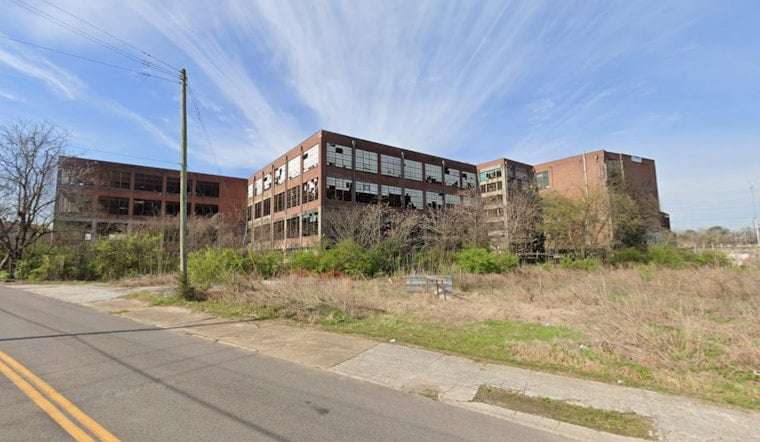
A 435,000-square-foot brick shell at 1400 Washington Avenue is the last physical trace of a factory complex that once made Knoxville the self-proclaimed “Underwear Capital of the World,” churning out roughly 10,000 garments an hour at its peak. Today, the building sits empty, its South Carolina-based owner has listed it for $8.5 million, and city officials say they are actively looking for someone new to take it on.
Standard Knitting Mill opened at its current location in 1901 and grew into one of the largest employers in Knoxville's history, according to the Knoxville News Sentinel. By 1921 the mill had around 800 employees; by 1940 that number had grown to roughly 2,500, and by 1962 the plant employed 3,500 people who together produced more than 42 million pieces of clothing a year, per the paper's reporting. During the Depression-era boom of the 1930s, the mill and its neighbor, Appalachian Mill, together made enough underwear to clothe a quarter of the U.S. population, and Standard Knitting Mill alone became Knoxville's largest private employer with more than 4,000 workers and weekly output exceeding 1 million garments, according to Knox Heritage.
A City Built Around Underwear
The scale of the operation reshaped Knoxville's identity. A 1936 write-up in the Knoxville News Sentinel described the city as “the greatest underwear producing city in the United States and probably in the world,” and textiles were the city's dominant, leading industry that year, the paper's historical reporting notes. Knoxville wasn't alone in claiming the “Underwear Capital” title — Piqua, Ohio, and Winston-Salem, North Carolina, made the same boast — but Standard Knitting Mill was central to Knoxville's version of the claim. By 1962, the city counted 30 factories producing or processing textiles, with female textile workers outnumbering men on the mill floors, according to the News Sentinel.
The mill's campus wasn't just factory floors. It included a hospital, a library and a dentist's office for workers, reflecting how thoroughly the operation was woven into daily life in the surrounding neighborhood. That neighborhood, Parkridge's Park City Historic District, was developed in the 1890s specifically as a streetcar suburb to house Standard Knitting Mill workers and now holds one of the nation's highest concentrations of Victorian mail-order homes, according to Knox Heritage. It was placed on the National Register of Historic Places in 1990.
Decline, Sale And A Broken Promise
Delta Apparel, part of Delta Woodside Industries, purchased the mill in the 1980s, and the distribution center remained at the site until it relocated to Clinton in 2004, per the News Sentinel's account. In June 1989, Delta announced the plant would close, a decision that cost 630 employees their jobs. Betty Rudder, one of those workers, said employees had been promised a new cafeteria, a raise and better benefits before the closure came instead. Delta ultimately vacated the site entirely by 2007, according to some news reports cited by the paper, selling the property that year to the Mid-Atlantic Foundation for $2 million, per Compass Knox.
What followed was two decades of stalled ambition. Knox County Schools at one point considered using the property as a central office, and Saw Works Brewing Co. considered moving in, but neither plan materialized. Mid-Atlantic resold the complex at a loss in 2012 to SKM Holdings, an entity affiliated with local developer Brant Enderle, for just $550,000 — a fraction of what the site would later fetch.
WRS Buys In, Then Backs Out
In November 2019, WRS Inc. Real Estate Investments, operating under the name Knoxville Mill Investment LLC, paid $4,075,000 for the site, planning a mixed-use development with loft-style apartments, specialty retail, market and restaurant space, and creative office space. The WRS Standard Knitting Mill project website still lists the project status as “planning in progress,” but the company is now off the project, according to the News Sentinel.
Two things derailed those plans, according to Ben Bentley, speaking at an Aug. 27 city council workshop: Tennessee's lack of a textile mill revitalization tax credit — a program South Carolina offers but Tennessee does not — and the discovery of an unmarked KUB water line beneath the mill structure. Together, Bentley said, those two factors caused WRS to lose millions of dollars on the project. The site had already required extensive environmental remediation before construction could even begin.
Then, on January 30, 2022, two separate fires broke out less than eight hours apart at the vacant building, according to the Knoxville News Sentinel, causing severe fire and smoke damage to the front portion of the structure and adding yet another layer of physical risk for whoever takes the project on next. WRS initially signaled it would stick with the site despite the fire damage before ultimately choosing to sell.
Preservationists Keep Watch As A New Buyer Is Sought
Knox Heritage has repeatedly flagged the mill on its annual “Fragile & Fading” list of endangered regional landmarks, keeping it there in 2025 under the “Still Fragile” category, the organization notes on its website. Back in March 2019, the City of Knoxville had awarded a $3,500 Historic Preservation Fund grant to Knox Heritage specifically to help complete the application for nominating the mill to the National Register of Historic Places — an effort tied to unlocking federal historic tax credits that could partly offset the absence of a state-level program.
The mill's location may now be its biggest selling point. The site sits adjacent to Caswell Park and just blocks from Covenant Health Park, the multi-use stadium that opened in 2025 for the Knoxville Smokies and has sparked renewed real estate interest in the surrounding corridor, according to Knox TN Today. Rebekah Jane Justice said Knoxville is willing and ready to talk to interested investors, and a new developer is now being sought for the property, per the News Sentinel's reporting. For now, the 435,000-square-foot building that once helped clothe a quarter of the country stands empty at 1400 Washington Avenue, its future resting on whether an investor is willing to absorb the cleanup costs that sank the last one.


