

























































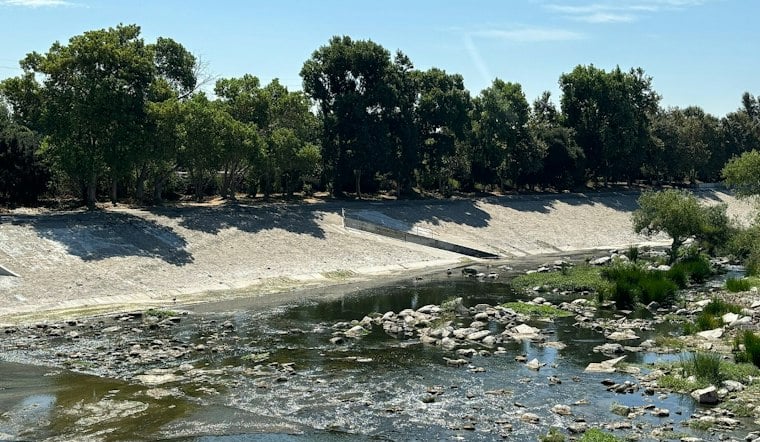
Los Angeles is about to greenlight construction on a long-delayed stretch of riverside bike path through the West San Fernando Valley, but cyclists riding it after it opens won't get the seamless, car-free experience originally promised. The city's Board of Public Works is scheduled to approve an $84 million construction contract for a 2.9-mile segment of the Los Angeles River bike and walk path running from Vanalden Avenue to Balboa Boulevard, threading through Reseda on its way toward the 2028 Olympics.
The project's price tag and timeline have shifted considerably since it was first anticipated to break ground in 2022, as reported by Streetsblog Los Angeles. Escalating construction costs forced the project to seek additional funding and, ultimately, to shrink its own ambitions. Rather than cancel the contract outright after bids came in higher than expected, the city engaged in what Move LA, in a letter to the California Transportation Commission, called a value-engineering solution, swapping planned undercrossings at five arterial streets for signalized at-grade crossings using Pedestrian Hybrid Beacons, commonly known as HAWK signals.
What Riders Will Actually Encounter
Under the revised scope, the path will include five at-grade crossings and just one undercrossing, preserving only the crossing at the Orange Line Busway along with the Caballero Creek bridge. Streetsblog Los Angeles reports that the eliminated undercrossings could still be added at a later date. In practice, that means cyclists reaching a cross street will have to press a button and wait to cross car traffic rather than riding beneath it, a tradeoff that erases the grade-separated experience originally envisioned for the corridor.
The route itself follows an existing maintenance service road along the south side of the LA River from Vanalden Avenue to White Oak Avenue, then crosses to the north side of the river between White Oak Avenue and Balboa Boulevard, according to the Los Angeles Times.
An Olympic Deadline Driving the Design Compromise
LA Metro formally backed the scope changes, stressing that finishing this segment before 2028 is essential to providing car-free transit access to the Sepulveda Basin Recreation Area, where temporary venues are planned for the 2028 Olympic and Paralympic Games, per the California Transportation Commission. The city received a Metro grant in 2025, and Urbanize LA also reported a recommended $34.4 million Active Transportation Program award for an East San Fernando Valley gap-closure project. Hoodline reported a $60 million original allocation for a separate 12-mile San Fernando Valley segment. In September 2025, Metro provided an additional $10 million in Measure M funding for that separate segment, Hoodline reported.
The project is scheduled for a Board of Public Works vote on Monday, September 28, 2026.
Environmental Concerns During Review
The Los Angeles Times reported that environmental objections were raised during public review.
The West Valley segment's relatively smooth path to construction stands in sharp contrast to a much larger missing link of the LA River bike path in downtown Los Angeles, where costs have climbed past $1 billion — roughly $24,000 per linear foot — for an eight-mile stretch not expected to be finished until at least 2031, as Hoodline previously reported. That downtown segment is complicated by rail lines and historic bridges. For now, whether Los Angeles ever funds the deferred undercrossings near Reseda — and how the new at-grade signals will hold up against traffic on busy West Valley arterials — remains to be seen.




