

























































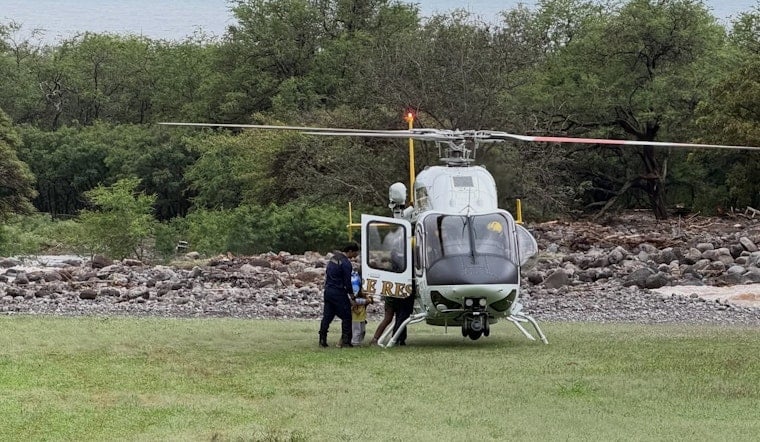
A man in his 30s had to be airlifted off the remote Laie Falls Trail on Oahu's North Shore Monday afternoon after suffering exhaustion and foot injuries that left him unable to hike out on his own. The Honolulu Fire Department received a 911 call at about 2 p.m. reporting a hiker in distress on the trail, and by the time crews reached him, he needed help getting off the mountain rather than just medical attention on scene.
According to the Honolulu Star-Advertiser, HFD responded with five units and 15 personnel, while the department's Air 1 helicopter launched an aerial search for the hiker and located him at 2:43 p.m. A rescuer was lowered to the hiker's position to conduct a medical assessment on the trail before preparing him for extraction. Air 1 then airlifted him to a nearby landing zone, where he received further treatment. No additional injuries were reported, and the newspaper noted that no further details were available.
A Grueling Hike Deep on Church-Managed Land
Laie Falls Trail sits on private land managed by Hawaii Reserves, Inc., which requires hikers to complete a free permit application online before setting out, according to Hawaii Reserves. The trail spans roughly 7 to 8 miles round-trip with about 1,200 to 1,500 feet of elevation gain, winding through access roads, ridge paths, and pine groves before a steep, often muddy descent to a two-tiered waterfall pool, per The Hiking HI. That combination of distance and slippery terrain near the waterfall basin is the kind of grind that can wear down even fit hikers well before they reach the falls.
Hawaii Reserves has also posted safety notices warning that a landslide damaged the upper trail past the Pine Forest section, instructing hikers not to proceed beyond that point. This is not the first time the trail has required an aerial rescue: Hoodline previously reported that a 21-year-old man injured near the fourth waterfall of Laie Falls Trail had to be airlifted to a landing zone by HFD's Air 1, a reflection of how often the steep terrain around the falls forces helicopter extractions rather than ground carry-outs.
Why Remote Rescues Still Trail Tourist Hotspots in Volume
Despite the technical difficulty of pulling someone out of a spot like Laie Falls, HFD data shows that accessible tourist trails generate far more rescue calls overall. Heavily trafficked sites such as Diamond Head Summit, Lulumahu Falls, Koko Crater Stairs, and Lanikai Pillboxes account for the highest annual volume of hiker rescues on Oahu, according to fire department figures reported by the Star-Advertiser and relayed by EMS1, with heat exhaustion and minor injuries driving most of those routine airlifts. Separately, HFD statistics covering 2022 through 2024 found 510 hiker rescues on legal, state-listed trails compared with 282 on illegal or unlisted trails, per data reported to the Hawaii Senate Majority, though officials noted no comprehensive registry exists listing every trail on the island.
Extractions like Monday's rely on HFD's twin-engine Bell 429 helicopter for Air 1 operations, which carries a 600-pound hoist capable of raising patients and rescuers directly into the aircraft cabin during steep mountain rescues, according to details relayed by Vertical Plus. That equipment upgrade over older single-engine models has become central to how the department handles hard-to-reach terrain across Oahu's ridgelines.
Rescue Fee Debate Looms Over Closed and Private Trails
The rescue also lands amid a recurring legislative fight in Hawaii over whether stranded hikers should be billed for search-and-rescue costs. Hoodline has previously reported that HFD opposes such proposals, warning that cost-recovery penalties could cause stranded hikers to delay calling 911 out of fear of the bill. State lawmakers have repeatedly introduced measures like SB 2358 this year aimed at charging hikers who enter closed trails.
Under current law, Hawaii Revised Statutes Section 137-2 allows government entities to seek reimbursement for rescue costs only when the rescue resulted from an act or omission showing intentional disregard for personal safety, such as ignoring posted closure signs, according to the Hawaii State Legislature. Recent legislative efforts have sought to broaden that liability standard for hikers on closed or private land, though the threshold remains narrow for now.
Zipline Dispute Adds to Scrutiny Near Laie Falls
The Laie Falls area has also drawn attention for reasons unrelated to hiking rescues. Unpermitted zipline construction in the hills behind Laie triggered an investigation by Honolulu's Department of Planning and Permitting, which confirmed grading and building violations on land managed by Hawaii Reserves, according to a report from SFGATE. Community members had noticed heavy machinery and land clearing that project developers claimed was simply trail maintenance, adding to broader concerns about land access and safety conditions in the area surrounding the falls.





