

























































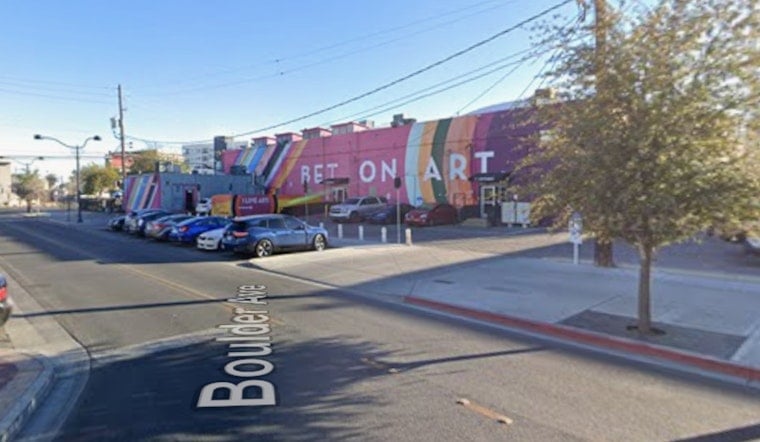
Property and business owners in the Las Vegas Arts District have launched a petition to create a self-funded Business Improvement District that could pump roughly $1.9 million into the neighborhood in its first year alone, with more than a third of that money earmarked for security. The proposal would tax commercial, apartment, nonprofit and governmental property owners up to 6.5 mills, or $6.50 per $1,000 of assessed value, while residential condo owners would pay half that rate at 3.25 mills. The effort covers the district generally bounded by East Bonneville Avenue to the north and West Wyoming Avenue to the south, with the Union Pacific Railroad tracks forming its western edge and parcels fronting Las Vegas Boulevard marking the east.
The petition, first reported by the Las Vegas Sun, would establish the district under Nevada Revised Statutes Chapter 271, which allows cities, counties and towns to create neighborhood improvement projects funded by the property owners inside them. Sam Cherry of Sharedowntown, one of several stakeholders named to the initial district board, framed the effort as a matter of self-determination for people who have already put money into the neighborhood. “The people who invested in the neighborhood need a sustainable way to invest together in its future,” Cherry said, per the Las Vegas Sun's report.
Unlike a city program, the proposed BID would be a stakeholder initiative rather than a City of Las Vegas operation, and the city would not oversee its daily operations. It would instead be governed by a nonprofit organization and a board representing property owners, businesses and other district stakeholders, with the board setting annual priorities based on stakeholder feedback and district needs. Christina Dylag of Velveteen Rabbit, another board member, said the funding model builds in direct accountability for the people paying into it. “People paying into the BID will set its priorities and hold it accountable,” Dylag said.
Where the Money Would Go
According to the district's proposed management plan, 35% of the roughly $1.9 million Year 1 budget would go toward public safety initiatives, including security ambassadors, improved lighting, cameras and coordination with law enforcement, while 20% would fund marketing aimed at building a cohesive Arts District identity and boosting foot traffic and spending. The remaining funds would cover trash and bulk-item removal, pressure washing, graffiti abatement, weed removal and general public-space upkeep, along with wayfinding and gateway signage, landscaping, pedestrian amenities and public art. The district board would track metrics tied to safety, cleanliness, marketing reach, foot traffic and spending to gauge whether the investment is working.
The plan also builds in a mechanism aimed at underutilized or neglected lots. Vacant commercial land would be assessed at 12.025 mills and vacant residential land at 4.875 mills, calculated on land value only, a minimum-utilization standard designed to discourage property owners from letting parcels sit undeveloped while everyone else pays into upkeep and safety.
A High Bar for Approval
Getting the district approved will require more than enthusiasm from the handful of board members pushing it forward. Under NRS Chapter 271.285, a petition must be signed by property owners representing at least 50% of the total assessed value in the proposed district before the Las Vegas City Council will even review it. If that threshold is met, the proposal goes to the council, which is required to hold a public hearing before any vote, and the district could be established only through adoption of a city ordinance. Adam Foulad of KLA Capital, also on the initial board, described the petition stage as an invitation rather than a done deal. “The petition invites property owners and the broader Arts District community to examine the plan and ask questions,” Foulad said.
Even if approved, the city would retain an ongoing role. The improvement district would be required to present an annual budget, work plan, financial information and an accomplishments report to the city council each year, and it would carry an initial 10-year term. The district describes itself as private sector led and managed, and it would supplement rather than replace existing city services.
A Neighborhood Under Pressure
The push for a self-taxing district arrives as 18b has transformed dramatically from its origins. The City of Las Vegas designated the Arts District across an original 18-block footprint in 1998, centered on The Arts Factory warehouse, which opened the year before, according to Travel Nevada. The monthly First Friday festival, launched in October 2002 with roughly 300 attendees, has since grown into a draw of up to 20,000 visitors per event, cementing the district's identity as a cultural destination.
That growth has come with costs. Median list prices in the 89101 ZIP code covering the Arts District hit $422,500 in June 2026, a jump that local venue operators have said is pushing up lease rates for galleries and independent businesses, according to Las Vegas REALTORS data. The city itself flagged the risk in a 2023 study warning that rising commercial rents were displacing local creatives from 18b, which led nonprofit developer Artspace to complete a preliminary feasibility study with the City of Las Vegas in April 2024 exploring affordable artist live/work housing.
Friction over how the district is managed isn't new either. Hoodline reported in January that new pay-to-park meters installed by the city sparked complaints from merchants and visitors who said the fees were disrupting foot traffic, part of a broader pattern of growing pains as 18b has densified. The neighborhood has also seen a six-story apartment approval and a new fine-art museum this year, alongside a two-alarm fire that tore through district buildings in triple-digit heat and a homicide investigation on South 3rd Street that has heightened concerns about public safety.
Looking to Reno as a Model
Nevada already has a working precedent for this kind of self-assessed district. The Reno City Council approved the assessment roll for the Downtown Reno Business Improvement District under NRS Chapter 271 in April 2022, according to the Federal Highway Administration, establishing that a privately managed neighborhood improvement project can function within the state's legal framework.
The initial board pushing the Las Vegas proposal draws from a cross-section of district stakeholders, including Cherry, Dylag and Foulad alongside Andrew Kjellman of the Regional Transportation Commission of Southern Nevada, Alex Woodin of Southern Land, Derek Stonebarger of Rebar, Jen Taler of Akin Cooperative and Market in the Alley, Weina Zhang of Z Life, Sean Blanchard of The Good Wolf and Gary Creagh Jr. of Sticky LLC. Whether their petition gathers enough signatures to reach the 50% assessed-value threshold will determine if the plan ever reaches a City Council vote.





