

























































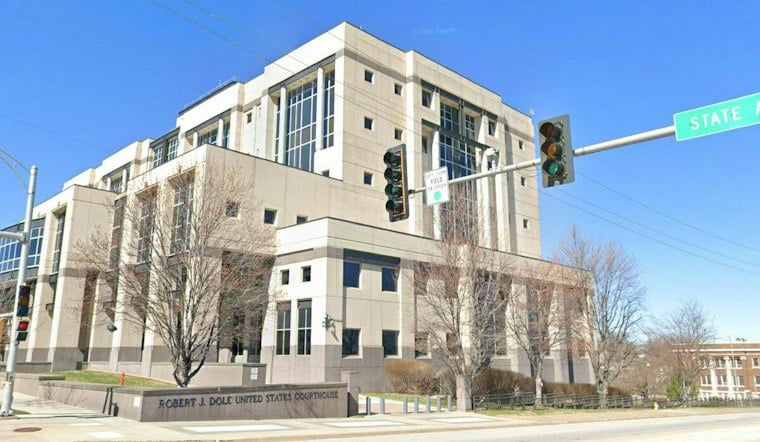
A Lawrence, Kansas business owner was sentenced Tuesday, September 15, 2026, to concurrent 18-month prison terms for his role in a long-running scheme that funneled sophisticated U.S.-origin avionics equipment to Russian buyers, including the country's Federal Security Service. Cyril Gregory Buyanovsky pleaded guilty in December 2023 to conspiracy to commit offenses against the United States and conspiracy to commit international money laundering.
According to FOX 4 Kansas City WDAF-TV, Buyanovsky and his conspirators exported U.S.-origin avionics equipment to Russian end users both directly and through other foreign countries, filing false export forms and, in some cases, failing to file the required paperwork at all. The station reports the group misrepresented export values, end users and end destinations to keep the shipments moving. Among the most striking details in the case: Buyanovsky and former KanRus vice president Douglas Edward Robertson, 58, of Olathe, Kansas, allegedly removed a sticker identifying Russia's Federal Security Service from a traffic alert and collision avoidance system before sending it out for repair, then reattached the sticker before shipping the repaired unit back to the FSB in 2021, per the same account.
Sanctions Tightened, but the Shipments Kept Coming
Russia invaded Ukraine in February 2022, prompting the U.S. government to tighten export controls tied to Russia. Rather than stop, Buyanovsky, Robertson and other conspirators kept purchasing and exporting U.S.-origin avionics equipment to Russian customers even after the new restrictions took hold, the station's report states. The group allegedly hid the activity from law enforcement and lied to U.S. suppliers about who the equipment was really going to.
A separate case connected to the same investigation shows just how deliberate that concealment could be. Court filings cited by CBS News show that in April 2022, Robertson messaged a Russia-based customer that “things are complicated in the USA” and that it was “NOT the right time for [more paperwork and visibility].” Robertson was arrested alongside Buyanovsky in March 2023, later pleaded guilty, and was sentenced on June 9 to 32 months in federal prison for export control and money laundering violations, according to the U.S. Department of Justice.
A Global Web of Shell Companies and Bank Accounts
To move both goods and money, the conspirators relied on a network stretching well beyond Kansas. Per the same account, Buyanovsky and his conspirators shipped goods through intermediary companies based in Armenia, the United Arab Emirates and Cyprus, while foreign bank accounts in Armenia, Kazakhstan and Kyrgyzstan were used in the operation.
A Latvian broker also played a key role in the operation. Oleg Chistyakov, 56, who solicited quotes and facilitated Russian payments for KanRus through an Emirati company called RosAero FZC, was extradited to the U.S. in August 2024 and sentenced on June 12 to 28 months in federal prison, the Justice Department reported. The case was prosecuted as part of Task Force KleptoCapture, an interagency Justice Department unit formed in March 2022 to enforce sanctions and export restrictions against Russia.
Seized Equipment and a Personal Financial Judgment
As part of his plea, Buyanovsky consented to forfeiture of more than $450,000 worth of avionics equipment and accessories, and he also received a $50,000 personal forfeiture judgment, per FOX 4 Kansas City WDAF-TV. Federal agents seized 86 avionics components during the investigation, including complex flight control, threat detection and navigation equipment, according to the Johnson County Post. In December 2023, the U.S. Department of Commerce added multiple foreign individuals and companies tied to the KanRus network to its Entity List, restricting their access to U.S.-origin items without special licenses.
Before the scheme unraveled, KanRus Trading Company operated in Kansas, supplying aircraft electronics and performing repairs, and was co-run by Buyanovsky, an aviation engineer, and Robertson, a commercial pilot, according to the Bureau of Industry and Security. Assistant Attorney General Matthew G. Olsen described Russia's invasion of Ukraine as unprovoked in remarks tied to the case. Export Control Reform Act violations can carry statutory maximums of up to 20 years in prison per count, while the defendants faced up to 35 years if convicted; the sentences ultimately handed down in the case ranged from 18 to 32 months.
Part of a Wider Crackdown on Sanctions Evasion
The KanRus case fits a broader pattern of federal enforcement against Russia-bound aviation smuggling since the 2022 invasion. Trade data analyzed by Import Genius and cited by Hoodline found that more than $14.4 million in restricted U.S. aircraft components, including $8.9 million in Boeing equipment, were illegally shipped to Russia during the first eight months after the invasion, as Western sanctions created severe shortages of spare parts there. Hoodline has also covered a Florida gun-parts case.





