

























































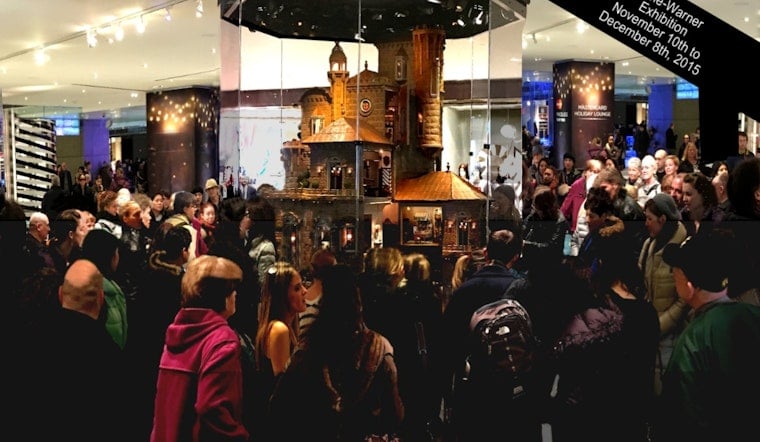
A nine-foot-tall dollhouse sitting in storage on Long Island carries a valuation that makes it, square foot for square foot, more expensive than nearly any apartment in Manhattan. The Astolat Dollhouse Castle, owned by Dr. Michael Freeman and his wife Lois, spans just 25.8 square feet but has been appraised at $8.5 million — a figure that works out to approximately $2,288 per square inch and approximately $329,457 per square foot, according to seed facts; CBS News reported an $8.5 million appraisal and described the dollhouse as costing nearly $25,000 per square foot.
According to the NYC Department of Finance, its rolling sales files include neighborhood, building type, and square footage data that can be used to make a separate comparison with Manhattan apartment sales.
A Long Island Home Built for a Castle
Michael Freeman, an 80-year-old PhD psychologist, bought Astolat in 1996 from Elaine Diehl, a commercial artist who spent 13 years building the structure and completed it in 1987, according to reporting from the New York Post. Freeman and his wife Lois, herself a dollhouse collector who at one point owned 80 dollhouses of her own, first laid eyes on the castle at Diehl's shop in Sedona, Arizona. Freeman has described the purchase price as a ridiculous amount, per the same account, but he went ahead anyway, later hiring a driver to transport the piece to Long Island and buying a first-class airline ticket so Diehl and an assistant could fly to New York and show the couple how to assemble it.
The castle now sits in storage on Long Island after time on display at the Freemans' home in Kings Point, Long Island. Before that, it was on display from 2005 until recently. Moving it is no small task: relocating the 815-to-890-pound structure requires 12 people working for two days to dismantle or reassemble it, per the Astolat Dollhouse Castle official site.
Twenty-Nine Rooms, Ten Thousand Objects, Zero Dolls
Named for Elaine of Astolat from Alfred Lord Tennyson's poetry, the castle contains 29 rooms across seven levels but, notably, no dolls at all — just room after room of furniture, art, and household objects rendered at miniature scale. Guinness World Records has officially recognized it as the world's most valuable dolls' house, cataloging the structure's nine-foot height, 29 rooms, and roughly 10,000 interior objects on public display at any given time. That figure represents only part of a much larger holding: the Freemans' total accumulated collection runs to about 30,000 miniature pieces that get rotated in and out, spanning Spanish, Tudor, Victorian, and 18th-century English styles, according to a 2015 PR Newswire release.
The Museum of the City of New York provides a local precedent for treating miniature interiors as art: its Stettheimer Dollhouse contains a miniature work by Marcel Duchamp.
The layout itself reads like a fantasy novel. There's an armory, a wine cellar, a grand ballroom, and a Wizard's Tower. The castle also includes a figure of Merlin, according to the same release, corroborated by a report from the Shops at Columbus Circle. Among the fixtures: a grand piano valued at $7,000, a working elevator Freeman says he has never turned on, tiny books with genuinely readable pages, and an antique 1811 thumb Holy Bible bound in rare early American leather.
Real Materials, Miniature Scale
The furnishings aren't just tiny replicas — many incorporate real materials at true value. The castle houses jewelry set with genuine gemstones, tiny bottles filled with real alcohol, a brass birdcage with a canary, a Victorian globe on a gold-plated brass stand, a gilt French baroque table with a marble top, and a silver carving set. Individual pieces carry serious appraisals on their own: a $5,000 sterling silver flatware set, a $2,500 drop-leaf secretary bookshelf, and a $2,500 miniature Hebrew Torah, according to reporting from The Mirror. Original artworks inside measure about one inch by one inch; at least one portrait was painted with a single-bristle brush, while the dining room even includes miniature food, including a roast turkey.
Diehl didn't build the castle alone. She commissioned hundreds of original artworks from other international miniaturists, including Warren Dick, who crafted an English oak kitchen table, alongside contributions from Eric Pearson, George Becker, and Laurel Coulon. The castle also runs on a genuine, sophisticated electrical system with two voltage levels, capable of producing night lighting and other effects, engineered so viewers can see objects from multiple angles using stereoscopy principles, per the official Astolat site.
Public Displays and an Uncertain Future
The castle's most prominent public showing came in 2015, when it went on display at the Time Warner Center, drawing more than 30,000 visitors that year. It was appraised at $8.5 million roughly a decade before the Post's current reporting. The Freemans have used public exhibitions to raise money for children's and health charities, a cause tied in part to their grandson, who has autism, according to reporting compiled from Flea Market Insiders.
What happens next to the castle remains an open question. Freeman has said Astolat should go where it will be most appreciated, and he has expressed hope that it might someday be displayed in the White House ballroom. For now, though, the most valuable real estate in the world — by square footage, at least — remains packed away in storage, waiting for its next home.




