

























































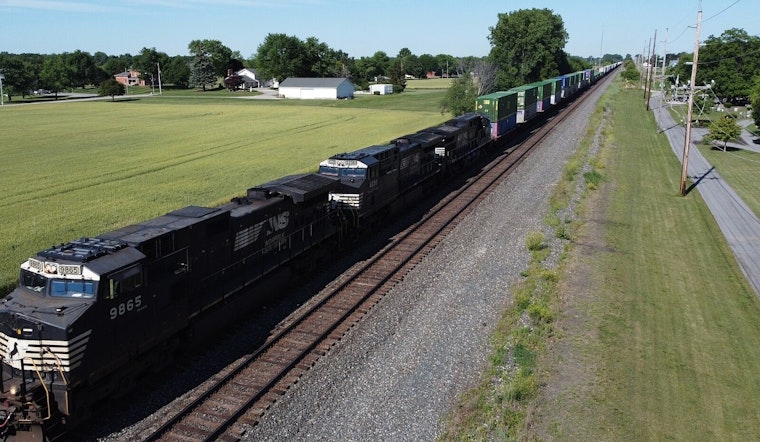
A stopped Norfolk Southern train blocked the Lake Breeze Road rail crossing in Sheffield Lake for 21 hours straight, from 11 p.m. one Tuesday night until 8 p.m. the following evening, cutting off a key route between neighborhoods. It was not an isolated incident. Another train blocked the same intersection in nearby Sheffield Village for around 35 hours in late August, and residents say the pattern of extended shutdowns has left them stranded, frustrated, and worried it could become routine. City records show that Sheffield Lake's boat launch is at the west end of the city, where Lake Road intersects with Lake Breeze.
Norfolk Southern confirmed the trains involved in the stoppages belonged to the company, according to News 5 Cleveland. Mackenzie Nott, who lives near the tracks, told the station that even when trains do not block crossings for a full day, they still routinely sit for two to three hours at a time, and that neither she nor her neighbors have ever received information about the cause or duration of the stoppages. She said she and others have called the railroad operator directly during the prolonged blockages, often without getting answers.
Wayne Herrle, who lives on Lake Breeze Road south of the tracks in Sheffield Village, put it bluntly: trains stopped for days at a time is not right, he said. He added that he believes the railroad is flexing its muscles and that ordinary people are the ones paying the price for it.
Schoolchildren Crossing Under Stopped Cars
The blockages have created more than just traffic headaches. Schoolchildren have climbed over or under stopped trains to get where they needed to go, according to the same News 5 Cleveland report. Aden Fogel said he personally stopped a pair of schoolchildren from crossing the tracks while a train sat idle, and he told Norfolk Southern the company is on notice to fix the problem. He said he hopes the railroad will provide more insight going forward and avoid the kind of extended stops that have become common in the area.
Community leaders have pushed back on the railroad's operations more broadly, questioning why Norfolk Southern could not separate train cars to keep intersections clear, or why trains could not stop farther east beneath an overpass instead of directly on top of local crossings. Because the Sheffield Village boundary sits on both sides of the tracks on Harris Road, a blocked crossing there can split the village in two. Officials have also warned that a blocked Harris Road crossing could cause service delays north of the intersection.
Norfolk Southern Points to Storms and Federal Crew Limits
Norfolk Southern has said the multi-day delay was partially caused by fallen power lines that came down across the track after a storm, a period that overlapped with the severe weather that knocked out power to thousands of FirstEnergy customers across Lorain County, including Sheffield and Sheffield Lake, in Hoodline's coverage of the August outages. The company said the downed lines caused the train crew to exceed its federally allowed maximum working hours, forcing the train to stop in the same location once the crew hit that limit.
That limit is not a matter of company policy. Under Federal Railroad Administration Hours of Service rules, train crews are strictly prohibited from remaining on duty for more than 12 consecutive hours, and once that threshold is reached, the crew must stop operating the train immediately, wherever it happens to be, until a relief crew arrives. Norfolk Southern spokesperson Kasandra Jenkins said the company recognizes the inconvenience stopped trains create and appreciates the public's patience, according to the News 5 Cleveland report. A Norfolk Southern statement added that the company tries to minimize impacts on neighboring communities, and that where a train stops is influenced by network conditions, traffic, track availability and safety.
No Legal Teeth to Force a Fix
Local leaders have little formal power to compel change. Ohio's law limiting how long a stopped train could block a crossing was struck down by the Ohio Supreme Court in its 2022 ruling in State v. CSX Transportation, Inc., which found the five-minute limit under state law preempted by federal authority over rail regulation, a decision the U.S. Supreme Court declined to review in January 2024, according to Court News Ohio. With that avenue closed off, Sheffield Lake and Sheffield Village leaders say they have received no communication from Norfolk Southern before delays occur, nor updates about how long a stoppage might last.
The Federal Railroad Administration has acknowledged the gap: the agency built a public online Blocked Crossing Incident Reporter in December 2019 specifically because no federal statutory time limit exists for how long a stopped train can occupy a public crossing, relying instead on public submissions to track chronic problem spots nationwide. William Visalden Jr. has requested that Norfolk Southern set up direct phone calls to the police departments affected by train stoppages so first responders have some warning when a crossing goes down. The City of Sheffield Lake's official website lists its Fire Department and Police Department at 609 Harris Rd., providing a local emergency-services reference point near the affected roads.
A National Pattern With Growing Trains
The frustration in Lorain County echoes a national trend. A U.S. Government Accountability Office study found that Class I freight train lengths grew by roughly 25 percent between 2008 and 2017, with some trains now stretching up to three miles, long enough to occupy multiple crossings at once when they stop. U.S. Senate Commerce Committee data found that in 2020 alone, the FRA received nearly 1,800 reports nationwide of crossings blocked for more than an hour, including 85 cases where a crossing stayed blocked for an entire day.
A 2023 ProPublica investigation documented a strikingly similar situation in Hammond, Indiana, where children routinely climbed over and under Norfolk Southern trains to reach school, a pattern of public pressure that eventually forced the railroad's CEO to meet with local officials and split stopped trains at key intersections. Bipartisan federal legislation reintroduced in Congress in March 2026 as the Railway Safety Act, born out of the 2023 Norfolk Southern derailment in East Palestine, Ohio, includes provisions ordering federal studies and mitigation strategies for blocked highway-rail crossings, according to the National Association of Counties.
For now, Sheffield Lake City Council discussed the train-blockage issue during a recent Wednesday evening meeting, but concrete solutions remain elusive. Romolo Debottis summed up the frustration many residents share: a train sitting on the tracks for two and a half days without moving or explanation, he said, is simply unacceptable. Repeated delays have left leaders in both Sheffield Lake and Sheffield Village frustrated, and residents worry the stoppages that disrupted their routines, commutes and safety this summer could become a regular occurrence rather than an exception.




