

























































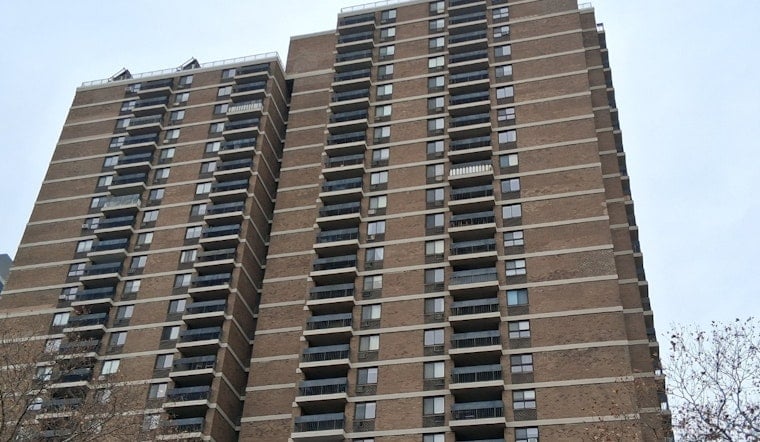
Co-op owners and board leaders from across New York City gathered at Southbridge Towers in Lower Manhattan to demand changes to Local Law 97, the city's building emissions law, which they say threatens to impose retrofit costs that could outweigh every other financial challenge their communities have faced in the past decade. The rally brought together co-op leaders and residents to address the law's financial burden on cooperative and condominium housing, according to the Southbridge Towers board.
The event was organized by Co-ops and Condos United of New York, a coalition describing itself as representing more than one million New York homeowners who live in cooperative and condominium housing across the city's five boroughs, as reported by the New York Real Estate Journal. Michael Wolfe, co-founder of the coalition, said rising maintenance costs, insurance premiums, property taxes, utility expenses, and unfunded legislative mandates are putting financial pressure on New York homeowners. The coalition holds live events meant to give residents information about housing issues and opportunities to take action, and it says it was created to unite co-op and condo communities with one voice.
Local Law 97 requires buildings over 25,000 square feet, or co-op complexes on shared tax lots totaling more than 50,000 square feet, to meet new greenhouse gas emissions limits and take measures to reduce their carbon footprint, according to the New York City Department of Buildings. Buildings that exceed their annual emissions limits face civil penalties of $268 per metric ton over the cap, plus monthly fines of $0.50 per gross square foot for failing to submit compliance reports on time. According to the NYC Local Law 97 Advisory Board Report, the City is seeking at least a 40% reduction in aggregate greenhouse-gas emissions from covered buildings. A 2017 New York City Comptroller report found that compliance with earlier building-energy requirements under Local Laws 84 and 87 was incomplete, improperly reported, and not adequately verified.
Southbridge and Celtic Park Say the Stakes Are Existential
Southbridge Towers, a 1,651-unit cooperative complex spanning nine high-rise and low-rise buildings near the Brooklyn Bridge, was the subject of a late-2014 shareholder vote to exit the Mitchell-Lama program, per an NYC Final Environmental Impact Statement. Charles Chawalko, board secretary of Southbridge Towers, said the optimization and retrofitting costs demanded by the law will outweigh all other financial challenges the community has faced in the past decade. The board supports exemptions and reforms to Local Law 97, warning the mandate could risk the financial security of the complex and its shareholders. According to an NYC Final Environmental Impact Statement, Southbridge Towers residents voted in late 2014, by a margin of 10 votes, to exit Mitchell-Lama, effectively terminating the complex's below-market status.
Celtic Park Apartments, a 756-unit, nine-acre co-op complex built in the 1930s on the site of a former Olympic training facility straddling Sunnyside and Woodside, Queens, also sent board leadership to the rally. Charles Herzog, president of Celtic Park Towers, said the law threatens the long-term housing affordability relied on by the complex's middle-income residents. Celtic Park has made proactive investments in green and modern upgrades, including a solar panel array built over its parking lot to reduce grid electricity usage and offset maintenance expenses, according to Wikipedia.
Jane Menton, legislative director of Co-ops and Condos United of New York, said the coalition is fighting mandates such as Local Law 97 and that support for the co-op community is growing as the group advocates for affordable homeownership. The coalition urges legislators to re-evaluate the law's timelines and penalties, arguing that proposed amendments would ensure fairness and equity in implementation while preserving affordability for working- and middle-class New York City homeowners. Organizers say the changes would also allow seniors and people living on fixed incomes to remain in their homes.
Two Legislative Tracks Aim to Ease the Burden
City Council members have advanced two distinct approaches to soften the law's impact. Intro 772, introduced in April 2024 with support from roughly half the council, would allow adjacent open green space to count toward floor-area calculations and would suspend Local Law 97 non-compliance fines until 2036 for qualifying co-ops and condominiums with an average assessed value of $65,000 per unit or less, according to the Urban Green Council. The organization notes that environmental advocates warn the bill would allow 11% more carbon pollution per year in typical co-ops, while proponents argue it prevents severe board insolvencies.
A second track focuses on financial assistance rather than delay. In August, City Council Housing and Buildings Committee Chair Pierina Sanchez introduced Intro 1015, legislation that would expand the J-51 tax abatement program to make up to 300,000 co-op and condo units eligible for tax relief to offset clean energy retrofit costs, per the New York City Council. The bill aligns local tax policy with state budget reforms that allow tax abatements for major heating and building envelope upgrades.
The Financial Scale Facing Outer-Borough Co-ops
The stakes are especially stark for the city's largest cooperative communities. Queens' 134-building Glen Oaks Village, which houses roughly 10,000 residents across 125 acres, faces estimated retrofit costs ranging from $50 million to $70 million under Local Law 97, leaving board leaders facing potential annual non-compliance fines starting at $1 million per year, according to City & State New York. That complex has also been mentioned in legal proceedings involving the law.
The city has already built at least one alternative path to compliance short of a full retrofit. Last month, Hoodline reported that the Department of Buildings finalized rules allowing property owners to purchase unlimited renewable energy credits at $35.52 per megawatt-hour to offset emissions penalties, with proceeds from those purchases helping fund a transmission project. Enforcement itself is also ramping up: the department confirmed in May that roughly 93% of covered properties had submitted their initial emissions reports, with audits underway and formal enforcement actions preparing to launch.
Buildings account for nearly 70% of the city's carbon emissions, city climate officials have said, arguing that retrofits will eventually lower operating costs even as co-op and condo boards face immediate, multi-million-dollar capital costs that threaten to drive up monthly maintenance charges or trigger steep special assessments. For multi-building complexes like Southbridge Towers and Celtic Park, compliance is not simply a technical HVAC upgrade — it is, in the coalition's telling, an existential financial issue for fixed-income seniors and long-time middle-class shareholders. Co-ops and Condos United of New York says its broader aim is to raise awareness, influence public policy, and protect affordable homeownership for current and future generations.




