

























































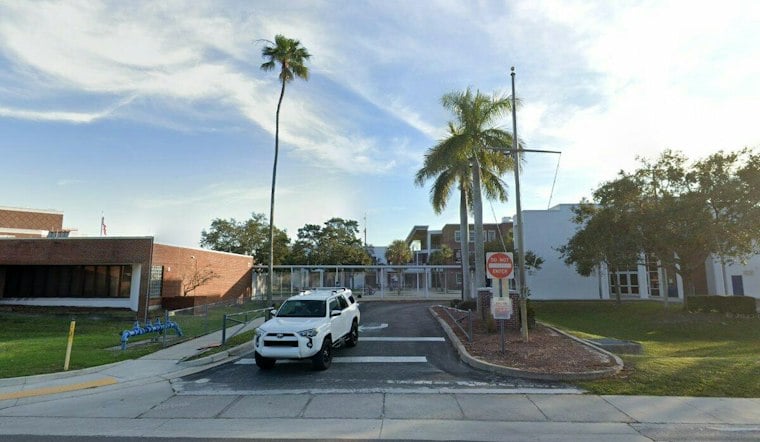
Manatee County’s new school-safety integration gives sheriff’s-office analysts access to selected live camera feeds during an active alert. When a staff member presses a wearable safety badge three times, the system identifies four nearby security cameras and makes their footage available to responders before they arrive on campus. The system now covers more than 60 schools across the district and is intended to assist during lockdowns, medical emergencies, and behavioral incidents.
The integration connects CENTEGIX wearable badges, carried by staff including substitute teachers, to the district’s existing OpenEye camera network, according to Tampa Bay 28. When an alert is activated, geospatial technology selects four cameras within roughly 75 feet and makes the feeds available through the CENTEGIX Safety Platform. School administrators and responders can view the footage on a phone or computer. Cameras are positioned in areas such as hallways, cafeterias, and outside buildings. The outlet reported that law enforcement access is limited to an active lockdown and ends when the alert is cleared; the platform does not record the live footage.
The Manatee County Sheriff’s Office Real-Time Intelligence Center receives the feeds during lockdowns, and crime analysts relay what they see to deputies responding to the scene, according to the outlet’s reporting. The office had used the integration in two lockdown situations since the school year began. A staff alert typically draws three to seven responders, depending on campus size.
How the Rollout Reached Every Campus
The district rolled the integration out in phases, starting with high schools, then moving to middle schools, and finally elementary schools, until the system became operational across every Manatee County school campus and district office. The integration is operational across all school campuses and district offices. Beyond streaming video, the system also displays school blueprints, exit pathways, and the locations of critical resources like AED devices, helping responders find the nearest defibrillator or ambulance access point.
The system is designed to support medical emergencies and behavioral incidents just as much as security threats, and district officials say it has already made a difference in ordinary, lower-profile moments. A staff alert helped prevent a potential physical altercation at a middle school, and in one case a resource officer arrived within 15 seconds after a teacher activated the badge, according to the outlet's reporting. A CENTEGIX K-12 safety trends report published in June 2026, analyzing more than 346,000 emergency activations nationwide, found that 88% were behavior-related, 10% involved medical emergencies, and 1% involved extreme campus-wide threats requiring lockdowns.
A National Pilot Born From State Law
Manatee County was the primary national pilot partner for the CENTEGIX and OpenEye live-video integration before its commercial launch, according to the Business Observer. The vendors announced the cloud-to-cloud partnership on September 15, linking OpenEye Web Services to the CENTEGIX Safety Platform during active incidents, as detailed by Campus Security Today. The district implemented its version without an additional integration fee, combining an existing $345,000-a-year CENTEGIX contract with roughly $486,000 a year in OpenEye camera spending, the Business Observer reported.
Florida’s Alyssa’s Law, enacted as Senate Bill 70 in June 2020, helped drive adoption of panic-alert systems in schools. The Florida Department of Education says the state allocated $6.4 million in recurring funds beginning that year to help districts purchase and maintain compliant systems. Florida is among at least 11 states, including New Jersey, Texas, Georgia, Washington, and Oregon, that have passed similar mandates, according to Momentum Telecom. CENTEGIX says its solutions are used in more than 18,000 locations, and the company has reported more than one million total alert activations.
What Panic-Alert Rules and Badge Data Show
The Florida Department of Education says Alyssa’s Alert requires public schools, including charter schools, to use a mobile panic system capable of coordinating emergency responders in real time. The requirement describes the alert system; it does not require or describe Manatee’s separate camera-streaming integration. CENTEGIX says its analysis of more than 346,000 alerts collected through its platform in the 2025/2026 school year found that 88% were behavior-related and 10% involved medical emergencies, according to the company’s 2026 K-12 safety trends report. Those figures describe the company’s platform data, not independently verified national incident totals.
District Leaders Frame Tech as a Support Tool
Scott Hanson, chief technology officer for the School District of Manatee County, said the integration simply provides more information for responders. Superintendent Laurie Breslin said strengthening safety responses helps create an environment where educators can teach confidently and students can thrive. District officials frame the technology as a support for human responders rather than a replacement for them.
The rollout arrives weeks after a separate safety scare rattled the district: a 17-year-old Manatee High School student was arrested on August 31, 2026, under Florida Statute 836.10 after an electronic threat posted through the district's MySDMC Focus student portal triggered a multi-agency police response. The School District of Manatee County operates roughly 80 schools and educational facilities serving more than 54,000 students districtwide, making campus safety technology a persistent concern for a system of that scale.





