

























































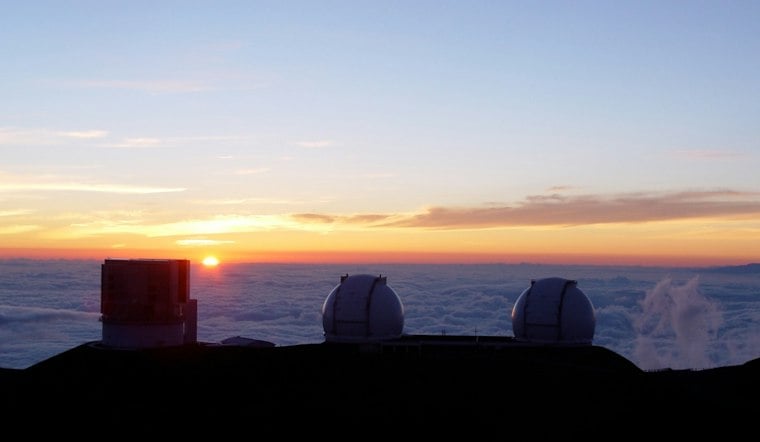
Hawaiʻi's observatories played a decisive role in confirming two quasars from the universe's earliest chapter, now the most distant ever confirmed. The pair dates back to the first 670 million years of cosmic history — roughly 5% of the universe's current age — and their confirmation depended on coordinated observations from instruments based in Hawaiʻi.
The search started with Europe's Euclid space telescope, which flagged quasar candidates through a distinctive optical and near-infrared color pattern, according to Maui Now. Because brown dwarfs can produce similar colors, the candidates required ground-based checks. Subaru supplied additional imaging, while Keck Observatory obtained the spectra used to confirm the objects' identities and distances, the report said.
Keck's follow-up involved more than a simple confirmation run. Researchers evaluated more than 100 potential targets with three instruments — MOSFIRE, LRIS and KCWI — and confirmed 21 of the 31 candidates flagged by Euclid, according to W. M. Keck Observatory. The observations looked for a Lyman-alpha break, a spectral feature used to distinguish very distant quasars from closer lookalikes.
A Distance Record Broken Twice Over
The record-holders sit at redshifts of 7.77 and 7.69, according to Space Daily, surpassing the previous cosmic-dawn record of redshift 7.64 set in 2021. Redshift measures how much cosmic expansion has stretched an object's light during its journey to Earth; a higher value generally means astronomers are seeing farther into the past. Before this discovery, astronomers had found only nine or 10 quasars from the universe's first 770 million years, meaning the 12 from that epoch more than doubled the known sample.
The newly discovered quasars are powered by supermassive black holes. That presents a genuine puzzle for astrophysicists: quasars mark a brief phase when young galaxies funnel enormous amounts of matter into their central black holes, and finding such black holes so early raises hard questions about how they grew so fast. Supermassive black holes existed when the universe was under a billion years old, and per Maui Now's report, these objects can reach masses in the billions of suns.
Why Maunakea and Haleakalā Matter To The Hunt
None of this would have been possible without a web of Hawaiʻi-based instruments working in concert with Euclid, which orbits from the Sun-Earth Lagrange Point 2 roughly 1.5 million kilometers from Earth. The space telescope launched from Earth in July 2023 as part of a planned six-year mission and surveys roughly one-third of the sky, mapping the universe's large-scale structure in three dimensions. Its planned coverage remains far from complete.
Ground support comes through the Ultraviolet Near Infrared Optical Northern Survey, known as UNIONS. UNIONS is a partnership among the Canada-France-Hawaiʻi Telescope, Subaru Telescope, and Pan-STARRS, according to Maui Now — with CFHT's MegaCam covering blue and ultraviolet light and providing all of CFHT's UNIONS contributions, while CFHT's WIRCam extends the telescope's near-infrared reach, Subaru's Hyper Suprime-Cam adding far-red imaging, and Pan-STARRS contributing red-light data from its perch on Haleakalā. UNIONS began surveying the northern sky in 2017, and Keck Observatory holds the largest mirror among the telescopes following up on Euclid's candidates.
“The discovery effectively settles whether quasars could exist that early in cosmic time,” said John O'Meara, chief scientist and deputy director at Keck Observatory, according to Maui Now. O'Meara also said spectra are needed to definitively identify objects Euclid detects from space, and that more data will be required before astronomers can pin down the true size of the ancient-quasar population. NASA's Roman Space Telescope is expected to join the search going forward, and Keck's advantage lies in pairing a large ground-based aperture with precision spectrographs.
Summit Governance Still In Flux
Jean-Gabriel Cuby, CFHT's executive director, said astronomy must engage meaningfully and reciprocally with Hawaiʻi's local communities and the Maunakea Stewardship and Oversight Authority, per Maui Now's reporting. That comment lands amid a broader, ongoing shift in who controls the mountain. Under Hawaiʻi's Act 255, enacted in 2022, management of 11,000 acres of Maunakea summit lands is transitioning over a five-year period from the University of Hawaiʻi to the newly created stewardship authority by 2028, according to Big Island Now.
That transition has not been free of conflict. In June 2025, the Office of Hawaiian Affairs withdrew its legal challenge against the constitutionality of Act 255 and pledged support for Native Hawaiian leaders serving on the new authority, according to Ka Wai Ola. Hoodline previously reported on protests tied to astronomical development and funding on the mountain, underscoring how the summit's scientific output continues to sit alongside cultural and political tension over its use.
The observatory footprint is changing under Maunakea's master plan, even as astronomy remains economically important in Hawaiʻi, per Big Island Now. That makes the summit's scientific output part of a broader transition involving both the future of individual facilities and the management of the mountain.
What Is Changing Across Hawaiʻi's Observatory Network
The documented recent closures have occurred on Maunakea. According to University of Hawaiʻi System News, the Caltech Submillimeter Observatory and UH Hilo's Hōkū Keʻa Observatory were decommissioned in 2024. The article also identifies Pan-STARRS on Haleakalā as a contributor to the UNIONS survey, showing that Hawaiʻi's astronomy infrastructure extends beyond the Maunakea summit. University of Hawaiʻi System News reported that UKIRT science operations were scheduled to conclude on September 15, 2026, as the observatory entered decommissioning, making it the third Maunakea observatory slated for removal under the university's management plan. That administrative decision is separate from the quasar project, but it helps explain why new scientific results are arriving alongside changes to the facilities that support Hawaiʻi-based astronomy.





