

























































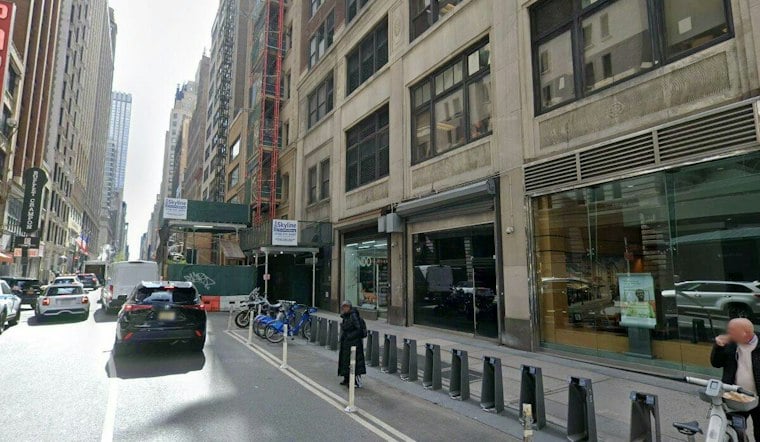
A century-old warehouse-turned-office building on West 36th Street is getting eight new floors and a brand-new purpose: storing New Yorkers' stuff. Developers Mequity Companies and Flatiron Equities Real Estate just landed a $57 million loan to push the ambitious conversion of 152 West 36th Street across the finish line, with the finished product slated to become a roughly 1,500-unit self-storage facility run by Manhattan Mini Storage.
The refinancing closed Friday afternoon and retired past construction debt tied to the project, according to Commercial Observer, which first reported the deal. PGIM supplied the new loan, and the funds will carry the conversion through its final development stages, with completion slated for early 2027. Colliers negotiated the financing, with managing director Dylan Kane leading a team that included Zach Redding and Jared King.
The building at 152 West 36th Street started life as a warehouse before it was later used as a 51,853-square-foot Class C office property. Mequity Companies and Flatiron Equities acquired the eight-story structure for $23.8 million from Falcon Properties in September 2024 in Manhattan's Chelsea neighborhood, financing that initial purchase and construction with a $50 million acquisition and construction loan from Elsee Partners plus $17 million in family office equity, per the Commercial Observer's earlier reporting picked up by The Real Deal.
Eight Stories, One Big Air-Rights Deal
The redevelopment calls for an eight-story vertical addition atop the original structure, ultimately turning the building into a 15-to-16-story facility designed by JMN Architecture PC. That expansion was made possible by acquiring adjacent air rights from Falcon Properties, the same seller that originally offloaded the property, according to New York YIMBY. The design uses setbacks above the existing cornice line to keep the added bulk from overwhelming the streetscape below.
Once finished, the project will span 75,000 rentable square feet, according to the Commercial Observer's reporting. The development is slated to receive a temporary certificate of occupancy within a few months, and Manhattan Mini Storage — the company that will operate the finished facility — has been a fixture in New York City's self-storage scene since 1978. StorageMart, an international self-storage operator running more than 300 properties across North America and the United Kingdom, acquired Manhattan Mini Storage in 2021, according to Modern Storage Media.
Zoning Shifts Are Reshaping Demand
Kane, the Colliers managing director, said the project's progress allowed the sponsors to increase loan proceeds, lower borrowing costs meaningfully, and provide runway through lease-up, per the Commercial Observer's account of the deal. He also pointed to the Midtown South rezoning as a factor set to boost demand for self-storage in the area, as residential housing sprouts up nearby.
The New York City Council formally adopted the Midtown South Mixed-Use Plan on August 14, 2025, rezoning 42 blocks across Midtown South to allow high-density residential development in formerly commercial and manufacturing districts. The NYC Department of City Planning projects the plan will create roughly 9,500 new homes, including more than 2,800 permanently affordable units — a wave of new residents that developers are already betting will need somewhere to stash their boxes.
Why Storage, Not Apartments
Self-storage conversions like this one represent a distinct alternative to the office-to-residential push sweeping Midtown South. That's partly because New York City enacted a Self-Storage Zoning Text Amendment in December 2017 requiring a City Planning Commission Special Permit for self-storage facilities built within Industrial Business Zones, according to CityLand. The 2017 amendment aimed to protect job-intensive manufacturing space in designated industrial hubs.
That regulatory squeeze collides with a supply gap that has persisted for years. The Real Deal has cited data on New York City's self-storage supply. High population density and small apartment sizes across the five boroughs keep that demand elevated, which helps explain why premium rents make Class C office-to-storage conversions like 152 West 36th Street financially attractive.
Older office stock is also struggling to compete. Prime Class A office vacancy in Midtown Manhattan stood at just 2.9% in early 2026, while older Class B properties were candidates for conversion, Hoodline previously reported on Midtown’s office market. That split market gives owners of aging Class C buildings a strong financial incentive to add floors and pivot to a different use entirely rather than chase increasingly scarce office tenants.
A Broader Pattern of Repositioning
The Garment District has been a flashpoint in the broader rezoning fight. The New York City Landmarks Preservation Commission designated five historic Garment District buildings as individual landmarks on August 12, 2025, just days before the City Council approved the Midtown South plan, according to 6sqft. During final negotiations over that plan, city officials also discussed the Garment District, according to Hoodline's coverage of the rezoning fight.
Flatiron Equities has been active elsewhere in Manhattan's shifting commercial landscape as well. The developer was part of a joint venture at 309 East 94th Street originally planned as a $350 million life sciences hub before that project was sold to LCOR for $73.1 million in September, a pivot Hoodline covered in its report on Lou Gehrig’s birthplace sale. PGIM, Mequity Companies, and Flatiron Equities did not immediately return requests for comment on the West 36th Street refinancing, according to the Commercial Observer.



