

























































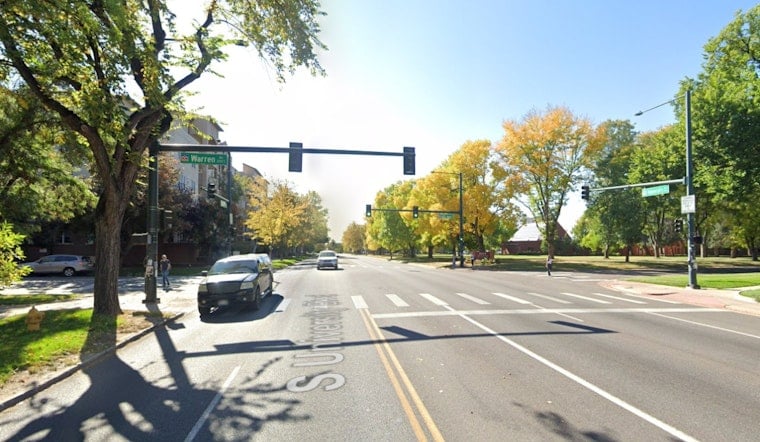
A motorcyclist suffered serious injuries Thursday evening in a crash at South University Boulevard and East Warren Avenue, prompting Denver Police to shut down northbound University Boulevard as investigators worked the scene. The closure, announced just after 9 p.m., left drivers near the University of Denver campus scrambling for alternate routes.
According to the Denver Police Dept., officers are investigating a traffic crash involving a single motorcyclist at the intersection, and the department confirmed the incident resulted in serious injuries. Police did not release the rider's name, age, or condition, and did not say what led up to the crash. Denver Police directed anyone with an emergency to call 911 and listed 720-913-2000 as the department's general police-services line.
Notably, Denver Police only issues a public Crash Alert when a collision involves at least one person with serious injuries or requires a road closure — a threshold this crash met on both counts. The department also noted that traffic crash data is available on Denver's Open Data Catalog for those looking to review broader patterns.
A Corridor Already Flagged as High-Risk
The crash landed on a stretch of roadway the city has already singled out for concern. South University Boulevard is part of Denver's High Injury Network, a designation covering roughly 5% of the city's roadway mileage that nonetheless accounts for about half of all local traffic fatalities and serious injuries, according to the City and County of Denver.
This is not the first serious motorcycle crash on the corridor this year. In June, a motorcycle rider died after colliding with an SUV on South University Boulevard near East Floyd Avenue, roughly two miles south of Thursday's crash site, as reported by 9News. Denver Police had also stepped up traffic enforcement along South University Boulevard earlier this year after citywide traffic citations jumped 121% compared to early 2025, per the Denver Gazette.
Colorado's Deadliest Stretch for Riders
The crash also fits into a grim statewide pattern. Motorcycle fatalities in Colorado hit a record 165 in 2024, making up nearly 24% of all traffic deaths statewide even though motorcycles account for just 3% of registered vehicles, according to the Colorado Department of Transportation. The state's start to 2026 was even worse in the early months, with 15 motorcycle fatalities recorded in the first quarter — the deadliest start to a year for riders since 2017, per The Colorado Sun — before fatal incidents eased heading into summer.
Whether speed, road conditions, or another factor contributed to Thursday's crash remains unknown, and Denver Police have not released that information. It is also unclear whether the injured rider was wearing a helmet. Colorado law requires helmets only for motorcycle operators and passengers under 18, meaning adult riders can legally forgo one as long as they wear eye protection, per Colorado Revised Statutes cited by FindLaw. State data shows that roughly 44% of motorcyclists killed in Colorado crashes in 2024 were not wearing a helmet at the time of the collision, according to the Colorado State Patrol.
Part of a Broader Pattern This Summer
Thursday's crash adds to a string of motorcycle incidents Hoodline has tracked across Denver this year, including a rider seriously hurt on Colorado Boulevard in August, a crash that shut down 6th and Broadway, and another on eastbound I-70 at Havana Street. In one especially troubling case, Denver Police called a Sheridan Boulevard motorcyclist's death an intentional hit-and-run.
City officials have also directed money toward safety upgrades in the area. Denver's Department of Transportation and Infrastructure has scheduled multi-million-dollar safety and intersection improvements along the nearby East Hampden Avenue corridor, between South University Boulevard and South Galena Street, running through 2026, according to a city planning document. It remains unclear when northbound University Boulevard will fully reopen to traffic, and Denver Police have not provided an estimated timeline for completing the investigation.



