

























































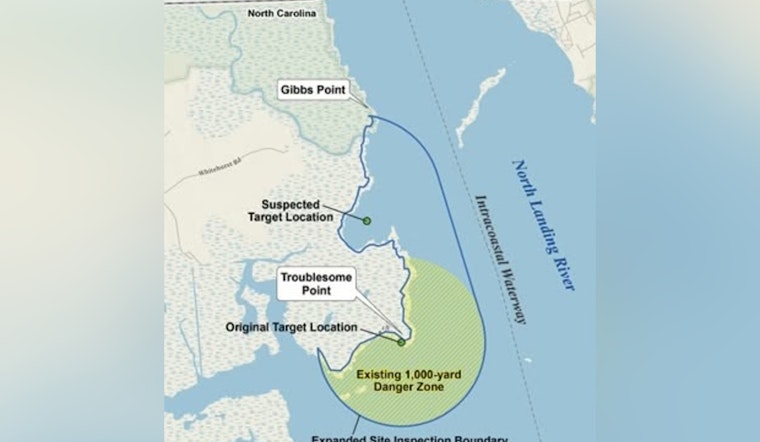
Navy contractors are set to begin diving in North Carolina's North Landing River on September 21, searching for Cold War-era practice bombs that may still be resting on the river bottom more than six decades after they were dropped. The operation, expected to run for up to three weeks, will focus on a cove between Troublesome Point and Gibbs Point in Currituck County, where the Navy once used the shoreline as a dive-bombing target range.
Troublesome Point served as a practice dive-bombing range for Naval Air Station Oceana from the mid-1950s through the mid-1960s, according to reporting by The Charlotte Observer. The site sits about 25 miles south of Virginia Beach, Virginia, and roughly 190 miles northeast by road from downtown Raleigh, and was sparsely populated and difficult to access during the years it was in active use. The Navy and the North Carolina Department of Environmental Quality now formally designate the location as Site UXO 01, managing it as an “other than operational” water range tied to the base, according to the Naval Facilities Engineering Systems Command.
Decades of Searching in the Wrong Spot
Finding the target range took far longer than expected. The Navy's Military Munitions Response Program ran a Preliminary Assessment in 2009 and a Site Inspection in 2010, but both efforts failed to locate any target remnants because the initial search parameters targeted the wrong section of the river, per the same command's account. Navy surveys at the time showed no pattern of metallic objects associated with a bombing site at all.
The breakthrough came only after researchers dug into archival news accounts. Two 1940s news articles reporting that the target sat between Gibbs Point and Troublesome Point ultimately redirected the search effort to the correct stretch of water, the Observer's reporting notes. An expanded site inspection that began in 2024 followed that lead, running geophysical surveys across 797 water acres in the cove and finally identifying metallic objects and wooden poles protruding from the water — remnants consistent with mid-20th-century naval target structures, according to NAVFAC.
What Divers Are Actually Looking For
Military researchers suspect miniature practice bombs may remain undetonated in the river. The Cold War-era devices used at the site were subcaliber types, such as Mk 23 or Mk 76 miniature practice bombs, engineered to release a smoke signal or pyrotechnic spotting charge on impact rather than explosive metal fragmentation, per NAVFAC's community outreach materials. In other words, the bombs were designed not to detonate violently — but unexploded pyrotechnic cartridges inside them can still pose a hazard after sitting underwater for decades.
Navy contractors will use divers to investigate the objects on the river bottom, locate and identify them, and recover the bombs where possible, Currituck County government officials reported. If items can't be safely lifted, Navy disposal technicians will conduct controlled underwater detonations, which generate visible flashes, smoke plumes, and loud acoustic booms across nearby waterways, NAVFAC says. Controlled detonations may occur if suspicious materials are found, and the resulting explosions, flashes of light and clouds of smoke could be visible from a distance.
River Closures and What Residents Might See
The public can expect to see dive boats, divers, a floating work platform, safety patrol boats and marked work zones on the water throughout the operation. Currituck County Emergency Management says the work will run strictly during daylight hours on weekdays, with complete river closures enforced around Gibbs Point and Troublesome Point for boaters, hunters, and fishermen. The North Landing River work area will be temporarily closed off to protect boaters and anyone near the work zone, a precaution that comes as early-autumn hunting and boating season ramps up.
The search area also borders the Northwest River Marsh Game Land, a roughly 3,000-acre protected state conservation area in Currituck County, according to the North Carolina Department of Natural and Cultural Resources. That proximity adds another layer of caution to a search already balancing public safety with sensitive coastal habitat.
A Recurring Problem Along the NC Coast
The North Landing River cleanup falls under the federal Military Munitions Response Program, established under 10 U.S.C. 2710 to systematically inventory, evaluate, and clean up unexploded ordnance at former military ranges no longer in active use. Nationally, the Department of Defense has identified more than 450 underwater Munitions Response Sites in rivers, lakes, and coastal waters, spanning over 10 million water acres that require investigation, according to the Interstate Technology & Regulatory Council.
Submerged World War II and Cold War training munitions have surfaced elsewhere along North Carolina's coast before, including past military clearance operations in Bogue Sound and along the Outer Banks, as reported by WFMY News 2. For Currituck County residents, the North Landing River search is the latest reminder that decades-old military hazards can still be lurking just beneath the surface of everyday waterways.




