

























































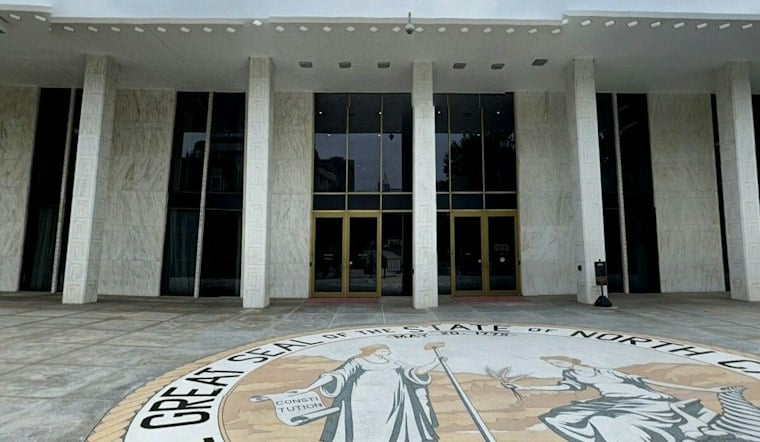
North Carolina's Blue Ribbon Commission on Public Education voted Monday on its first formal set of recommendations, urging state leaders to make the state a regional leader in teacher pay by 2028 and to overhaul how new teachers are recruited, trained and licensed. Whether any of it becomes reality is now up to the General Assembly and Gov. Josh Stein.
A Panel Born From a Teacher Shortage Crisis
The commission was established in March 2026 by Stein, Senate President Pro Tempore Phil Berger and House Speaker Destin Hall, according to NC State's Friday Institute, though an earlier EdNC account dated the leaders' announcement to March 2025 — the two sources give differing formation timelines. As reported by The News & Observer, the commission spent most of its first six months focused on student achievement and teacher training before adopting draft recommendations on early literacy and the teacher pipeline this week, with work still ahead on administrative operations, educational leadership and accountability.
The Friday Institute notes the commission is made up of 29 members from education, business and government sectors, co-chaired by Dr. Don Martin and Anne Faircloth, and was charged with studying the structure and implementation of public education across the state throughout 2026. The News & Observer reports the panel actually includes 30 members and was charged with making recommendations to improve education for North Carolina's 1.5 million public school students.
Pushing the Pay Target Up
Among the most consequential moves: the commission changed its own target date for establishing a competitive teacher compensation system, pulling the goal forward from 2030 to 2028, per the News & Observer's reporting. Commission member Emma Braaten said 2030 would have been too long a wait to establish and sustain competitive pay, according to the same account. Faircloth said the commission can still deliver actionable recommendations by March 2027, the outlet reports — after the panel's original December 31 deadline was extended to March 2027.
The urgency tracks with the state's numbers. More than 9,100 teachers left North Carolina's public schools in 2024-25, roughly 10% of the statewide teaching workforce, according to NC Newsline. Beginning teachers left at an even higher rate of 14.7%, the outlet notes. WLOS separately reported that attrition among new teachers ranges from 14% to 18%, while teachers with 30 or more years of experience see attrition between 15.5% and 25%.
Raises That Skip the Middle of a Career
State lawmakers already adopted a budget this year with an average teacher raise of about 8%, according to the News & Observer. North Carolina's teacher salary schedule starts at $48,000 in base pay and tops out at $59,000 after 25 years of experience, the paper reports. But NC Newsline notes the largest percentage gains in recent raises have heavily favored early-career educators, while teachers with 15 to 24 years of experience currently go without an annual raise for nearly a decade — a structural gap the commission's 2028 target is meant to address.
North Carolina was ranked the eighth-worst state in the nation for teachers by WallettHub, per the News & Observer's reporting. Other rankings paint a similarly rough picture: the average teacher salary statewide is $60,323, according to the National Education Association as cited by Moreland University, ranking 43rd nationally and roughly $14,000 below the U.S. average. The Reason Foundation, meanwhile, ranked the state 48th in the nation for teacher pay specifically, WLOS reports — the two rankings appear to use different measures. The Education Law Center's Making the Grade report ranked North Carolina last nationally in per-pupil spending, according to the same WLOS account.
Rebuilding the Pipeline Into Teaching
Beyond pay, the commission recommended expanding the N.C. Teaching Fellows program, which helps subsidize college costs for students who commit to becoming teachers but is currently limited to 10 institutions and certain subjects, per the News & Observer. The program just posted a record class: 522 future teachers committed for 2026-27, up from 498 the year before, according to the University of North Carolina System. Teachers who come through educator-preparation programs have a 55% lower attrition rate than those entering through Residency Licensure pathways, per an NC Department of Public Instruction report cited by the same source.
The commission also called for phasing out emergency and permit-to-teach licenses by 2030, establishing clearer and more consistent pathways to full licensure, and revising licensure rules that create unnecessary barriers for beginning teachers, the News & Observer reports. Other recommendations include funding paid student teaching, residencies, apprenticeships and grow-your-own programs; expanding advanced teaching roles and mentoring by 2032; and modernizing policies by 2027 so retired teachers can return to or stay in classrooms.
A Literacy Push, With Math Left for Later
The commission's literacy recommendations proved especially detailed. It called for establishing a literacy advisory committee to oversee K-3 curricula and high-dosage tutoring models, adopting and funding up to three evidence-based K-3 literacy curricula by May 2028, and requiring public school units to implement one of those three curricula by the 2028-29 school year, according to the News & Observer. The panel also recommended a statewide high-dosage tutoring framework by May 2028, state-funded literacy coaching in every low-performing elementary school by 2028-29, and authorizing districts to require summer reading camps or other evidence-based interventions for third-graders who lack reading proficiency.
Commission member Connie Book called limiting the state to a small set of K-3 literacy curricula the commission's most powerful recommendation, the News & Observer reports. Notably, the panel did not include recommendations for improving math instruction in this round, even though it discussed the subject, according to the same reporting — leaving that work, like several other pieces of the commission's mandate, for later.
The stakes were visible outside the meeting room, too: a rally at Halifax Mall in downtown Raleigh in May protested for more school funding, the News & Observer notes. With the commission's first vote now cast, the remaining question is whether the General Assembly and Stein will turn any of these recommendations into law and dollars — with implementation, the paper reports, largely up to North Carolina lawmakers.



