

























































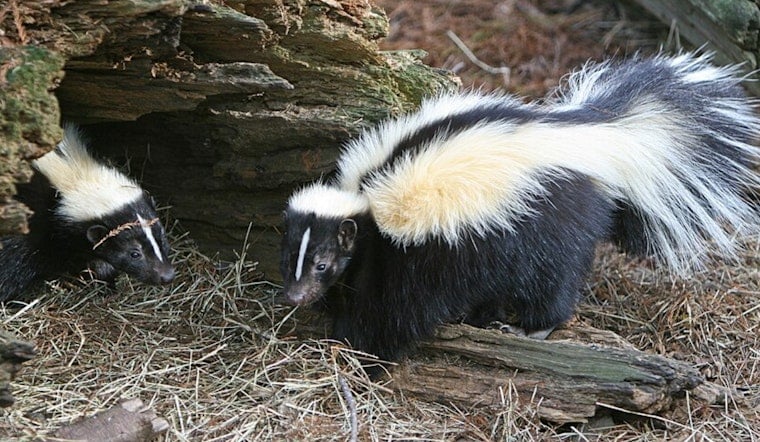
What started as a small backyard gathering hosted by Deb Cipriani in 2001 has grown into a full-blown festival celebrating one of the animal kingdom's most misunderstood pets. Skunkfest returns to South Central Park in North Ridgeville, Ohio on September 12, running from 10 a.m. to 4 p.m., marking a quarter-century of bringing skunk owners and curious onlookers together in one place.
According to the City of North Ridgeville, the growing Lorain County community has over 37,000 residents.
The event is hosted by Skunk Haven, the rescue shelter Cipriani founded after her own pet skunk, Daisy, fell ill and she discovered there was almost no medical information available for treating domestic skunks, according to Midstory. That gap pushed Cipriani to partner with a local veterinarian to build baseline care guidelines and blood diagnostic standards for the species, and the shelter has since become a go-to resource for owners nationwide. As FOX 8 News reports, what began as a small gathering in Cipriani's backyard has evolved into a much larger event over the past 25 years.
Skunkfest is open to everyone, not just skunk owners, and organizers describe activities celebrating domesticated skunks throughout the day. Cipriani said she helps people with their pet skunks whenever and wherever they need assistance, per the same FOX 8 report. This year's lineup includes a costume contest, a traditional skunk pageant crowning a king, queen and princess, and a new addition: a giant inflatable skunk towering over the park grounds.
City records show that North Ridgeville completed a Parks and Recreation Master Plan in 2013 to guide future park and recreation development.
New This Year: A Phone Tournament With Cash on the Line
Among the festival's newest attractions is the Skunk'dmobile Tournament, which lets guests compete against each other on their phones for a chance to win $250. It joins a roster of longstanding competitions that, per Skunk Haven's own event details, include the Skunk Run, Best Tail, Best Detective, and Most Talented Skunk categories, alongside the pageant that crowns a King, Queen, Prince, and Princess in the Skunk Royal Court. Judges evaluate the animals on both appearance and overall physical health, according to Skunk Haven.
The festival's reach extends well beyond Ohio. Skunk Haven notes that attendees have traveled from Florida, Texas, New Jersey, and Michigan, along with international visitors from Canada and the Netherlands, to take part in what began as a backyard picnic back in 2001.
Look, Don't Touch: Why Petting a Skunk at the Festival Is Off-Limits
Festival organizers are firm on one safety rule: spectators should look at skunks without touching them. The stakes behind that rule are serious. Skunk Haven warns that a reported bite can trigger state public health mandates requiring the animal to be euthanized for rabies testing, since no rabies vaccine is officially approved for skunks in the United States.
That legal exposure is tied to how domestic skunks are raised. Licensed breeders de-scent the animals during infancy, removing their scent glands entirely, which leaves them dependent on indoor housing or close supervision because they have no way to defend themselves from predators, according to a video posted by Little Critters Vet. Releasing a de-scented domestic skunk into the wild would be fatal, since the animal lacks any natural defense mechanism.
Ohio law reflects those realities. Keeping a domestic skunk as a pet in the state requires a $25 annual Noncommercial Propagating License from the Ohio Department of Natural Resources, and the animal must be captive-bred rather than taken from the wild — wild skunks cannot legally be captured or kept as pets under state law. Ohio is one of 17 states where the practice is allowed: as of 2026, 17 states permit private pet skunk ownership, with nine requiring permits and five allowing it without statewide permit barriers, per World Population Review.
The Vet Network Keeping Rescued Skunks Alive
Skunk Haven's day-to-day operation depends on specialized veterinary support that's hard to find outside its network. Dr. Frank Krupka of Avon Lake Animal Clinic, an exotic pet veterinarian who has published clinical papers and consults internationally on skunk medicine, provides much of that expertise, since standard treatments designed for dogs and cats aren't always suitable for skunks. Cipriani reportedly houses up to 30 rescued skunks in her own home, which doubles as shelter headquarters, per Midstory's reporting.
Running that operation isn't cheap or simple. The shelter relies heavily on public donations of paper towels to keep enclosures sanitary, going through multiple rolls a week on top of the financial support needed for medical procedures and specialized diets. Captive-born domestic skunks generally live six to 10 years in home settings, according to Midstory, outliving their wild counterparts thanks to balanced nutrition, climate control, and freedom from natural predators — a testament to generations of captive breeding aimed at temperament and pet suitability.
For a festival built around an animal most people only think of as a nuisance, Skunkfest's 25th anniversary is a reminder of how far a backyard picnic can travel. What Cipriani started to solve her own knowledge gap around Daisy's illness has become an annual meeting point for a small but devoted community spread across states and countries, all gathering in North Ridgeville next weekend to celebrate the same misunderstood animal.





