

























































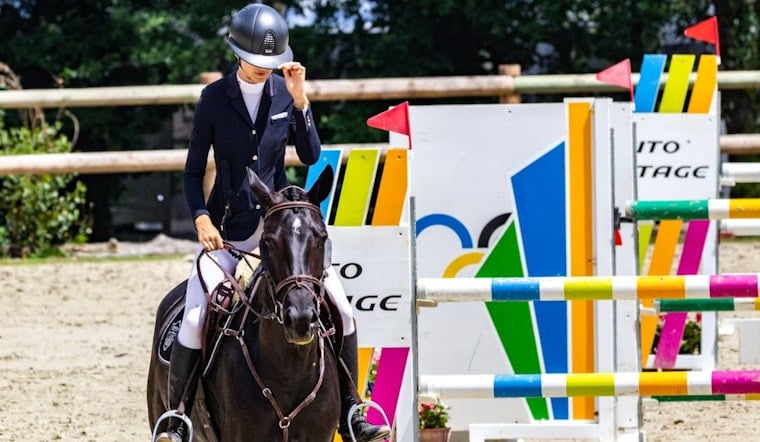
Some of the top-ranked show jumpers on the planet are converging on a horse park just outside Traverse City this month, capping a 12-week series that culminates in a $340,000 grand prix on September 20. Flintfields Horse Park in Williamsburg, about 20 minutes from downtown Traverse City, is hosting the Traverse City Horse Shows through the final weekend, with the Longines FEI Jumping World Cup serving as the centerpiece of the closing days.
The World Cup class is rated a 5-star event, the highest level of grand prix showjumping, and it doubles as competition for the American Gold Cup, according to The Detroit News. The class is set to start at 2 p.m. on September 20 and is expected to bring in top talent from across the world. Riders reportedly planning to enter at least one horse include at least nine of the top 30 riders in the world, per the same report.
Among those expected to compete during the final weekend are 2024 U.S. Olympic silver medalists McClain Ward, Kent Farrington, and Karl Cook, along with U.S. Showjumping Hall of Fame inductee Margie Goldstein Engle. International riders Shane Sweetnam of Ireland, Erynn Ballard of Canada, and Nina Mallevaey of France are also anticipated to take part, as are riders Lillie Keenan, Charlotte Jacobs, and Natalie Dean. Farrington, currently ranked No. 2 among jumpers worldwide, won the $340,000 American Gold Cup at Flintfields last September riding the mare Greya, according to World of Showjumping — his third career win in the historic event, following earlier titles in 2016 and 2020.
How the Sport Works, for First-Timers
For spectators unfamiliar with the sport, the Detroit News outlines two main disciplines on display: hunters and jumpers, together known as hunter jumpers. Hunters are judged on the way and look of the horse and rider's jumps, requiring an even, flawless-looking ride. Jumpers, meanwhile, are scored on faults — competitors must clear jumps in the correct order, avoid knocking anything over, avoid stopping before a jump, and finish within the allotted time.
Knocking over a jump costs four faults, and jumping faults can also be added for exceeding the time allowed. A clear round means a rider finishes without any jumping faults within the allotted time. Riders with equal faults are placed by speed, meaning a slower clear rider still beats a faster rider who knocks over a jump. Grand prix jumper classes generally run in two rounds, with the course changing between them; if no one posts a clear first round, there's no jump-off, but riders who do go clear advance to a timed jump-off where placements come down to speed without knocking anything over. Jumpers make up part of Olympic showjumping competition, tying the Williamsburg circuit directly to the sport's biggest stage.
A Circuit That Reshaped Local Tourism
The event traces back to 2004, when it began as a four-week regional show called Horse Shows by the Bay before Morrissey Management Group acquired it in 2013 and expanded the venue into a 130-acre facility, according to The Northern Express. What started as a six-week show has since grown into the 12-to-13-week circuit now underway, a shift that an economic impact report from the Sport Management Research Institute found generated an estimated $120 million in direct economic impact for the local tourism economy in 2021 — up from $8 million in 2017, per Interlochen Public Radio.
The Northern Express reports that visiting equestrian parties average about nine people, spend roughly $6,577 per day on local lodging, dining, and shopping, and stay in the region for an average of 33 nights during the show season, with roughly one-third of attendee households reporting incomes exceeding $500,000. That spending helps explain the roughly $20 million venue managers invested in 2018 to install all-weather GGT footing in the competition rings, cushioning horses' joints and tendons during jumps, according to the same Interlochen Public Radio report — infrastructure credited with helping attract Olympic-level riders and multimillion-dollar horses to the site.
The American Gold Cup itself, an elite grand prix first held in 1970, relocated permanently from New York to Flintfields in 2020 after the venue received a $250,000 grant from the Great Lakes Sports Commission, which notes the move helped solidify Flintfields as an international equestrian destination. Overall, Traverse City Horse Shows awards more than $7 million in total prize money across its 13-week schedule, spread across the Spring Series, the Great Lakes Equestrian Festival, and the Tournament of Champions.
Charity Ties and Local Partnerships
The organization donates 100 percent of general admission ticket proceeds to local nonprofits through its Charity Ticket Program, which has raised more than $175,000 for regional organizations over five years, with each week of the 13-week series spotlighting a different featured nonprofit that receives on-site visibility and a check presentation. Grand prix admission fees on those days are likewise given to a local charity, per the Detroit News.
The circuit also maintains a cultural and marketing partnership with the Grand Traverse Band of Ottawa and Chippewa Indians, hosting its marquee grand prix events in the Turtle Creek Casino & Hotel International Ring. That collaboration, which began in 2019, features Native American cultural exhibitions and offers free admission to tribal members.
Tips for Attending
Traverse City Horse Shows run tomorrow through Saturday or next Sunday, with a daily schedule posted on its website, and take place at Flintfields Horse Park, 6535 Bates Road in Williamsburg. Admission is free on days without a grand prix; on grand prix days, tickets cost $15. Free parking is available on the horse show grounds, and golf cart rides are offered for people needing assistance.
Once inside, spectators can sit on the lawn or use some chairs available in the grand prix ring. Crowds are usually quiet during a class, but clapping and cheering are encouraged at the end of a round, and spectators are invited to walk around the jumps after the show. Barn space is generally limited to riders and trainers, so guests are asked not to touch or approach horses, or feed them treats, without the owner's permission. Red flags positioned to a rider's right on the jumps indicate the direction of travel, a small detail that helps first-time visitors follow the course along with everyone else in the stands.





