

























































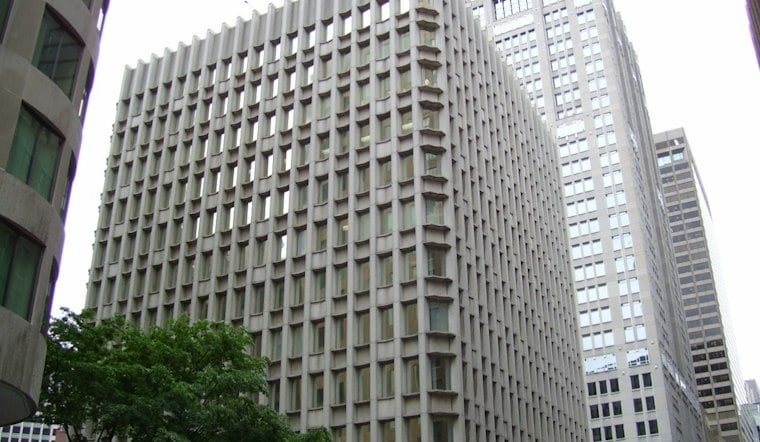
A 12-story Brutalist landmark in Boston's Financial District is headed toward a major transformation, with developer Kendall Capital proposing to convert the 1960s office tower at 133 Federal Street into 155 residential units, mostly studios expected to rent between $2,500 and $4,500 a month.
A Landmark Tower Changes Hands
The building, designed by architect Paul Rudolph and completed in 1960 as the Blue Cross-Blue Shield Building, was purchased by Kendall Capital manager Mai Luo for almost $16 million in December 2025, according to Bisnow. The seller, Natick-based B.E. Realist LP, had owned the property since acquiring it for $6 million back in 1994, the outlet reports. Luo estimates that construction on the roughly 155,000-square-foot conversion could take 16 to 24 months once underway.
The project is expected to lean on historic tax credits for financing, a necessity given that the Boston Landmarks Commission certified the property as an official landmark in 2024. That designation, per the same account, means any exterior work faces strict oversight even as the interior gets reimagined for apartment living.
Why Rudolph's Design Works For Housing
Part of what makes 133 Federal Street attractive for conversion lies in its architecture. Rudolph's design moved structural supports to the building's exterior in a concrete exo-structure, leaving interior floor plates free of columns and integrating heating and ventilation ducts directly into the facade masonry, according to Docomomo US. That column-free layout gives developers the kind of open, flexible floor plans well-suited to studio apartments rather than the awkward, deep-floor layouts that complicate many office-to-residential conversions elsewhere.
Rudolph is also responsible for the Hurley and Lindemann buildings, two state-owned structures in Boston, and his broader Boston legacy includes the 1971 Boston Government Service Center, a massive Brutalist complex in Government Center that remains one of the city's most prominent modernist landmarks alongside Boston City Hall, per the Boston Preservation Alliance. The tower's survival is notable given its history: it previously faced demolition threats, including a 2007 municipal redevelopment proposal for 115 Winthrop Square that planned to tear it down entirely to build an open civic plaza for a neighboring skyscraper, according to Docomomo US.
Boston's Conversion Pipeline Keeps Growing
The 133 Federal Street proposal lands within a broader municipal push. Boston's office conversion program has fielded 28 applications proposing 2,420 units across roughly 2.1 million square feet of underutilized commercial space, Bisnow reports. Yet execution has lagged behind ambition: only one project had actually been completed as of August 2026.
That completed project, a 15-unit transformation of a 145-year-old former office building at 281 Franklin Street, secured $5.1 million in private bank financing and welcomed its first tenants in mid-2025, according to the City of Boston. Other proposals in the pipeline dwarf the Federal Street plan in scale — Vanbarton Group's proposed 476-unit conversion at 31 St. James Street in Back Bay would be the largest in the city, while Synergy has floated a 258-unit project at 294 Washington Street and Mahoney Development has proposed 169 units at 50 Congress Street, per Bisnow.
The Financial Pressure Behind The Pivot
The rush toward conversions reflects a commercial real estate market under strain. Downtown Boston office vacancy held between 18.7% and 20.1% in the second quarter of 2026, according to CBRE, with older Class B office assets bearing the brunt of declining rents and value relative to newer Class A towers. Hoodline previously reported on Kendall's 18 Tremont deal, in which the firm acquired another distressed office building for roughly a 71% discount off its 2019 sale price.
Public money is also flowing into the sector. Boston's own conversion pilot program offers participating developers an average 75% property tax abatement for up to 29 years through a Payment in Lieu of Taxes structure, while requiring at least 20% of units to be affordable, according to the Boston Planning & Development Agency. Beyond city incentives, the Commonwealth of Massachusetts awarded $15.3 million in state commercial conversion tax credits in August across five municipalities, funding 856 housing units statewide, according to Bisnow.
Developers who win city approval, however, face firm deadlines: they must secure full building permits and begin construction within fixed program windows or risk losing their tax relief, and they must pay a 2% municipal fee on any resale within five years, per the Boston Planning & Development Agency. For a building that survived one demolition threat decades ago and now carries formal landmark protection, the countdown toward those construction deadlines may prove just as consequential as the design itself in determining whether Rudolph's Brutalist tower actually becomes home to hundreds of new Boston residents.




